


Company Registration
1 Week
Local Director?
Yes
Bank Account Opening
4 Weeks
Travel Required?
No
`
Table Of Contents
Register company in Australia in 2026
- In case you are looking forward to register company in Australia in 2026, then you will be provided with full-fledged assistance right from the start till the end of the incorporation process. Assistance to register company with the help of ASIC, acquiring a DIN, appointment of a nominee director, corporate bank account opening, and compliance support will make sure that your business gets set up without any problems.
- In the year 2026, the procedure to register company in Australia is transformed by a rise in digital compliance, strict identity verification, and real-time reporting requirements. Businesses must navigate the framework that is established under the Corporations Act 2001 (CTH), along with the digital systems that are managed by the Australian Taxation Office.
- Foreign business owners can still register a Pty Ltd company remotely but should ensure compliance with the updated requirements like the Director Identification Number (DIN), updated tax reporting obligations, and ongoing ASIC compliance.
- When registering your company in Australia, you can access a comprehensive business registration package that includes everything required to establish and operate your business successfully:
- Company registration with Australian Company Registry (ASIC)
- Professional Australia nominee director service
- Local company secretary and registered address
- Corporate bank account opening
- Australia Business Number (ABN) and Tax File Number (TFN)
- Tax registration and annual accounting services
- Australia AFS license Compliance Service
How to register company in Australia?
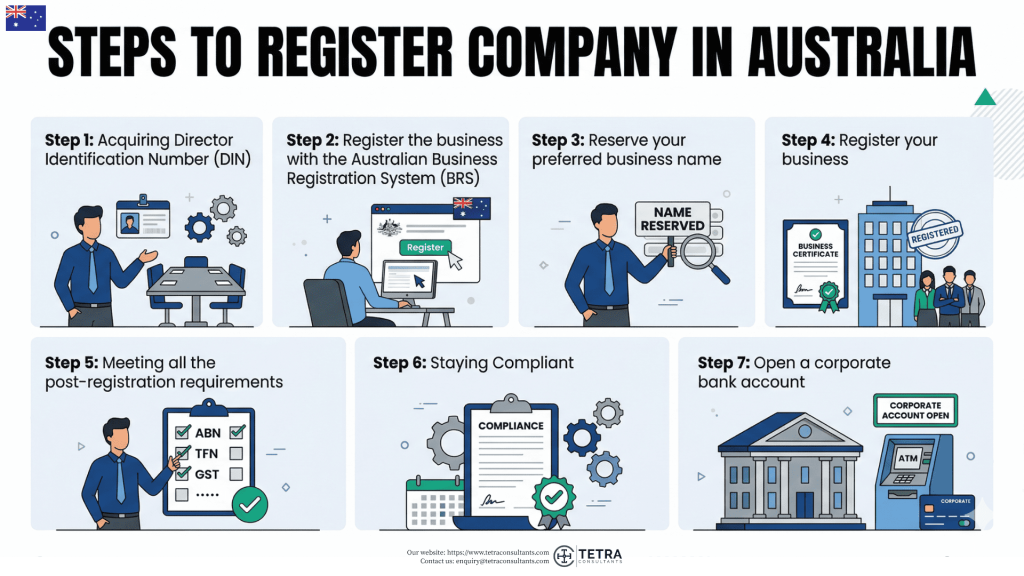
In order to register your business in Australia, you must follow these steps:
Step 1: Acquiring Director Identification Number (DIN)
- Under the Treasury Laws Amendment (Registries Modernisation and Other Measures) Act 2020, Director Identification Number (DIN) is a unique 15-digit identifier assigned to directors in Australia. This is introduced to prevent identity fraud and illegal activities and remains consistent throughout their directorial tenure across various companies in Australia, serving as a personal identification number for each director.
- The eligibility criteria for acquiring DIN involves:
- You must be at least 18 years old.
- You should not be disqualified from being a director under any Australian law.
- You must provide valid identity proof.
- You can apply for a Director Identification Number (DIN) in Australia through a streamlined process, which is typically completed within 6–8 weeks. The process begins with the online application through the official Australian Securities and Investments Commission (ASIC) website or the designated DIN application platform.
- Applicants are required to fill in personal details such as full name, date of birth, and address on the application form to ensure accuracy and prevent complications. Vital identity documents like passports or driver’s licenses must be uploaded, ensuring they are valid and clearly legible. Before submitting the application, you should carefully review all information provided to ensure accuracy and prevent delays.
- Furthermore, companies should also decide whether to adopt:
- Replaceable rules under the Corporations Act, or
- A custom constitution (recommended for companies with multiple shareholders)
Step 2: Determine the suitable company structure and reserve name
- Before registration, you must determine the most suitable business structure for your company. Common structures in Australia include:
- Sole Trader
- Partnership
- Company (Pty Ltd)
- Trust
- The most popular structure for both local and foreign entrepreneurs is the Proprietary Limited Company (Pty Ltd) due to its limited liability, scalability, and higher credibility.
- At this stage, you can check and reserve your preferred company name with ASIC while ensuring that the proposed name complies with Australian regulations.
- Thereafter, Form 410 can be used to reserve your preferred company name for up to two months while the company registration process is being finalized.
- You should also verify the availability of your proposed company name through ASIC. However, registering a company name does not provide intellectual property protection. Therefore, it is advisable to check trademark availability through IP Australia to help avoid potential legal conflicts in the future.
Step 3: Register your business with the Australian Business Registration System (BRS)
- You can review the application and ensure that all required documents, including the Articles of Incorporation, are prepared and submitted correctly.
- After the business structure is finalized, you can proceed with registering your business through the Business Registration Service (BRS). This allows you to obtain both an Australian Company Number (ACN) and an Australian Business Number (ABN).
- Once registration is completed, you will receive the incorporation documents, including the Certificate of Registration, Memorandum and Articles of Association, and other relevant corporate records.
- Do note that when incorporating a company in Australia, shareholders must determine the share structure:
- Fully paid shares– Shareholders pay the full value upfront with no future liability
- Partially paid shares– Shareholders may be required to pay the remaining amount when called upon
- Choosing the right share structure is important for investment planning and risk management. You should carefully evaluate your business objectives and funding requirements before selecting the most suitable share structure.
Step 4: Corporate bank account opening
- Once the company is successfully registered, you can proceed with opening a corporate bank account in Australia. This helps ensure that your business is ready to conduct financial transactions and operate efficiently from the outset. A streamlined approach can help make the process faster and more convenient.
Step 5: Meeting all the post-registration requirements
- You must register your business for tax with the Australian Taxation Office and obtain a Business Tax File Number, which is required to conduct business in Australia.
- Additionally, you should ensure compliance with the following post-registration requirements:
- Display company name during business operations to ensure transparency
- Disclose ACN/ABN on all official documents for regulatory compliance
- Maintain company records, including registers, meeting minutes, and financial records
- Appoint key executives, including at least one director (with residency requirements depending on company type)
- Obtain written consent for registered office address if using third-party premises
Step 6: Staying Compliant with Australian regulations (2026)
- After your business registration is completed, you should continue to ensure that your company remains compliant with all applicable government regulations and ongoing statutory requirements. Maintaining compliance is essential to preserving your company’s good standing and avoiding potential penalties.
- ASIC 28-Day rule– Any changes to company details must be reported to ASIC within 28 days to avoid penalties.
- Annual review & fees– Companies must pay an annual ASIC review fee and confirm company details each year.
Step 7: Accounting and tax obligations in Australia (2026)
- You must adhere to accounting and financial reporting requirements to maintain transparency and compliance.
- Financial reporting– Companies are required to prepare financial statements. You should ensure that the following financial statements are prepared and maintained accurately:
- Balance sheet
- Profit & loss statement
- Cash flow statement
- Accounting standards compliance- You must comply with Australian Accounting Standards aligned with International Financial Reporting Standards (IFRS).
- Annual financial statements– Businesses and public entities must lodge financial statements with ASIC, while small companies may have reduced obligations.
- Audit requirements– Audits are mandatory for certain companies, depending on size and regulatory thresholds.
- Furthermore, you will also have to follow tax compliance regulations such as
- File annual corporate tax returns
- Lodge Business Activity Statements (BAS)
- Manage payroll and superannuation contributions
Timeline to register company in Australia in 2026
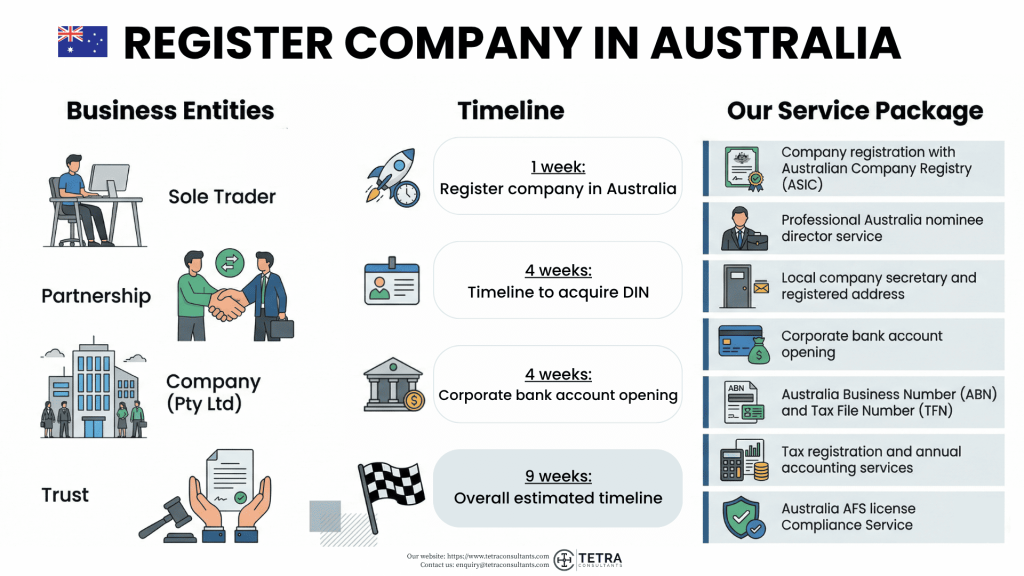
- Register company in Australia in 2026 with ASIC. Tetra Consultants assists with company incorporation, DIN application, and corporate bank account opening.
- Register company in Australia- 1 week
- Timeline to acquire DIN- 4 weeks
- Corporate bank account opening- 4 weeks
- Overall estimated timeline- 9 weeks
Cost to set up an Australian company in 2026
- For a standard Australian Pty Ltd company, the government registration fee (ASIC) amounts to AU$ 611.
- Once contacted, Tetra Consultants will send over a detailed proposal with exact breakdown of the fees for company incorporation, registered agent, registered address, nominee director services, annual renewal, corporate bank account opening and other corporate service provider services.
- At Tetra Consultants, we follow a transparent fee policy, where all costs (including government fees, professional service charges, and any third-party expenses are clearly outlined in the engagement letter prior to commencement. This is to ensure that there are no hidden charges and complete cost visibility for our clients.
Tax and employment compliance in Australia in 2026
- Operating a company in Australia in 2026 involves updated tax and employment obligations:
Payday superannuation (effective July 2026)
- If you employ staff, you should pay Superannuation Guarantee contributions (12%) at the same time as employee salaries. This requirement increases ongoing payroll and compliance responsibilities.
Corporate tax rates
- 25% for Base rate entities (turnover below AU$ 50 million)
- 30% for other companies
GST & BAS Reporting
- If your business turnover exceeds AU$ 75,000, you should register for GST and submit Business Activity Statements (BAS) in accordance with Australian tax requirements.
Public Officer Requirements
- You should appoint a Public Officer within three months of commencing business operations. The Public Officer acts as the primary point of contact between your company and the Australian Taxation Office (ATO).
Division 7A Rules
- If your company provides loans or other financial benefits to shareholders, you should ensure compliance with Division 7A rules, as these arrangements are closely monitored to prevent tax avoidance.
How can we help to register company in Australia?
- Tetra Consultants works as your advisor and trusted partner in your business expansion and company registration in Australia. With our own team of lawyers, incorporation specialists, compliance team, and accountants, we tell our clients what they need to know, instead of what they want to hear. Most importantly, we are known for being a one-stop solution for our valued clients.
- Contact us to find out more about how to set up a company in Australia. Our team of experts will revert within the next 24 hours.
FAQs
Can a foreigner register a company in Australia?
What is a Proprietary Limited Company (Pty Ltd) in Australia?
What is a partnership in Australia?
What is a branch company in Australia?
What is representative office in Australia?
What are the documents requirement to register company in Australia in 2026?
What are the common challenges applicants face during company registration in Australia in 2026?

Author
Sharma Prabakaran
Sharma Prabakaran is the Head of International Business Advisory at Tetra Consultants. With over 15 years of professional experience, he specialises in international business setup, accounting and tax advisory, and cross-industry SME engagements. His expertise encompasses end-to-end project management, ranging from company incorporation and corporate bank account establishment to ongoing annual accounting and tax compliance.