


Company Registration
2 Weeks
Local Director?
No
Bank Account Opening
4 Weeks
Travel Required?
No
`
Table Of Contents
Canada company registration in 2026
- If you are planning to complete your Canada company registration in 2026, you can benefit from comprehensive support throughout the entire incorporation process. From company registration with the appropriate federal or provincial authority and the appointment of a nominee director, where required, to corporate bank account opening, tax registration, and ongoing compliance support, every stage can be managed efficiently to help your business establish a strong presence in Canada.
- As of 2026, Canada has improved corporate transparency requirements in order to fight financial crime and improve regulatory oversight. As per the Canada Business Corporations Act (CBCA), and similar provincial legislation like the Ontario Business Corporations Act (OBCA), Alberta Business Corporations Act (ABCA), and Business Corporations Act (British Columbia) (BCBA), corporations in Canada should maintain a Transparency Register identifying Individuals with Significant Control (ISC).
- Foreign entrepreneurs can continue to register a company in Canada remotely, provided they meet the applicable incorporation and compliance requirements. Proper planning and timely fulfilment of regulatory obligations can help your business operate smoothly while maintaining compliance with Canada’s corporate governance and anti-money laundering framework.
- When completing your Canada company registration in 2026, you can access a comprehensive business setup package that includes everything required to establish and maintain your company successfully:
- Canada company registration
- Local company secretary and registered address
- Nominee Canada director services
- Opening a local or international corporate bank account
- License applications (if required)
- Annual accounting and tax services
- Canada compliance officer services (if required)
How to register a company in Canada in 2026?
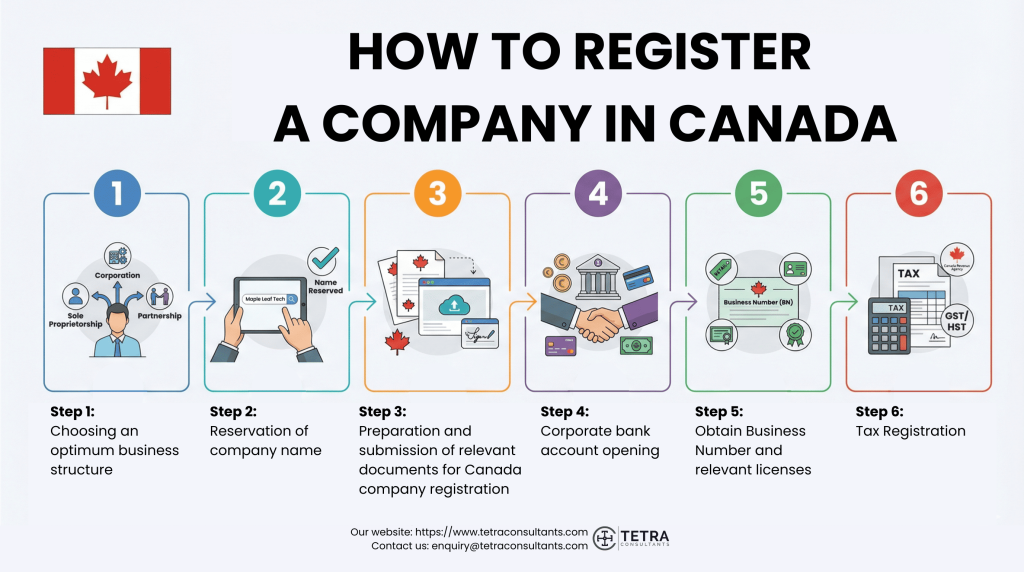
Step 1: Choosing an optimum business structure
- Prior to company formation, it is essential to choose the correct type of company. Based on your business objectives, ownership preferences, and future expansion plans, you can determine the most suitable business entity for your operations in Canada. Some of the business structures for Canada company registration are:
- Corporation (Limited Liability Company)
- General Partnership
- Limited Partnership
- Co-operative
- Sole Proprietorship
- Generally, the most common type of company in Canada is a Corporation, which is the equivalent of a limited liability company (LLC). Depending on the scale of your business and your long-term goals, you can choose between Federal Incorporation and Provincial Incorporation.
- During this stage, shareholders can also consider implementing a Unanimous Shareholder Agreement (USA). A USA enables shareholders to define how director powers are practiced, rights of the shareholders, and dispute resolution mechanisms, offering greater governance flexibility for the privately held corporations.
Step 2: Reservation of company name
- Depending on whether you choose Federal Incorporation or Provincial Incorporation, you can conduct a company name search and apply for pre-approval through the Newly Upgraded Automated Name Search (NUANS) report or the relevant provincial name search system. Corporate name pre-approval is generally valid for 90 days from the date stated in the NUANS name search report.
Step 3: Preparation and submission of relevant documents for Canada company registration
- After your proposed company name has been approved, you can prepare the necessary incorporation documents required for a foreign director and shareholder. These generally include the application form, notarized passport copies, and proof of address for individual directors and shareholders.
- Your Articles of Incorporation and other relevant corporate documents should be prepared based on your intended business activities and corporate structure.
- If you plan to appoint a corporate shareholder, you may also need to provide the Certificate of Incorporation, Memorandum and Articles of Association, minutes of the relevant Board of Directors’ meeting, a power of attorney for the appointment of the corporate shareholder’s representative, directors’ personal information, and other supporting documents.
- Once the required documents are ready, they can be submitted to Corporations Canada and, where applicable, to the relevant authority within the Canadian province or territory where your company will be established.
- At the time of incorporation, you should also prepare and maintain a Corporate Minute Book, which forms part of the company’s Corporate Records Office in the province of incorporation. The Minute Book typically includes the Articles of Incorporation, shareholder registers, directors’ resolutions, share certificates, and other statutory records required under Canadian corporate law.
- Lastly, for corporations incorporated in certain provinces, such as Ontario or British Columbia, a company without a resident director may need to appoint a nominee director. The nominee director is a resident individual or entity responsible for receiving legal documents and handling official government correspondence on behalf of the corporation.
Step 4: Obtain Business Number and relevant licenses
- After your company has been incorporated, you can proceed with registering for a Business Number (BN). This is needed according to the guidelines of the Canada Revenue Agency, for various purposes such as for tax on export and import duties, tax on Goods and Service or on Harmonized sales, tax on your business’ income, or deducting payrolls.
- In addition, depending on the nature of your business and the municipality in which it operates, you may also need to obtain specific permits or business licenses before commencing operations.
- During registration with the Canada Revenue Agency (CRA), your company may also need to register for the relevant indirect tax programs based on your location and business activities. These consist of the Harmonized Sales Tax (HST), which is applicable in Ontario and several Atlantic provinces, Provincial Sales Tax (PST) in provinces like British Columbia and Saskatchewan, and Quebec Sales Tax (QST), which is for businesses operating in Quebec.
- Based on your business activities, you can also complete the necessary registrations for the applicable licenses and tax programs.
Step 5: Tax Registration
- Once your Business Number and any required licenses have been obtained, you can proceed with registering for a corporation income tax account with the Canada Revenue Agency (CRA). All companies operating in Canada are subject to accounting and tax obligations requirements.
- Generally, companies in Canada pay a net corporate tax rate of 15% after applicable tax reductions. Depending on the location of your business, different corporate tax rates may apply. The lower rate is generally available for income that qualifies for the federal small business deduction, while the higher rate applies to other forms of taxable income.
- Your company will also be required to prepare and submit annual financial statements in accordance with the applicable reporting requirements.
- All corporations incorporated in Canada should file an annual T2 Corporate Income Tax Return with the CRA. This filing reports the company’s taxable income and helps ensure compliance with federal corporate taxation requirements.
- For businesses that hire employees, you may also need to register for provincial payroll-related obligations, such as the Employer Health Tax (EHT) in Ontario and mandatory workers’ compensation insurance programs, including WorkSafeBC, the Workplace Safety and Insurance Board (WSIB) in Ontario, or other Workers’ Compensation Boards (WCB), depending on the province in which your business operates.
Step 6: Corporate bank account opening
- After your company has been incorporated, you can proceed with opening a corporate bank account to support your business operations in Canada.
- You can open a corporate bank account with reputable Canadian financial institutions such as the Royal Bank of Canada (RBC), Bank of Nova Scotia (Scotiabank), and Bank of Montreal (BMO), subject to the bank’s internal policies and compliance requirements.
Timeline for Canada company registration in 2026
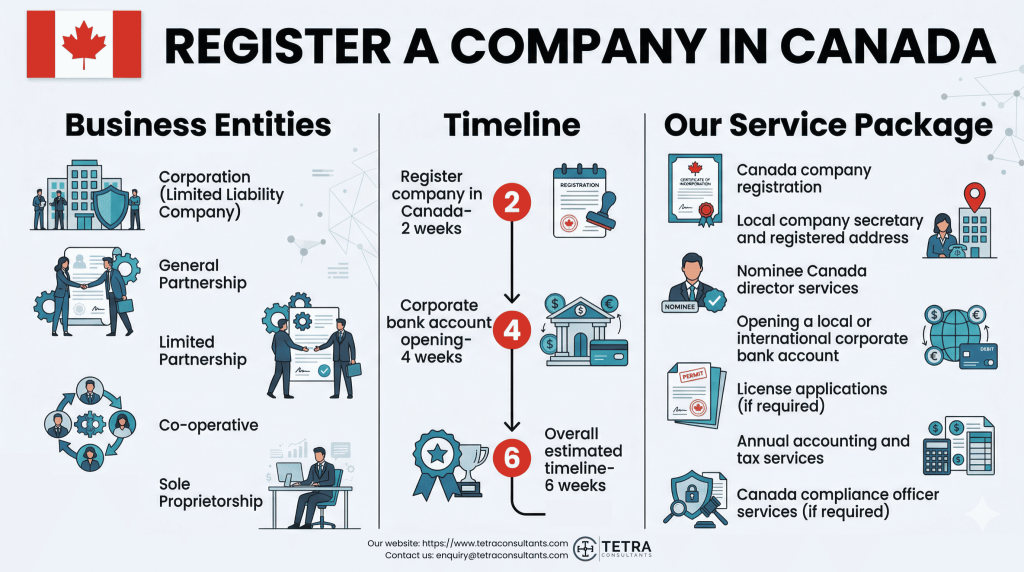
- Register company in Canada- 2 weeks
- Corporate bank account opening- 4 weeks
- Overall estimated timeline- 6 weeks
Cost for company registration in Canada in 2026
- The government fee for Canada company registration ranges between CAD 200 to CAD 400. The final pricing may vary on the basis of several factors including the jurisdiction of incorporation, whether it is federal or provincial, the complexity of the corporate structure, and the additional services needed. Companies should expect costs that are associated with government incorporation filing fees, tax registration fees, etc.
- At Tetra Consultants, we follow a transparent and straightforward fee policy, our team ensures that all our clients understand the scope of our services offered, and associated fees, before the engagement begins.
Difference between provincial and federal incorporation in 2026
| Factor | Federal incorporation | Provincial incorporation |
| Governing legislation | It is governed by the Canada Business Corporations Act (CBCA) | It is governed by the provincial legislation like the Ontario Business Corporations Act (OBCA), Alberta Business Corporations Act (ABCA), or Business Corporations Act (British Columbia) (BCBA) |
| Geographic business rights | Federal incorporation enables the companies to operate across all Canadian provinces and territories | In provincial incorporation company is mainly authorized to operate within the province of incorporation |
| Regulatory authority | Companies are regulated by Corporations Canada under the federal jurisdiction | Companies are regulated by provincial registries like the Ontario Business Registry or provincial corporate registrars |
| Business expansion | This is best for companies that are planning to operate nationwide or internationally | This is best for businesses that are operating mainly within one province |
| Compliance filings | Annual returns should be filed with federal authorities and sometimes provincial authorities | Annual filings should be submitted to the provincial corporate registry |
| Corporate transparency requirements | Companies must maintain an Individuals Significant Control (ISC) Transparency Register under the federal corporate law | Most province businesses have to maintain ISC or beneficial ownership registers |
| Registered office | Companies should maintain a registered office address within Canada | Companies should maintain a registered office within the province of incorporation |
| Business expansion | It is best for companies that are planning to operate nationwide or internationally | It is best for businesses who want to operate mainly in one province |
Looking to register company in Canada in 2026?
- Tetra Consultants works as your advisor and trusted partner in your business expansion and Canada company registration. With our own team of lawyers, incorporation specialists, compliance team, and accountants, we tell our clients what they need to know, instead of what they want to hear. Most importantly, we are known for being a one-stop solution for our valued clients.
- Contact us to find out more about Canada company registration. Our team of experts will revert within the next 24 hours.
FAQs
Can a foreigner register a company in Canada in 2026?
What is a Corporation (Limited Liability Company) in Canada?
What is a General Partnership in Canada?
What is a Limited Partnership in Canada?
What is a Co-operative in Canada?
What is a Sole Proprietorship in Canada?

Author
Sharma Prabakaran
Sharma Prabakaran is the Head of International Business Advisory at Tetra Consultants. With over 15 years of professional experience, he specialises in international business setup, accounting and tax advisory, and cross-industry SME engagements. His expertise encompasses end-to-end project management, ranging from company incorporation and corporate bank account establishment to ongoing annual accounting and tax compliance.