


Company Registration
2 Weeks
Local Director?
No
Bank Account Opening
4 Weeks
Travel Required?
No
`
Register company in South Korea in 2026
- The process of company incorporation in South Korea involves several regulatory requirements, including foreign investment reporting, company registration, corporate bank account setup, tax registration, and compliance with local corporate laws.
- Depending on the investment structure, many foreign-owned businesses are established as Foreign Direct Investment (FDI) Companies, which are regulated under the Foreign Investment Promotion Act and the Foreign Exchange Transactions Act. In addition, all incorporated entities must comply with the provisions of the Commercial Act (Sang-beop), which governs corporate formation, shareholder rights, director responsibilities, and ongoing corporate governance requirements.
- To complete the incorporation process, investors are generally required to register the company through the Supreme Court’s Internet Registry Office and obtain the relevant tax registrations before commencing business activities. Businesses must also maintain ongoing compliance with accounting, reporting, and tax obligations to operate legally within the country.
- Before proceeding with incorporation, foreign investors should review South Korea’s Foreign Investment Negative List, which identifies sectors where foreign ownership may be restricted or subject to additional regulatory approvals. Industries such as defence, broadcasting, and certain energy-related activities may be subject to specific investment limitations. Investors can also refer to guidance published by the Korea Trade-Investment Promotion Agency (KOTRA) to better understand sector-specific requirements and investment opportunities available in South Korea.
- To successfully establish and operate a company in South Korea, you will need to complete the following requirements:
- Register the company with the South Korea Registry of Companies.
- Maintain a local company secretary and a registered office address in South Korea.
- Open a local or international corporate bank account to support business operations and financial transactions.
- Obtain the necessary business licence in South Korea if the intended business activity falls within a regulated industry.
- Register for the Four Major Social Insurances in South Korea as required under the Labour Standards Act (LSA).
- Complete VAT registration and ensure ongoing quarterly filing compliance with the National Tax Service (NTS).
- Maintain corporate bookkeeping records in accordance with Korean accounting standards, including K-GAAP or K-IFRS requirements.
- Establish employer payroll systems and ensure compliance with South Korean employment regulations, including the Labour Standards Act (LSA).
How to register company in South Korea in 2026?
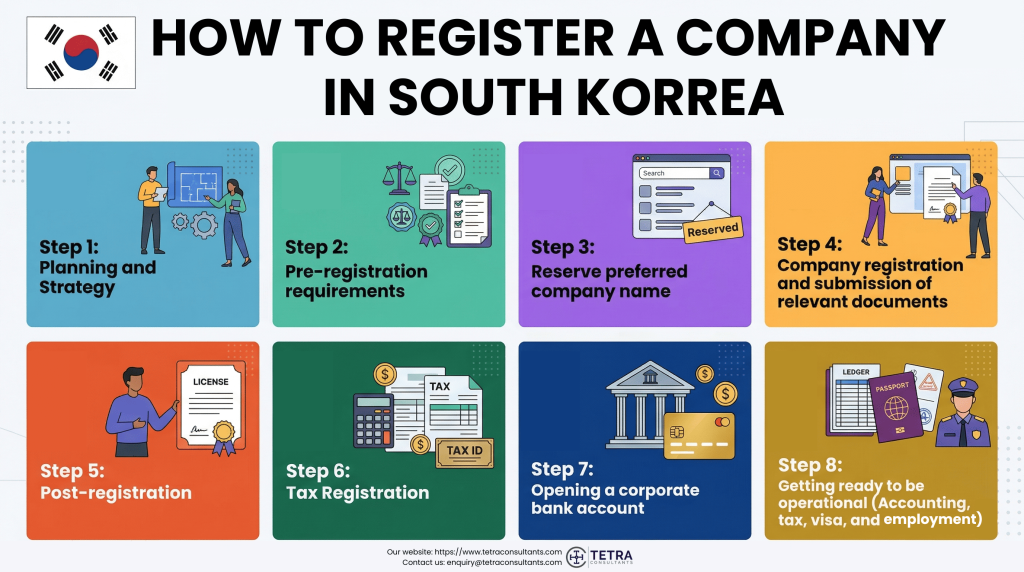
Step 1: Planning and Strategy
- Before you register a company in South Korea, you will need to determine your intended business activities, proposed share capital, and the nationalities of the directors and shareholders. Based on these factors, you should identify the most suitable business entity and determine whether any industry-specific licenses or regulatory approvals are required before commencing operations.
- Some of the most common business structures available in South Korea include:
- Limited Liability Company (Yuhan Hoesa)
- Joint Stock Company (Chusik Hoesa)
- Partnerships
- Branch Office
- Representative Office
- During the planning stage, you will need to decide on the most appropriate market entry structure for your business. This may involve establishing a subsidiary, branch office, or liaison office. Subsidiaries in South Korea are generally incorporated under the Foreign Investment Promotion Act (FIPA), while branch offices and liaison offices are regulated under the Foreign Exchange Transaction Act (FETA).
- If you choose a subsidiary structure, you will also need to determine the most suitable legal entity type, such as a Limited Liability Company (Yuhan Hoesa) or a Joint Stock Company (Chusik Hoesa).
Step 2: Pre-registration requirements
- Before commencing the incorporation process, you will need to prepare and submit all required due diligence documents relating to the directors, shareholders, and beneficial owners of the company.
- You will also need to secure a registered business address in South Korea. While a virtual office or serviced office may be sufficient for the initial incorporation process, many South Korean banks may require a physical lease agreement when you apply for a corporate bank account. Therefore, you should ensure that your chosen business address satisfies both incorporation and banking requirements.
Step 3: Reserve preferred company name
- Before incorporation, you will need to verify the availability of your preferred company name and ensure that it complies with South Korean company naming regulations.
- Under Korean corporate law, the legal company name must be registered using Korean characters (Hangeul – 한글) and include the appropriate legal suffix. For example, a Limited Liability Company should include the suffix 유한회사 (Yuhan Hoesa), while a Joint Stock Company should include the suffix 주식회사 (Chusik Hoesa).
Step 4: Company registration and submission of relevant documents
- Once your company structure has been finalized, you will need to prepare all incorporation documents required for registration.
- If your business is structured as a Joint Stock Company (JSC), you may also need to appoint a Statutory Auditor (Gamsa) when specific revenue or asset thresholds are reached under South Korean corporate regulations. You should therefore review all applicable corporate governance requirements before incorporation.
- You will then need to prepare and submit the necessary incorporation documents, including the Articles of Association and other statutory filings, to the Supreme Court’s Internet Registry Office for registration. Upon successful approval, your company will become a legally recognized business entity in South Korea.
Step 5: Post-registration
- Once the incorporation process has been completed, you will receive various corporate documents relating to your newly established company. These typically include the South Korea Business Registration Certificate, Memorandum and Articles of Association, and the Register of Directors and Shareholders.
- These documents will contain your South Korea company registration number, which you will need when conducting business activities, opening a corporate bank account, and completing regulatory filings.
- It is important to note that official corporate documents are generally issued in Korean and may need to be translated if required for international business purposes.
Step 6: Tax Registration
- After incorporation, you will need to register your company with the National Tax Service (NTS) and obtain the necessary tax identification number before commencing business operations.
- If your company supplies taxable goods or services, you will also need to comply with Value Added Tax (VAT) requirements. In South Korea, VAT returns are generally filed on a quarterly basis, with filing periods commonly occurring in April, July, October, and January.
- Depending on the nature of your investment, your company may also qualify for certain tax incentives available under the Restriction of Special Taxation Act. You should therefore review the eligibility requirements applicable to your business activities and investment structure.
Step 7: Opening a corporate bank account
- Following incorporation, you will need to open a corporate bank account to facilitate business transactions and manage company finances.
- Corporate banking institutions in South Korea operate under the supervision of the Financial Supervisory Service (FSS). During the account opening process, you may be required to provide incorporation documents, business registration certificates, shareholder information, proof of business activities, and source-of-funds documentation.
- Once approved, your corporate bank account will enable your company to receive payments, conduct domestic and international transactions, and manage operational expenses efficiently.
Step 8: Getting ready to be operational (Accounting, tax, visa and employment)
- After your company has been incorporated, you will need to ensure ongoing compliance with South Korean accounting, tax, employment, and corporate regulations.
- You will be required to maintain proper accounting records, prepare financial statements, and fulfill ongoing tax filing obligations in accordance with applicable Korean regulations.
- If you plan to hire employees, you will also need to register them under South Korea’s Four Major Social Insurances, including: National Pension, National Health Insurance, Employment Insurance, and Industrial Accident Compensation Insurance
- For foreign investors who intend to relocate to South Korea and actively manage the business, it may be necessary to apply for a D-8 Investor Visa. This visa is generally available to individuals who establish a foreign-invested company under South Korean investment regulations and meet the applicable investment requirements.
- After obtaining the D-8 Investor Visa and relocating to South Korea, you will generally need to obtain an Alien Registration Card (ARC), which serves as your official identification and residency document.
- Alternatively, if you wish to test the South Korean market before establishing a legal entity, you may consider using an Employer of Record (EOR) model. This structure allows businesses to legally hire employees in South Korea without establishing a subsidiary or branch office. The EOR model may be particularly suitable if you wish to assess market opportunities before committing to the capital investment and regulatory requirements associated with company incorporation.
Key requirements for registering a company in South Korea
- You will need to register your company with the South Korea Registry of Companies to obtain legal recognition and establish your business as a valid corporate entity under Korean law.
- You will need to maintain a registered business address in South Korea and, where applicable, ensure that the company fulfils all local corporate administration requirements.
- You will need to open a local or international corporate bank account to facilitate business transactions, receive payments, manage operating expenses, and support day-to-day financial activities.
- Depending on your intended business activities, you may need to apply for the relevant business licenses or regulatory approvals before commencing operations in South Korea.
- If your company plans to hire employees, you will need to register for the Four Major Social Insurances in South Korea, including National Pension, National Health Insurance, Employment Insurance, and Industrial Accident Compensation Insurance, in accordance with local labor regulations.
- You will need to complete VAT registration with the National Tax Service (NTS) and ensure that quarterly VAT filings are submitted within the prescribed deadlines to remain compliant with South Korean tax requirements.
- You will need to maintain accurate accounting records and corporate bookkeeping in accordance with the applicable Korean accounting standards, including K-GAAP or K-IFRS, depending on your company’s reporting obligations.
- If you employ staff in South Korea, you will need to establish a compliant payroll system and fulfill employment-related obligations, including compliance with the Labor Standards Act (LSA), employee compensation requirements, and statutory reporting obligations.
Timeline to register company in South Korea in 2026
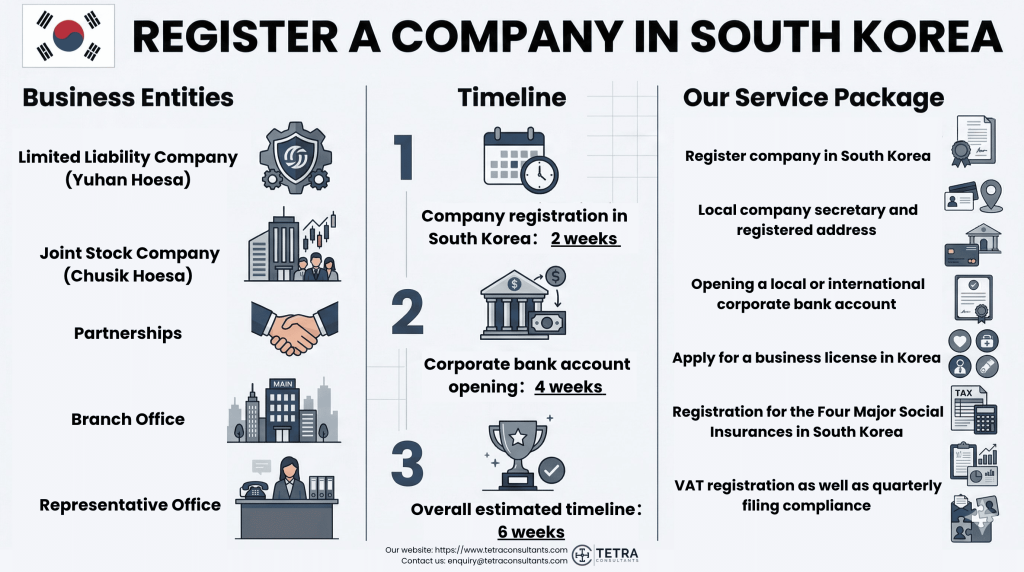
- Company registration in South Korea- 2 weeks
- Corporate bank account opening- 4 weeks
- Overall estimated timeline- 6 weeks
Cost to register company in South Korea in 2026
- Depending on type of business entity, share capital and services required, Tetra Consultants’ fees range from US$3,000 to US$15,000. The final fee to register company in South Korea will be based on multiple factors this includes the type of legal entity, paid-up capital, office requirements, and whether additional licenses are needed for the intended business activities.
- At Tetra Consultants we follow a transparent fee policy, ensuring that all our clients are fully informed about all government fees, professional service charges, and third-party costs before the engagement begins. During initial consultation, our team will send you a detailed fees breakdown, so you know exactly what services you are paying for.
Find out more!
- Tetra Consultants works as your advisor and trusted partner in your business expansion and South Korea company incorporation. With our own team of lawyers, incorporation specialists, compliance team, and accountants, we tell our clients what they need to know, instead of what they want to hear. Most importantly, we are known for being a one-stop solution for our valued clients. Here are why our clients choose us:
- Tetra Consultants provides complete support for company registration in New Zealand. We assist you with the incorporation process and all related compliance requirements.
- Our team includes incorporation specialists, legal advisors, accountants, and compliance professionals. They work closely with you at every stage of the setup process.
- We offer clear and transparent pricing with no hidden costs. With our reliable guidance and practical support, you can expand your business into New Zealand with confidence.
- Contact us to find out more about how to do business in Korea. Our team of experts will revert within the next 24 hours.
FAQs
Can foreigners register company in South Korea in 2026?
What is a Limited Liability Company (Yuhan Hoesa) in South Korea in 2026?
What is a Joint Stock Company (Chusik Hoesa) in South Korea in 2026?
What is a Partnership in South Korea in 2026?
What is a Branch Office in South Korea in 2026?
What is a Representative Office in South Korea in 2026?