


Company Registration
1 Week
Local Director?
No
Bank Account Opening
4 Weeks
Travel Required?
No
`
Table Of Contents
Costa Rica crypto license in 2026
- Costa Rica’s 2026 cryptocurrency licensing regime allows firms to establish digital-asset businesses under the oversight of SUGEF as the sector rapidly expands. At Tetra Consultants, our team of lawyers, licensing specialists, compliance team, and accountants can help to seamlessly obtain a crypto license in Costa Rica in 2026.
- At Tetra Consultants, our license and compliance specialists will guide clients through all phases of establishing a compliant crypto business entity by assisting with company formation, regulatory paperwork, developing a compliant operational framework (to include meeting all financial and AML requirements), and drafting an AML/KYC regulations manual and respective risk management policies for clients involved with a cryptocurrency license.
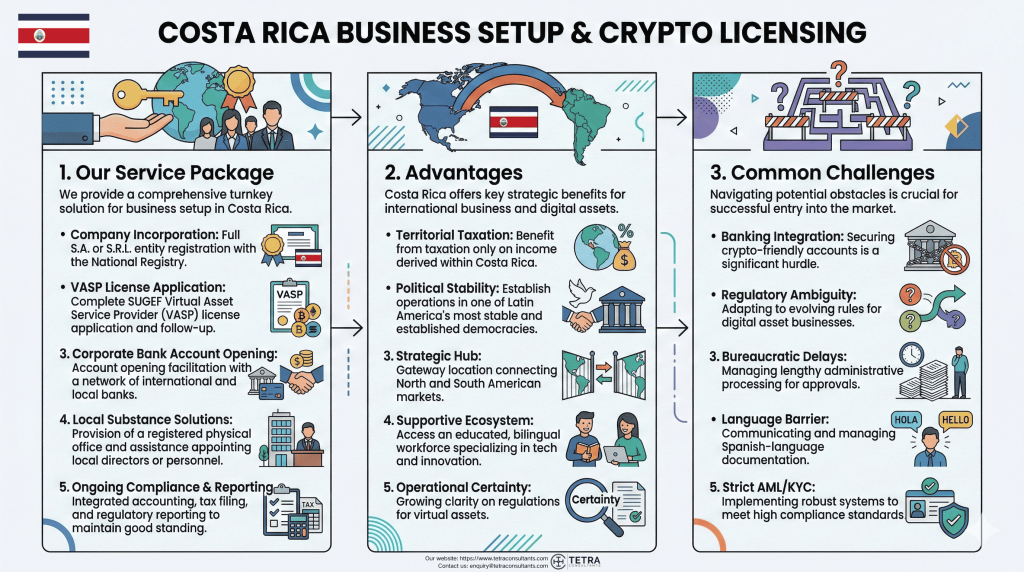
- Costa Rica’s major licensing body to obtain a crypto license is Superintendencia General de Entidades Financieras (SUGEF). There is no specific crypto licensing process as of 2026, crypto businesses are governed under general financial laws, including Law No. 7786 (AML/CFT Law) and laws against terrorist financing.
- ICD (Anti-Money-Laundering body) is majorly involved with the enforcement of AML/CFT laws, while BCCR (Central Bank) is involved in aligning crypto businesses with monetary policy laws. Article 166 of the Labor Code (Crypto Wage Law) allows crypto payments to employees, creating another layer of compliance.
- Recent legislative initiatives include Bill No. 22.837 (Crypto Asset Market Law) and Bill 23-415, which outline the process of registration with SUGEF as a Virtual Asset Service Provider (VASP). These bills outline the integration of AML/KYC API with blockchain analytics, transaction monitoring, and adherence to FATF/GAFI recommendations, OECD CARF (reporting framework), and UBO/RTBF registry requirements.
Regulatory requirements for the Costa Rica crypto license in 2026
- At least 1 director, 1 shareholder, and 1 compliance officer of any nationality are required for company formation under Costa Rica’s crypto license framework.
- A physical local office is mandatory to establish a legal presence in Costa Rica and satisfy regulatory expectations.
- The company must register as a legal entity with the National Registry (Registro Nacional).
- Compliance with anti-money laundering (AML) and counter-terrorist financing (CFT) policies aligned with FATF recommendations is obligatory.
- Corporate bank account opening is essential for conducting financial transactions but may require thorough documentation and can be time-consuming.
- No minimum share capital requirement or local residency is enforced for founders.
Regulatory outlook in 2026
VASP registration progress:
- Bill No. 22.837 remains pending due to a procedural setback in the second debate, with the SUGEF-mandated registration of crypto and digital assets (VASP/CASP) to comply with FATF standards on AML/CFT; the requirement remains in 2026.
No crypto license framework:
- No specific crypto license framework exists, crypto operations are covered by general financial regulations like Law No. 7786, with financial licensing options available for Forex, EMI, PSP, and AFS through SUGEF.
AML/CFT:
- Regulatory Compliance and AML audits are anticipated, including mandatory customer due diligence and risk-based monitoring for VASPs, reflecting the OECD CARF report.
Banking integration:
- Corporate banking and IBAN solutions are not readily available to crypto companies due to conservative banking approaches. Proposed legislation could facilitate greater access, with a focus on AML vetting.
Activities allowed in Costa Rica crypto license
Costa Rica’s crypto-friendly framework provides a wide array of activities for companies with a crypto license or suitable registration under local law. The activities that are allowed include:
Crypto exchanges:
- Setting up platforms for crypto-to-crypto and crypto-to-fiat exchanges is allowed as long as businesses do not violate the anti-money laundering procedures and do not violate any general commercial law.
Wallet services:
- Providing custodial and non-custodial (wallet) services is allowed, although there are some compliance obligations consistent with the standards imposed on financial operators.
ICO or token issuance:
- Projects can launch ICO or ITO and token issuances as long as the person who issues the tokens does not consider the tokens to be securities. Otherwise, SUGEF registration is required.
Tokenization:
- It is legal to tokenize real-world or digital assets into blockchain-based tokens, for example, for payment or fractional ownership.
NFTs:
- Minting NFTs and conducting marketplace operations are permitted. However, there have been increasing amounts of use cases for digital collectibles, art, and GameFi projects.
Custodial services:
- There are clients’ crypto assets custodial services that are permitted to both individuals and institutions with the recommended AML controls in place.
Gaming and gameFi:
- Crypto gambling, GameFi, and Web3 game platforms are allowed, and there is great opportunity within Costa Rica’s established framework of gaming businesses.
Excluded activities in Costa Rica crypto license
- Excluded activities under the Costa Rica crypto license are defined by general legal and financial statutes, regardless of the absence of a specialized crypto law.
Fiat deposit-taking and lending:
- Accepting deposits or making loans in fiat must have a banking license in a traditional manner, it is prohibited under the crypto license.
Securities trading:
- Securities trading type activities (e.g., any token defined as a security) must comply with Costa Rican securities laws. If you do not get registered and comply, these activities are excluded.
Illegal or fraudulent activities:
- Any business activity that has money laundering, terrorist financing, or illegal online gambling potential is not permitted. The criminal penalties for AML/CFT violations can be severe.
Unregistered financial services:
- Operating financial activities that require registration with SUGEF or other authorities without proper authorization is not allowed.
Steps for obtaining Costa Rica crypto license
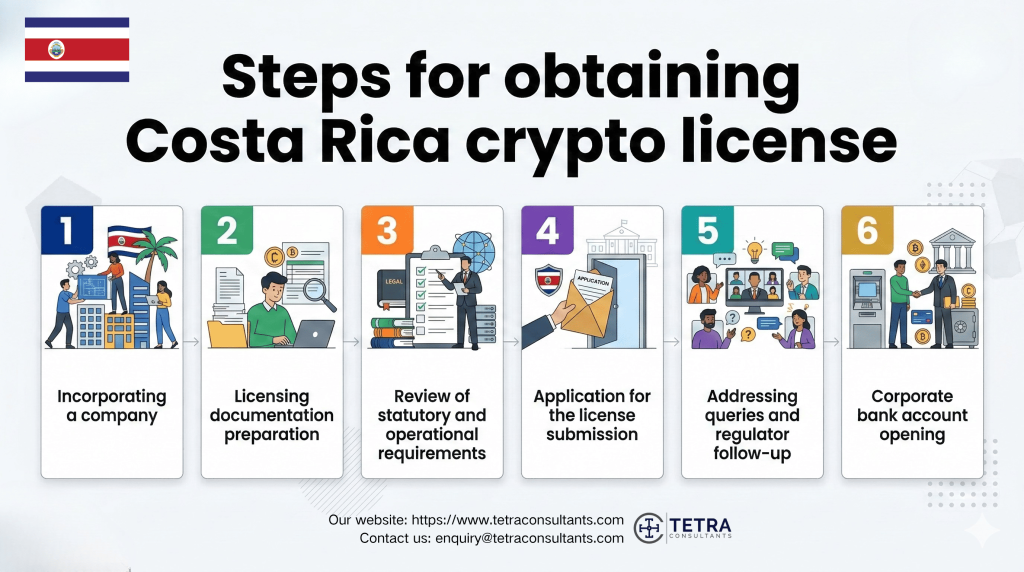
Step 1: Incorporating a company
- Our lawyers and licensing specialists will begin by helping you to incorporate a Costa Rican company, which is needed to apply for the crypto license. Our legal and corporate services lawyers will complete the registration of your company by obtaining all statutory documents and registering with the required authorities. Our approach is efficient, so we expect that your company will be registered within one week and a fully compliant local entity.
Step 2: Licensing documentation preparation
- Once your company is incorporated, our legal team will prepare and draft the relevant documentation for your crypto licensing application, which involves pre-filling application forms, drafting corporate resolutions, and ensuring compliance with any regulatory requirements. By utilizing our knowledge and experience of Costa Rica’s licensing structure, we will make sure that all documents are accurate and prepared for submission, maximizing the chance for no delays or outright rejection by regulators.
Step 3: Review of statutory and operational requirements
- Prior to submission, our team of lawyers and licensing specialists will engage with you to review and finalize all operational and statutory requirements as mandated by local Costa Rican Authorities. Further, we will ensure that the business model, corporate governance structure, and compliance framework align with the regulators’ expectations.
- Our consultants will provide clear steps in aligning your operations with the local laws so that public consultation will be streamlined, and we will be ready for the steps leading to licensing.
- Additionally, our accounting and tax team will manage all tax and accounting-related matters of the company, ensuring smooth and compliant operations without burdening the client.
Step 4: Application for the license submission
- Once all the requirements have been established, Tetra Consultants will submit your crypto license application to the relevant authorities in Costa Rica. We will act as your point of contact with the regulators, so your application goes through an intense review with as little delay as possible.
- In the event that the regulators have any questions or clarifications, we will coordinate contact with them on your behalf, as promptly as possible while maintaining transparency.
Step 5: Addressing queries and regulator follow-up
- Regulators may raise queries or ask for further documentation during the evaluation phase. Tetra Consultants will fully assist you in resolving these queries by preparing the explanations, documents, or compliance changes. Our legal and compliance team will continue to engage until these queries from regulators are all resolved, and the application has the greatest chance of being approved.
Step 6: Corporate bank account opening
- Alongside the licensing stages, our banking team will simultaneously begin discussions with local and international banks to open a corporate bank account for your business. We will prepare a comparison table that illustrates banks that have expressed interest and what they need from you for your corporate bank account, minimum deposits, online-banking capabilities, travel obligations, and how they deal with client funds. When you select the preferred bank, our lawyers and licensing specialists will manage the whole application and onboarding process for your corporate account and aim for it to be opened within four weeks.
Benefits of Costa Rica crypto license
Favorable tax implications
- Costa Rica does not impose capital gains tax on cryptocurrency transactions. Moreover, its territorial tax system will only tax local income, allowing international crypto businesses to significantly reduce their tax liability and operate at maximum efficiency.
Fast and simple incorporation
- The incorporation process is very fast, simple, and inexpensive. Costa Rica has minimal limits, which creates a lower barrier to entry for start-ups and international companies.
Regulation supportive of growth
- The regulatory environment in Costa Rica in 2026 is permissive and generally supportive of innovation, with few obstacles to entry. Businesses can legally offer cryptocurrencies under general commercial laws without being restrained to a license requirement like in other parts of the world.
Friendly business environment
- Costa Rica in 2026 is known for political stability, strong legal protections, developed telecoms infrastructure, and a bank that are becoming increasingly friendly to crypto businesses, and these conditions are vital for long-term growth and international growth.
Minimal financial reporting requirements
- Crypto companies are not subject to audits and do not have to submit financial reports on a regular basis, making continued compliance easier and lowering costs in 2026. Additionally, our accounting and tax team will manage all tax and accounting-related matters of the company, ensuring smooth and compliant operations without burdening the client.
Timeline for obtaining Costa Rica crypto license
- The timeline to obtain a Costa Rica crypto license with Tetra Consultants is structured in clear stages. The incorporation of your company and document preparation will take roughly 1 week. Once your operational and statutory requirements are established, your license application will be submitted to the regulators for review. We complete this step efficiently to address any comments the regulators may have quickly, and not cause delays.
- Our team of lawyers will proactively interact with local and international banks to secure interest from these banks and finalize a bank account accordingly. The banking team provides information to help you assess which bank might suit your needs, based on minimum deposits, travel requirements, and internet banking facilities. A corporate bank account is expected to take roughly 4 weeks to open. The entire exercise provides an efficient route towards obtaining regulatory approval in Costa Rica.
Cost for obtaining Costa Rica crypto license
- At Tetra Consultants, we provide complete transparency while assisting clients with the acquisition of a Costa Rica crypto license. This way, clients can understand each and every part of the licensing process with complete clarity. Our team of experts will assist clients with company incorporation and other compliance documents to help them complete the licensing process smoothly.
- Tetra Consultants’ team of legal experts will assist businesses with financial licensing and crypto and digital assets VASP, CASP regulatory structuring needs. Our accounting and taxation experts will assist clients with regulatory compliance and AML audits, while our banking experts at Tetra Consultants will assist clients with corporate banking and IBAN Solutions to help clients establish a sound financial infrastructure for their international operations.
Conclusion
- Tetra Consultants works as your advisor and trusted partner in your business expansion with a cryptocurrency license. With our own team of lawyers, licensing specialists, compliance team, and accountants, we tell our clients what they need to know, instead of what they want to hear. Most importantly, we are known for being a one-stop solution for our valued clients.
- Tetra Consultants will help you through the licensing process, including ensuring proper company registration, regulatory compliance consulting, and banking support. With the assistance of Tetra Consultants you share risk and shorten the time to market as your partner to licensing the business in an efficient manner that is compliant and in a meaningful way that allows you to license, register, and incorporate as well as to comply with the local legal requirements.
- Contact us to know more about the Costa Rica crypto license, and our team will get back with you in 24 hours.
FAQs
What specific license is required for operating a crypto exchange in Costa Rica?
Is a local physical office mandatory for a crypto company in Costa Rica?
Are there capital requirements for crypto company registration?
What anti-money laundering (AML) standards apply?
Can foreign nationals be directors or shareholders?
What are some of the challenges in getting a crypto license in Costa Rica?

Author
Sharma Prabakaran
Sharma Prabakaran is the Head of International Business Advisory at Tetra Consultants. With over 15 years of professional experience, he specialises in international business setup, accounting and tax advisory, and cross-industry SME engagements. His expertise encompasses end-to-end project management, ranging from company incorporation and corporate bank account establishment to ongoing annual accounting and tax compliance.