


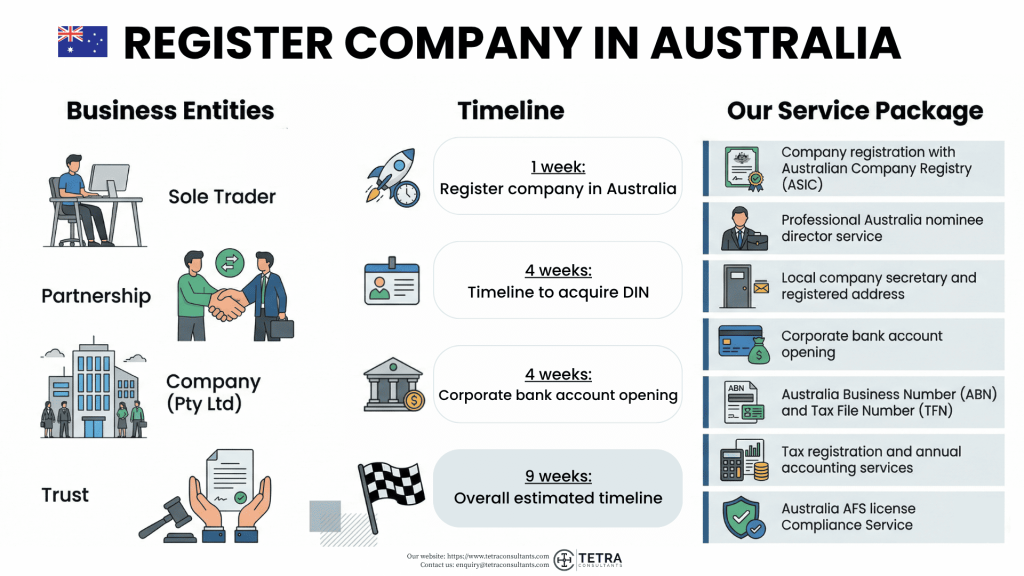
Company Registration
1 Week
Local Director?
Yes
Bank Account Opening
4 Weeks
Travel Required?
No
Register Company in Australia in 2026
- Entrepreneurs who want to register company in Australia must incorporate with the Australian Securities and Investments Commission (ASIC) under the Corporations Act 2001, appoint at least one Australian-resident director, and obtain an Australian Company Number (ACN) before applying for an Australian Business Number (ABN). Australia’s stable legal system, sizeable consumer market and strong sovereign credit rating make it a preferred jurisdiction for founders expanding into the Asia-Pacific region. This guide explains the registration process, requirements, costs, and compliance obligations so that you can move from initial planning through to an operational company with confidence.
Quick Answer:
- To complete Australian company registration, you must:
- Choose a company name and confirm availability through ASIC.
- Select a business structure, typically a Proprietary Limited (Pty Ltd) company.
- Appoint at least one director who ordinarily resides in Australia and obtain a Director Identification Number for each director.
- Register a registered office address in Australia.
- Lodge your application with ASIC and receive your ACN.
- Apply for an ABN through the Australian Business Register (ABR), then register for GST and PAYG withholding where applicable.
- There is no single fastest path for every founder; the strongest approach usually combines the correct business structure with a resident director solution suited to your ownership plans.
Why register a company in Australia?
- Market access: Australia’s domestic economy exceeds 26 million consumers, with established trade links across the Asia-Pacific region.
- Legal certainty: Company law is codified under the Corporations Act 2001, providing predictable governance and disclosure rules.
- Credibility: An ASIC-registered Pty Ltd signals legitimacy to banks, suppliers and enterprise customers.
- Practical takeaway: Founders targeting Australian customers, government contracts or local banking relationships generally benefit from local incorporation rather than operating solely through a foreign entity. A properly planned company setup in Australia strategy also strengthens eligibility for local grants and tenders.
What are the requirements to register a company in Australia?
Meeting company registration requirements in Australia-wide involves several fixed legal conditions under the Corporations Act 2001, and understanding them early makes company formation in Australia-wide considerably smoother.
Do I need an Australian resident director?
- Answer: Yes. Every Pty Ltd company must have at least one director who ordinarily resides in Australia, and public companies require at least two resident directors out of a minimum of three.
- Explanation: This rule is set out in section 201A of the Corporations Act 2001, and “ordinarily resident” refers to regular, settled physical habitation in Australia rather than citizenship or tax residency alone.
- Evidence: Australian Securities and Investments Commission (ASIC) will not process an incorporation application that lists only overseas-resident directors, regardless of shareholder nationality.
- Practical takeaway: founders without a locally based director typically engage a professional nominee director service to satisfy this requirement while retaining full beneficial ownership.
What other officeholder and documentation requirements apply?
- Directors: Each director, including foreign nationals, must obtain a Director Identification Number from the Australian Business Registry Services before appointment.
- Shareholders: There is no residency restriction on shareholders, so a Pty Ltd can be 100% foreign-owned.
- Registered office: Every company needs a physical registered office address in Australia; a post office box alone is not sufficient.
- Company secretary: Optional for a Pty Ltd, but any appointed secretary must ordinarily reside in Australia.
- Constitution or replaceable rules: Companies may adopt the default replaceable rules under the Corporations Act 2001 or lodge a custom constitution.
How long does company registration take in Australia?
- Answer: Standard Pty Ltd registration through ASIC is typically completed within a few business days once documentation is finalised, though the full process including ABN, tax file number and GST registration usually takes one to three weeks end to end.
- Explanation: Delays most often arise from obtaining Director Identification Numbers for foreign directors, since paper-based identity verification can take considerably longer than the standard online process.
- Practical takeaway: founders should apply for Director Identification Numbers well before lodging their ASIC application to avoid holding up incorporation.
How do you register pty ltd company in Australia: step-by-step process
Whether you complete company registration in Australia processes yourself or engage a corporate services provider, the sequence of steps to register Pty Ltd company in Australia entities remains broadly consistent.
Step 1: Reserve a company name:
- Confirm availability through ASIC’s name-check tool and ensure the name is not identical or deceptively similar to an existing entity.
Step 2: Choose your structure:
- Most foreign founders select a Pty Ltd company, limited to 50 non-employee shareholders and unable to raise funds from the public.
Step 3: Obtain Director Identification Numbers:
- Every director must secure this identifier through the Australian Business Registry Services (ABRS) before the application is lodged.
Step 4: Appoint your resident director:
- Satisfy the mandatory residency requirement through a locally based founder, business partner or nominee director service.
Step 5: Set your registered office and principal place of business: b
- Both addresses must be physical Australian locations.
Step 6: Lodge your application with ASIC:
- Submission through the Business Registration Service issues your Australian Company Number.
Step 7: Apply for an ABN:
- Register through the Australian Business Register (ABR) to obtain your Australian Business Number, which is required to invoice clients and claim GST credits.
Step 8: Register for tax and GST:
- Apply for a tax file number and, if projected turnover exceeds AU$75,000, register for GST with the Australian Taxation Office (ATO).
Step 9: Corporate bank account opening:
- Most Australian banks require in-person verification or certified documentation for non-resident directors and shareholders.
Founders comparing this process against other entity types should review our overview of the 6 types of business structures in Australia in 2026 before committing to a Pty Ltd.
What documents do you need to register a company in Australia?
Having the right paperwork ready before you start reduces the most common cause of delay: back-and-forth requests from ASIC or your service provider after lodgment has already begun.
For each proposed director and shareholder:
- A valid passport or national photo identification
- Proof of residential address, such as a recent utility bill or bank statement, typically dated within the last three months
- A completed Director Identification Number application, or evidence of an existing DIN
- Contact details, including a personal email address and phone number, since ASIC and the ABR communicate directly with officeholders
For the company itself:
- The proposed company name, along with one or two backup options in case the first choice is not available
- Confirmation of the registered office address and principal place of business, both of which must be physical Australian addresses
- Details of the share structure, including the number of shares issued and their allocation among shareholders
- A company constitution, if the default replaceable rules under the Corporations Act 2001 are not being adopted
If you are relying on a resident director service:
- A signed nominee director agreement outlining the scope, duration and limits of the arrangement
- Board resolutions or shareholder agreements confirming that beneficial control remains with the actual founders, despite the nominee’s formal officeholder status
For bank account opening, often the most document-heavy step:
- Certified copies of passports and proof of address for all directors and signatories
- The company’s certificate of incorporation and ACN
- A description of the business activity and expected transaction volumes, which banks use for anti-money laundering checks
- In many cases, in-person verification at a branch, or a video call, for non-resident directors
Practical takeaway: founders based overseas should start gathering certified identification documents and proof of address well before engaging a service provider, since certification requirements, such as a notary, an Australian consulate, or specific professional categories, vary and can take longer to arrange than the incorporation itself.
What is the difference between ACN and ABN?
Understanding the distinction between these two identifiers is central to Australian company registration for foreigners.
| Identifier | Issued By | Purpose |
| ACN (Australian Company Number) | ASIC | Unique nine-digit number identifying the company as a legal entity |
| ABN (Australian Business Number) | Australian Business Register (ABR) | Eleven-digit number used for tax, invoicing and GST purposes; incorporates the ACN |
Practical takeaway: a company must obtain its ACN from ASIC first, since the ABN application references the ACN as part of the eleven-digit structure.
How much does it cost to register a company in Australia?
Company registration cost in Australia figures vary depending on whether you engage a professional service provider or self-lodge directly with ASIC.
| Item | Cost (AU$) | Notes |
| ASIC company registration (Pty Ltd) | 636 | From 1 July 2026 |
| Director Identification Number | Free | Mandatory via Australian Business Registry Services |
| ABN registration | Free | Via Australian Business Register |
| Tax file number registration | Free | Via ATO |
| GST registration | Free | Mandatory above AU$75,000 turnover |
| ASIC annual review fee | 342 | Payable each year to maintain registration |
Practical takeaway: government fees are modest, but founders without a resident director should budget for an ongoing nominee director service as part of their annual compliance cost.
Can a foreigner register a company in Australia?
Register Company in Australia as a non-resident
- Answer: Yes. Foreign individuals and companies can own 100% of an Australian Pty Ltd, since there is no residency restriction on shareholders.
- Explanation: The only structural constraint applies to directors, where at least one must ordinarily reside in Australia. Certain regulated sectors, such as agricultural land or sensitive infrastructure, may also require Foreign Investment Review Board for clearance regardless of entity type.
- Evidence: Non-resident founders commonly satisfy the resident director rule through a professional nominee director arrangement while retaining full control through shareholding and reserved matters in the company constitution.
- Verdict: Register company in Australia as a foreigner is entirely achievable, provided the resident director requirement and any sector-specific approvals are addressed early in the planning process.
Start a Company in Australia from Overseas
- Best for: founders with an established product, service or customer base who need a credible local entity without relocating immediately.
- Main challenge: sourcing a compliant resident director and navigating Director Identification Number verification, which can take longer for applicants without an Australian tax file number.
- Verdict: engaging a corporate services provider to arrange the resident director and manage lodgement significantly reduces delays for founders based overseas. Our 4 things to know if you plan to register company in Australia guide covers additional planning considerations for non-resident founders.
Ongoing compliance after you register a company in Australia
- Annual review: ASIC issues an annual review statement and invoices the annual review fee; details must be confirmed or updated within the required timeframe.
- Financial records: Companies must maintain adequate financial records for at least seven years under the Corporations Act 2001.
- Tax lodgment: Companies lodge annual returns with the Australian Taxation Office and pay company tax at 30%, or 25% for eligible base rate entities with turnover under AU$50 million.
- Register of members and officeholders: Companies must keep registers up to date and notify ASIC of any change in director, shareholder or registered office details.
- Takeaway: Consistent compliance protects your company’s good standing and avoids ASIC penalties for late lodgment.
What are the tax and accounting obligations after you register company in Australia?
- Obtaining your ACN and ABN is only the beginning. Once your Pty Ltd is trading, the Australian Taxation Office (ATO) expects it to meet a recurring set of tax and reporting duties, while the Australian Securities and Investments Commission (ASIC) oversees important corporate compliance obligations. Getting these requirements wrong is one of the common reasons foreign-owned companies face penalties or compliance issues in their first year.
What corporate tax rate will my company pay?
Quick Answer: Australian companies pay either 25% or 30% company tax, depending on turnover and the proportion of income that is passive.
A company qualifies as a “base rate entity” and pays the lower 25% rate if:
- Its aggregated turnover is under AU$50 million, and
- No more than 80% of its assessable income is passive (interest, dividends, rent and similar sources)
Companies that do not meet these tests pay the standard 30% rate.
Practical takeaway: most early-stage foreign-owned trading companies fall into the 25% bracket, but this should be confirmed with an accountant each financial year, since turnover and income mix can shift the rate.
Do I need to register for GST?
- Yes. Once your projected or actual turnover passes AU$75,000 in a 12-month period, GST registration with the ATO becomes compulsory. Below that threshold it is optional, though many B2B companies register voluntarily so that they can claim GST credits on business expenses from day one.
What is a Business Activity Statement (BAS), and how often do you lodge one?
Once registered for GST, your company reports and pays GST, and usually PAYG withholding, through a Business Activity Statement. Key points to note:
- Most small and mid-sized companies lodge quarterly
- The ATO can require monthly lodgment for larger businesses or those with a history of late payment
- Missing a BAS deadline triggers penalties that scale with how overdue the statement is, so this is worth building into your calendar from the outset
Do you need to run payroll and pay superannuation if you hire staff?
If your company employs anyone in Australia, the following obligations apply:
- Registration for Pay As You Go (PAYG) withholding is required
- Payroll must be run through Single Touch Payroll (STP), which reports wage and super information to the ATO each pay run
- Superannuation guarantee contributions must be paid on top of salary, currently set at 12% of an eligible employee’s ordinary time earnings
- From 1 July 2026, “Payday Super” rules take effect, requiring employers to pay superannuation at the same time as wages rather than quarterly, so companies planning to hire staff should factor this tighter payment cycle into their cash flow planning
What records do you need to keep, and for how long?
- Companies must maintain accurate financial and business records, including invoices, receipts, bank statements, payroll records and supporting documentation.
- For tax purposes, records generally need to be kept for at least five years, although certain corporate records and documents may be subject to longer retention requirements. Companies should therefore establish a proper record-keeping system from the beginning.
- The Australian Securities and Investments Commission (ASIC) also imposes corporate reporting obligations on certain companies. Larger proprietary companies that meet applicable size thresholds may have additional ASIC financial reporting and audit requirements.
Do you need a registered tax agent or an accountant?
It is not legally mandatory for every company, but in practice, most foreign founders engage a local accountant or registered tax agent to handle:
- BAS preparation and lodgment
- Annual company tax returns
- Payroll and PAYG compliance
- Superannuation obligations
- Financial reporting requirements
- ASIC annual review and corporate compliance obligations
Beyond avoiding penalties, a local accountant is often essential simply to interpret ATO correspondence and deadlines correctly, particularly for directors who are not based in Australia year-round.
Using professional accounting support can also help foreign directors understand ATO and ASIC correspondence, reporting deadlines and ongoing compliance requirements, particularly when the company’s directors or owners are based outside Australia.
Practical takeaway: budgeting for ongoing accounting support alongside your ASIC annual review fee gives a more realistic picture of your true cost of maintaining an Australian company, rather than treating incorporation as a one-off expense.
How can Tetra Consultants help you register a company in Australia?
Tetra Consultants supports founders through every stage of Australian company registration for foreigners, including:
- Offshore company incorporation: Our team manages end-to-end offshore company incorporation, including ASIC lodgment, ACN and ABN applications and registered office arrangements.
- Corporate bank account opening: We coordinate corporate bank account opening with banks experienced in serving non-resident directors and shareholders.
- International trademark registration: Protect your brand before you launch through international trademark registration, securing your intellectual property across your target markets.
- Resident director and compliance support: Our specialists arrange compliant resident director solutions and manage ongoing ASIC and ATO obligations, so your company remains in good standing year after year.
Founders evaluating whether incorporation is worthwhile should also review the benefits of registering a company in Australia and our successful case study of Australia company setup, which illustrates a real engagement from planning through to an operational entity.
Conclusion
- Australia offers a stable, well-regulated environment for founders who want to establish a credible local presence, provided the resident director requirement and ASIC compliance obligations are planned for from the outset.
- Whether you are a first-time founder or expanding an existing international business, working with an experienced corporate services provider removes much of the administrative friction from the process.
- Contact us and we will revert within 24 hours.
FAQs

Author
Sharma Prabakaran
Sharma Prabakaran is the Head of International Business Advisory at Tetra Consultants. With over 15 years of professional experience, he specialises in international business setup, accounting and tax advisory, and cross-industry SME engagements. His expertise encompasses end-to-end project management, ranging from company incorporation and corporate bank account establishment to ongoing annual accounting and tax compliance.