


Company Registration
1 Week
Local Director?
Yes
Bank Account Opening
4 Weeks
Travel Required?
No
`
Table Of Contents
Register company in New Zealand in 2026
- New Zealand has established itself as one of the most business-friendly destinations in the world, attracting entrepreneurs, startups, and international investors seeking a transparent and efficient corporate environment. With a strong legal framework, simplified incorporation procedures, and access to global markets, the country offers an ideal platform for businesses looking to expand their international presence. The business environment in New Zealand is overseen by Ministry of Business, Innovation, and employment (MIBE) and the company governance and framework are governed through companies Act 1993.
- Whether you are launching a new venture or entering the New Zealand market, completing the incorporation process correctly is essential to ensuring long-term operational success.
- To register a company in New Zealand, businesses must comply with several regulatory and administrative requirements, including company incorporation with the New Zealand Companies Office, appointment of a resident director where applicable, tax registration, establishment of a registered business address, and opening a corporate bank account.
- To successfully incorporate and operate a company in New Zealand, you will typically need to complete the following requirements:
- Register the company with the New Zealand Companies Registry.
- Appoint a New Zealand resident nominee director to satisfy local regulatory requirements.
- Maintain a local company secretary and a registered office address in New Zealand.
- Open a local or international corporate bank account to facilitate business transactions.
- Obtain the necessary tax registrations with the relevant New Zealand authorities.
- Ensure ongoing compliance through annual accounting, bookkeeping, and tax filing services.
- Apply for the appropriate financial services licence if the intended business activities fall within a regulated sector.
How to register a company in New Zealand in 2026?
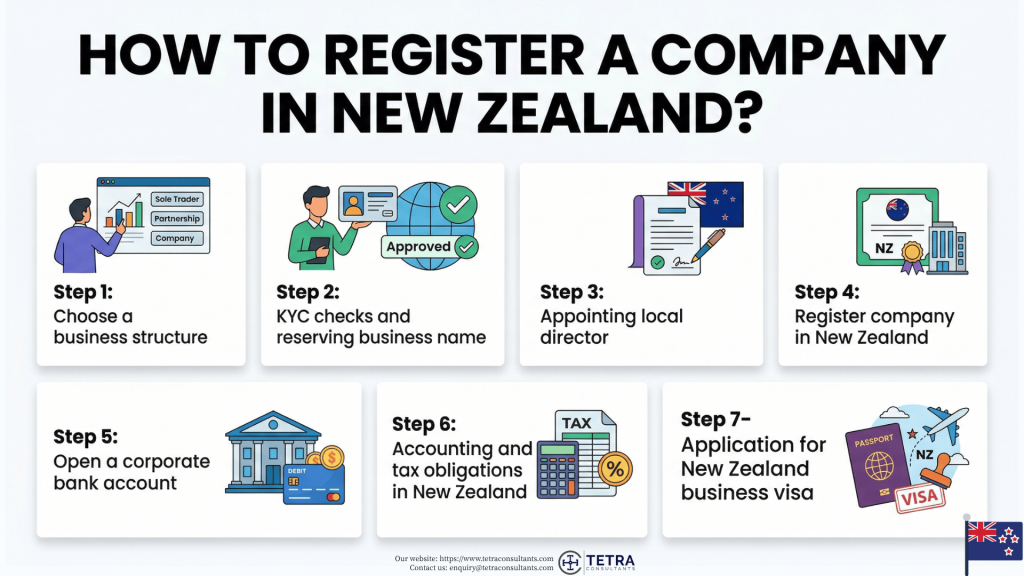
In order to register your business in New Zealand, you must follow these steps:
Step 1: Choose a business structure
- Before you register a company in New Zealand, you will need to select the most suitable business structure based on your business activities, ownership requirements, and long-term objectives. New Zealand offers several business structures, including:
- Sole Trader
- Limited Liability Company
- Limited Partnership
- Branch Office
- Representative Office
- Among these options, a Limited Liability Company (LLC) is the most commonly chosen structure due to its flexibility and limited liability protection.
- In some cases, you may also consider establishing a Look-Through Company (LTC). This type of structure allows company income, losses, and tax obligations to pass directly to shareholders rather than being taxed at the corporate level. If your business is operated by a small group of investors seeking tax efficiency while maintaining limited liability protection, an LTC may be a suitable option.
Step 2: KYC checks and reserving business name
- Once you have selected a business structure, you will need to conduct Know Your Customer (KYC) checks and verify the availability of your preferred company name through the Ministry of Business, Innovation and Employment’s ONECheck tool.
- After confirming availability, you will need to reserve the chosen name with the Companies Register and create a RealMe® account to access the Companies Office’s online services. The reserved company name will remain valid for a limited period, during which you must submit the incorporation application.
- You will also need to prepare and submit supporting documents, including identification documents, proof of residential address, and details of directors and shareholders. Any signed consent forms from directors and shareholders must be submitted within the statutory 20-working-day period.
- If your New Zealand company is part of a larger international corporate group, you will also need to disclose the Ultimate Holding Company (UHC) when filing incorporation documents. The UHC refers to the highest parent company within the ownership structure.
Step 3: Appointing local director
- Before you can complete the incorporation process, you will need to ensure that your company meets the director residency requirements set by the New Zealand Companies Office. Every New Zealand company must appoint at least one director who is a resident of New Zealand or Australia.
- If the appointed director resides in Australia, the individual must also be a director of a company registered with the Australian Securities and Investments Commission (ASIC) and possess a valid Australian Company Number (ACN).
- If you are a foreign investor and do not have a suitable resident director available, you will need to arrange for a nominee resident director t
Step 4: Register company in New Zealand
- Once all required documents have been prepared, you will need to submit the incorporation application to the Companies Office. The application must include details of the company’s directors, shareholders, registered office address, and shareholding structure.
- Upon approval of the incorporation application, your company will receive a New Zealand Business Number (NZBN). This unique identifier will be used for government registrations, tax filings, invoicing, and various business transactions throughout the life of the company.
- During the incorporation process, you will also need to complete tax registrations with Inland Revenue. This includes obtaining an Inland Revenue Department (IRD) number and registering for Goods and Services Tax (GST), where applicable, in accordance with New Zealand tax regulations.
- Once the registration process has been completed, you should retain important corporate documents, including the Certificate of Incorporation, tax registration certificates, shareholder records, and company constitution, if applicable.
Step 5: Open a corporate bank account
- After your company has been incorporated, you will need to open a corporate bank account to conduct business operations, receive payments, and manage company finances effectively.
- Some of the banks in which you can work with include ANZ Bank New Zealand, ASB Bank, Westpac New Zealand and Rabobank New Zealand.
- When applying for a corporate bank account, you may be required to provide incorporation documents, proof of business activities, identification documents of directors and shareholders, and information regarding the source of funds. Depending on the bank’s compliance requirements, additional due diligence checks may also be conducted.
- Once your corporate bank account has been approved, your company will receive banking details, including a SWIFT/BIC code, enabling you to conduct international transactions and receive cross-border payments.
Step 6: Accounting and tax obligations in New Zealand
- After registering your company, you will need to comply with ongoing corporate, accounting, and tax obligations to maintain good standing with the relevant New Zealand authorities. These obligations are administered by the New Zealand Companies Office, Inland Revenue Department, Financial Markets Authority, and the Ministry of Business, Innovation and Employment. All of this needs to be done as per rules laid down under Companies Act, 1993 and Income Tax Act 2007.
- One of the primary requirements is the filing of an annual return with the Companies Office. Through this filing, you will need to confirm and update company information such as directors, shareholders, and registered office details.
- You will also need to file an annual income tax return (IR4) with the Inland Revenue Department based on your company’s financial year-end. To support these filings, your company must maintain accurate accounting records that clearly reflect its financial position and business transactions.
- If your annual turnover exceeds NZ$60,000, you will be required to register for Goods and Services Tax (GST) and submit periodic GST returns. In addition, if you intend to hire employees, you will need to register for Pay As You Earn (PAYE) and comply with payroll tax obligations.
- Any changes involving directors, shareholders, registered office addresses, or other company details must be reported to the Companies Office within 20 working days. You will also need to comply with governance requirements under the Companies Act 1993, including maintaining statutory records and conducting shareholder meetings where necessary.
- New Zealand’s standard financial year runs from 1 April to 31 March. Accordingly, you will need to submit annual returns and tax filings within the prescribed deadlines. Companies are generally subject to a corporate income tax rate of 28% on both locally sourced and foreign income. Depending on your company’s profitability, you may also be required to pay Provisional Tax throughout the year. This system allows you to make advance tax payments in instalments rather than paying the entire tax liability at the end of the financial year.
Step 7- Application for New Zealand business visa
- If you intend to relocate to New Zealand or actively manage your business operations from within the country, you may need to obtain the appropriate business visa before commencing activities.
- The type of visa you require will depend on your business objectives, investment plans, and intended duration of stay. Common options include the Entrepreneur Work Visa and the Active Investor Plus Visa, both of which are administered by Immigration New Zealand.
- Before submitting a visa application, you should review the eligibility criteria, investment requirements, and supporting documentation requirements associated with the relevant visa category. Obtaining the appropriate immigration approval will allow you to legally establish, manage, and expand your business activities in New Zealand while remaining compliant with local immigration laws.
Setup requirements for registering a company in New Zealand
- To successfully establish and operate a company in New Zealand, you must complete several legal, administrative, and tax-related requirements. These steps not only ensure that your business is properly incorporated but also help you maintain ongoing compliance with New Zealand’s corporate and financial regulations.
Company registration with New Zealand Companies Registry
- You will have to register your company with the New Zealand Companies Registry to establish a legally recognized business entity and obtain official incorporation status.
Provision of New Zealand nominee director
- Depending on your business structure and regulatory requirements, you may have to appoint a New Zealand resident nominee director to ensure compliance with local corporate regulations.
Local company secretary and registered address
- You will have to maintain a registered business address in New Zealand and, where required, appoint a company secretary to manage statutory and administrative obligations.
Opening a local or international corporate bank account
- You will have to establish a corporate bank account to facilitate business transactions, receive payments, and manage company finances efficiently.
Tax registration
- You will have to complete the necessary tax registrations, including obtaining an Inland Revenue Department (IRD) number and registering for GST where applicable.
Annual accounting and tax services
- You will need to maintain accurate financial records, prepare annual accounts, and fulfill ongoing tax filing requirements to keep your company compliant.
Time to register New Zealand company in 2026
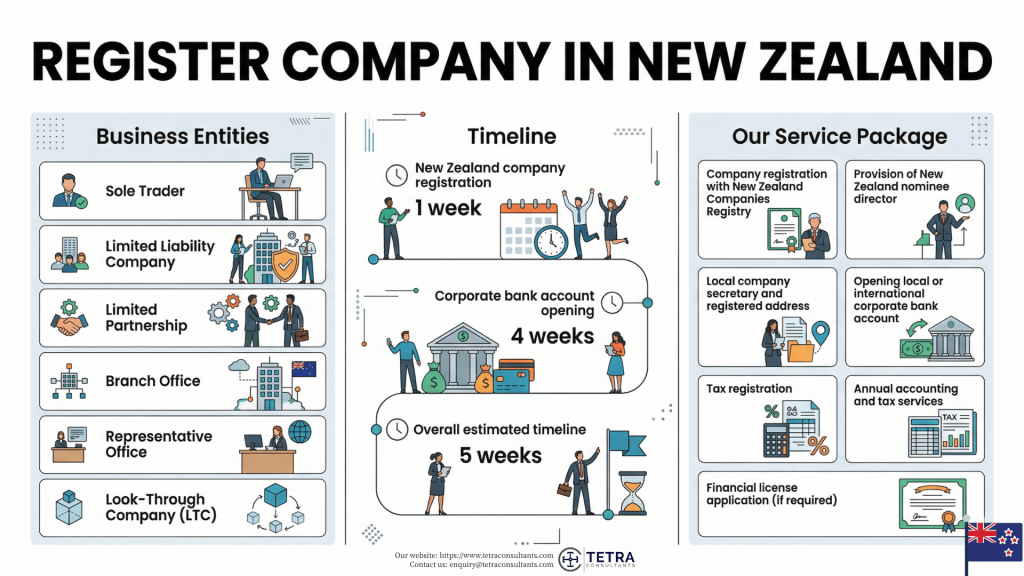
- New Zealand company registration- 1 week
- Corporate bank account opening- 4 weeks
- Overall estimated timeline- 5 weeks
Cost to setup New Zealand company
- For a standard New Zealand Limited Liability Company (LLC), the government registration fee payable to the Companies Office amounts to NZD 118.74 excluding GST. After GST, the amount increases to NZD 136.55.
- You can contact Tetra Consultants, and team will send over a detailed proposal with exact breakdown of the fees for company incorporation, registered agent, registered address, nominee director services, annual renewal, corporate bank account opening and other corporate service provider services.
- At Tetra Consultants, we follow a transparent fee policy, where all costs including government fees, professional service charges, and any third-party expenses are clearly outlined in the engagement letter prior to commencement. This is to ensure that there are no hidden charges and complete cost visibility for our clients.
Latest business landscape in New Zealand in 2026
- New Zealand is also a strategic jurisdiction for international trade because of its participation in major global trade agreements like the Comprehensive and Progressive Agreement for Trans-Pacific Partnership (CPTPP). Furthermore, the New Zealand–European Union Free Trade Agreement (NZ-EU FTA) has recently entered into force, increasing trade opportunities between New Zealand as well as European markets.
- Businesses that are incorporated in New Zealand can benefit from reduced tariffs, better regulatory cooperation, and easy market access across various jurisdictions.
Looking to register company in New Zealand in 2026?
- Tetra Consultants works as your advisor and trusted partner in your business expansion and New Zealand company registration. With our own team of lawyers, licensing specialists, compliance team, and accountants, we tell our clients what they need to know, instead of what they want to hear. Most importantly, we are known for being a one-stop solution for our valued clients. Here is why our clients choose us:
- Tetra Consultants provides end-to-end support for company registration in New Zealand, from handling incorporation to each compliance requirement.
- Our multidisciplinary team of incorporation experts, legal advisors, accountants, and compliance specialists works closely with you.
- With a transparent pricing structure, Tetra Consultants delivers reliable guidance that will help your business to expand into New Zealand with clarity and confidence.
- Contact us to find out more about how to set up business in New Zealand. Our team of experts will revert within the next 24 hours.
FAQs
Can a foreigner register a company in New Zealand in 2026?
What is a Limited Liability Company in New Zealand?
What is a Limited Liability Partnership in New Zealand?
What is a Representative Office in New Zealand?
What is a Sole Trader in New Zealand?
What are the documents required to register company in New Zealand in 2026?
What are the benefits of registering a company in New Zealand in 2026?
What are the common challenges of registering a company in New Zealand in 2026?

Author
Sharma Prabakaran
Sharma Prabakaran is the Head of International Business Advisory at Tetra Consultants. With over 15 years of professional experience, he specialises in international business setup, accounting and tax advisory, and cross-industry SME engagements. His expertise encompasses end-to-end project management, ranging from company incorporation and corporate bank account establishment to ongoing annual accounting and tax compliance.