


Company Registration
1 Week
Local Director?
Yes
Bank Account Opening
4 Weeks
Travel Required?
No
`
Table Of Contents
Australia AFS License (Australian financial services) in 2026
- Australia AFS License (Australian financial service license or AFSL) is mandatory for financial businesses in 2026. At Tetra Consultants, our team of lawyers, licensing specialists, compliance team, and accountants can help to seamlessly obtain the AFS license in Australia.
- This license is issued by ASIC for services such as advice, dealing and custody. Tetra Consultants will help you assess your needs, recommend the type of AFSL (retail/wholesale), and apply for the AFSL for entry into the financial service market in 2026. Our team of lawyers and licensing specialists, compliance team, and accountants will help you obtain an Australian AFS license.
Introduction to Australia AFS License
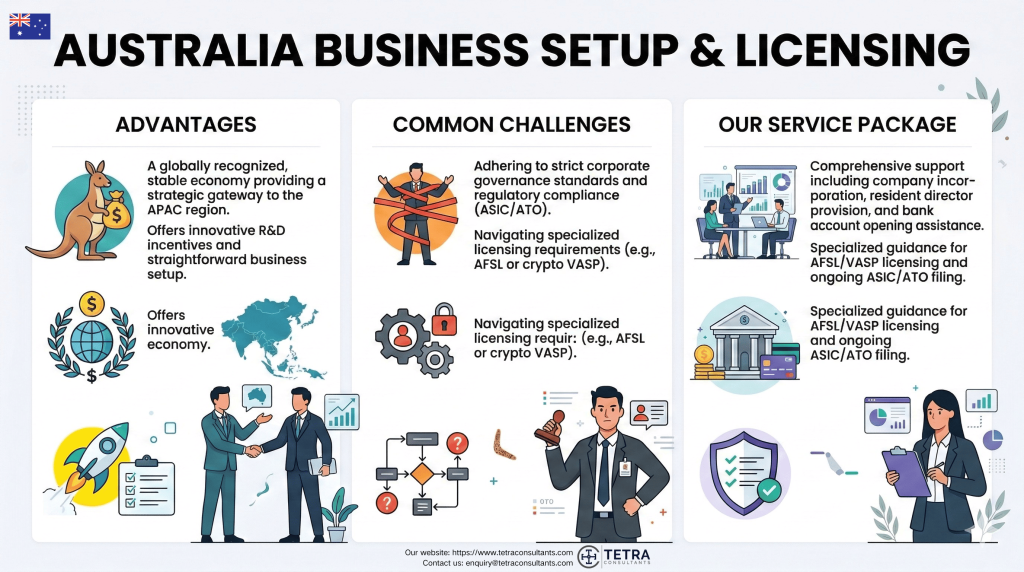
- Achieve unrestricted entry into Australia’s financial markets with an Australian financial service License (AFSL) issued by ASIC, the key license under the Corporations Act 2001, Chapter 7, Section 911A, for the provision of financial advice, dealing, or custody services.
- Specific AFSL types, retail/wholesale, low/high complexity, are designed to suit your business requirements, keeping you compliant with 2025–2026 changes, including the introduction of rules for digital assets. Non-compliance can attract heavy fines.
- Our in‑house team of local lawyers, licensing specialists and compliance professionals ensures everything is in good standing. If required, Tetra Consultants
When will you require an Australia AFS License?
- All businesses conducting the following activities are required to obtain an Australian financial service License to conduct their business in the country:
- Provide or deals in financial products
- Provide consulting services to financial planners
- Markets a financial product
- Manages a registered scheme
- Provide a custodial or depository service
- Organising crowdfunding campaigns
- Other services in the financial service sector
- Businesses may be exempted from obtaining an Australia AFS License. Some of these reasons include the following:
- Business provide its services as a representative of another business that has the Australia AFS License or is exempted from obtaining one.
- Business’s service includes providing general advice (not for the purpose of providing personal financial advice) that is published in the newspaper or periodical and is available to the public
- If you are unsure about whether your business requires an Australian financial service license, we can provide you non-obligatory consultation. Our in-house legal team and licensing specialists will understand your business activity and clarify your queries.
Regulatory Authority for Australia AFS License in 2026?
- Australian Securities and Investments Commission (ASIC) acts as the main regulatory body for the granting of Australian financial service (AFS) Licenses. As per the Corporations Act 2001 (Chapter 7), the base legislation for the granting of AFS Licenses, Section 912A of the Act outlines the “General Obligations,” which require the efficient, honest, and fair delivery of financial service with sufficient resources, competence, and compliance. AFSL holders must maintain AFCA membership for independent dispute resolution. The ASIC regulatory guides outlining the regulations for the granting of AFS Licenses include the following:
- RG 104 outlines the compliance and risk management regulations;
- RG 105 outlines the “Responsible Manager” competence regulations;
- RG 126 outlines the Professional Indemnity (PI) Insurance regulations;
- RG 166 outlines the Net Tangible Assets (NTA) and cash needs regulations; and
- RG 271 outlines the internal dispute resolution (IDR) and external dispute resolution (EDR) for handling client complaints.
FFSP Transitional Relief Extended to March 2027
- Foreign financial service Providers (FFSPs) should note that ASIC has extended the transitional relief until 31 March 2027, instead of March 2026, which means eligible foreign firms can to wholesale clients (e.g., sophisticated investors), without an Australian financial service License.
- This has been made possible by ASIC’s Corporations (Wholesale FFSP Relief) Instrument 2025, which has been made to provide relief to low-risk FFSPs listed on the FFSP Register. In addition to this, the Foreign financial service Providers Bill 2025 has been introduced, which will implement a permanent limited connection exemption based on home jurisdiction standards.
- Tetra Consultants is here to guide international fintech companies and financial advisors through FFSP registration, compliance, and AFSL for 2026-2027 market entry into Australia.
ASIC Intensifies AFSL Enforcement in 2025-2026
- ASIC has stepped up surveillance programs and audits against Australian financial service License (AFSL) holders, examining their organizational competence, Responsible Manager oversight, breach reporting, and financial/human resource adequacy. In the recent past, ASIC has taken actions against AFSL holders in 2025-2026, such as cancellation of AFSLs for non-compliance. This requires strong governance structures under Section 912A of the Corporations Act.
- These surveillance programs and audits are aimed at safeguarding consumers in the wake of growing financial misconduct. ASIC AFSL enforcement, Responsible Manager compliance and AFSL breach reporting are key compliance themes that require immediate adaptation for compliance.
- Tetra Consultants helps in building ASIC compliance systems, conducting RM audits, automating breach reporting, and developing resource adequacy frameworks for your AFSL.
How Long to secure Australia AFS License?
- Businesses can expect to obtain the Australia AFS License within 3 to 4 months from application submission.
- Firstly, the application submitted is reviewed within a period of 6 weeks.
- Following this, ASIC may revert to asking for additional supporting documents which should be submitted within 10 working days.
- ASIC will then review the application and documents for an additional 2 to 3 weeks.
How to Apply for Australia AFS License?
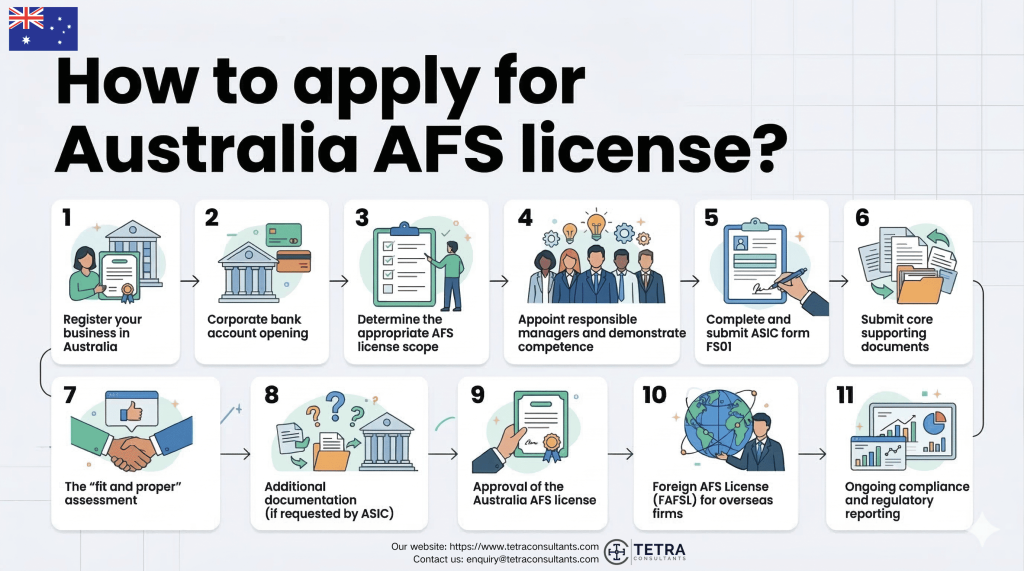
Step 1: Register your business in Australia
- The first step in the process of obtaining an Australian Financial service (AFS) License in 2026 is to register company in Australia. Tetra Consultants’ legal team and licensing specialists will help you with the registration process, drawing up the necessary documentation, and registering your company with the relevant authorities. Our legal and licensing specialists will also provide you with a registered address and a resident company director if needed.
- Our local team in Australia is more than happy to assist with your project. The registration process will take around 1 week, and your company will be able to proceed with the next steps in the licensing process, as per the 2026 ASIC licensing regulations.
Step 2: Corporate bank account opening
- After completing the company registration process, Tetra Consultants will help you with the corporate bank account opening with a bank of your choice. We have access to a wide network of international banks and will help you open a bank account at a bank that meets the necessary requirements.
- The bank account opening process will take around 4 weeks, depending on the bank’s due diligence and compliance procedures.
Step 3: Determine the appropriate AFS license scope
- Before making the application, we will help businesses to establish the scope of the Australian financial service (AFS) License.
- Some of the factors that businesses must consider include:
- Retail Authorisation vs. Wholesale Authorisation
- Retail Authorisation permits the provision of financial services to retail clients. However, the requirements for retail authorisation are stringent, including the requirement for disclosure and the protection of retail clients.
- Wholesale Authorisation permits the provision of financial services only to sophisticated or institutional investors. Wholesale authorisation requires fewer regulatory requirements.
- Retail Authorisation permits the provision of financial services to retail clients. However, the requirements for retail authorisation are stringent, including the requirement for disclosure and the protection of retail clients.
- Niche License Categories
- Another factor that businesses must consider is the type of financial service activity that the business intends to conduct. Some of the examples of financial service activities that businesses may conduct include the provision of financial product advice, dealing in financial products, or making investments.
- Selecting the appropriate authorisation is important for full compliance with ASIC’s licensing requirements.
Step 4: Appoint responsible managers and demonstrate competence
- Next, our lawyers and licensing specialists will appoint a Responsible Manager who will demonstrate competence in one of the five ways set out by ASIC, which are:
- Relevant university degree and financial service experience
- Relevant diploma or advanced diploma and industry experience
- Extensive industry experience of 5 or more years in financial service
- Professional certification or membership with industry experience
- Combination of targeted qualification and relevant work experience
- Also, our appointed responsible managers will demonstrate competence in the following ways:
- Demonstrating that the applicant has the necessary skills, knowledge, and experience to conduct the financial service activities.
Step 5: Complete and submit ASIC form FS01
- Further, the application for the AFS License in 2026 will require the completion and submission of the ASIC Form FS01, which is the official application form for the license.
- Our lawyers and licensing specialists assist with this step of the application process by preparing and reviewing the FS01 form, ensuring that all information provided is accurate, complete, and compliant with ASIC regulations, as providing incorrect or misleading information may be a criminal offence under Australian law.
- The government fees for the application of the AFS license will be determined based on the information provided in the application form.
Step 6: Submit core supporting documents
- After we submit the FS01 application form on your behalf, ASIC will require core supporting documents (e.g., proof of statement) to assess the business’s operational structure and financial capabilities. These will include documents regarding business information, financial resources documents, and organizational competence.
Step 7: The “fit and proper” assessment
- The ASIC will carry out a fit and proper test to assess whether the company’s directors, owners, and responsible managers are “fit and proper” to run a licensed financial service business.
- This will involve an assessment of:
- Integrity and Professional Reputation
- Financial Soundness and Solvency Record
- Criminal and Regulatory Record
- Professional Experience and Qualifications
- The Fit and Proper Test is an important requirement for obtaining an AFS License in 2026.
Step 8: Additional documentation (if requested by ASIC)
- In the course of the review, ASIC may request additional documentation in order to further assess the company’s compliance system. Such as outsourcing documents indicating the outsourced functions of the company, dispute resolution systems documents indicating the company’s procedure for handling customer complaints, and other documents. These documents must be submitted within 10 business days from the date ASIC requests them.
Step 9: Approval of the Australia AFS license
- After the ASIC review of the application and the submission of the additional documents, ASIC may send the applicant a Letter of Offer for the grant of the AFS License. This letter outlines the conditions under which the license will be approved.
- Upon acceptance of the conditions by the applicant and the fulfilment of the conditions, the AFS License will be approved, and the business will be permitted to provide financial service in Australia.
Step 10: Foreign AFS License (FAFSL) for overseas firms
- Financial institutions based overseas and looking to conduct business in Australia may apply for a Foreign AFS License (FAFSL) under the Australian financial regulations.
- ASIC may, under the 2026 regulatory environment, offer relief to overseas firms if the host country is deemed to possess “sufficiently equivalent” regulations and legislation. This will enable overseas financial institutions to conduct and offer financial service in Australia, adhering to local regulations and legislation.
Step 11: Ongoing compliance and regulatory reporting
- Once your company obtains an AFS License, it is essential to ensure ongoing compliance with the regulations to remain in good standing with the ASIC.
- The ongoing compliance cycle for firms under the new 2026 environment may include the following:
- FS70: Submission of the Annual Profit and Loss Statement
- FS71: Submission of the Annual Audit Report
- Maintenance of sufficient financial resources
- Continuous monitoring of Responsible Managers’ competencies
- Reporting of significant breaches or changes to ASIC
- Our team of lawyers and licensing specialists is here to ensure your company maintains ongoing compliance with ASIC and functions smoothly under the new Australian financial regulations 2026.
- Additionally, our accounting and tax team will make sure to comply with all the taxation and accounting requirements.
Our Services
- Tetra Consultants works as your advisor and trusted partner in your business expansion and payment license application. With our own team of lawyers, licensing specialists, compliance team, and accountants, we tell our clients what they need to know, instead of what they want to hear. Most importantly, we are known for being a one-stop solution for our valued clients.
- Additionally, Tetra Consultants also offers advisory services in the areas of management structure and developing a comprehensive business plan, which includes strategy, market and client targeting, customer journey maps, structure, procedures, and AML procedures, among other services. Moreover, with the backing of certified RMs, NTA requirements, and comprehensive PI insurance coverage, Tetra Consultants also offers services in communicating with the relevant authorities on behalf of the clients, acting as a liaison and project manager, and offering tax and legal services, among other services.
- In addition, Tetra Consultants can also assist with attaining other offshore financial licenses depending on your long-term business goals.
- Contact us to find out more about how to secure an Australian AFS License to conduct business in the financial industry in the country. Our team will respond within 24 hours.
FAQs
What is AFS in Australia?
Do I need an AFS License?
What does an AFS License do?
How do you obtain a financial services license in Australia?
How long does it take to obtain an AFS License?
What are the fees for an AFS License?

Author
Sharma Prabakaran
Sharma Prabakaran is the Head of International Business Advisory at Tetra Consultants. With over 15 years of professional experience, he specialises in international business setup, accounting and tax advisory, and cross-industry SME engagements. His expertise encompasses end-to-end project management, ranging from company incorporation and corporate bank account establishment to ongoing annual accounting and tax compliance.