


Company Registration
2 Weeks
Local Director?
No
Bank Account Opening
4 Weeks
Travel Required?
No
Register company in Cayman Islands in 2026
- The Cayman Islands has established itself as one of the world’s leading international financial centres, attracting entrepreneurs, multinational corporations, investment funds, and high-net-worth individuals seeking a stable and business-friendly jurisdiction. Known for its efficient regulatory framework, tax-neutral environment, and strong legal system based on English common law, the jurisdiction continues to be a preferred destination for international business structuring and cross-border investments.
- As a self-governing British Overseas Territory, the Cayman Islands has developed a diversified economy that extends well beyond tourism. Over the years, the government has successfully expanded the financial services sector, transforming the jurisdiction into one of the largest offshore financial centres globally. Today, the Cayman Islands is widely recognized as the fifth-largest banking centre in the world and is home to more than 100,000 registered companies, reflecting its significance in the global business landscape.
- For entrepreneurs and foreign investors looking to register a company in the Cayman Islands, the incorporation process is generally straightforward and supported by a well-established corporate and regulatory framework. Depending on the nature of the business, investors may choose from various legal structures and may need to satisfy specific incorporation, compliance, and licensing requirements before commencing operations.
Key requirements for registering a company in Cayman Islands
- To establish a legally recognized business entity in the Cayman Islands, you must complete the company incorporation process with the Cayman Islands General Registry.
- As part of the incorporation requirements, your company must maintain a registered office address in the Cayman Islands and, where applicable, appoint a company secretary to fulfill statutory obligations.
- Following incorporation, a corporate bank account should be opened to facilitate commercial transactions, manage company finances, and receive payments from clients and business partners.
- Depending on the nature of your intended business activities, obtaining the appropriate financial licenses or regulatory approvals may be necessary before operations can commence.
- To maintain good standing with the relevant authorities, your company should keep accurate accounting records and comply with ongoing annual accounting, reporting, and regulatory requirements.
How to register company in Cayman Islands in 2026?
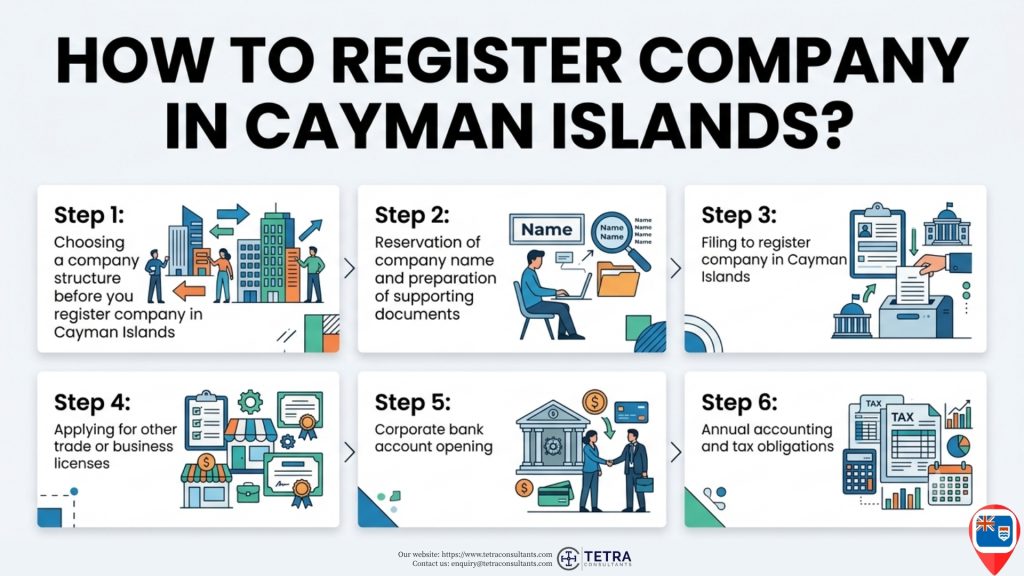
Step 1: Choosing a company structure before you register company in Cayman Islands
- Before proceeding with incorporation, it is important to select a business structure that aligns with your commercial objectives, planned activities, tax considerations, and ownership structure. The Cayman Islands offers several entity types, including an Exempt Company, Limited Liability Company (LLC), Foundation, Segregated Portfolio Company (SPC), and Limited Partnership.
- Among these, the Exempt Company remains the most popular choice for international businesses due to its flexibility, tax-neutral status, and straightforward incorporation process.
- At this stage, you should also determine the appropriate share capital structure, applicable regulatory requirements, and whether your intended business activities require any industry-specific licenses before operations can commence.
Step 2: Reservation of company name and preparation of supporting documents
- Once you have selected the appropriate business structure, the next step involves reserving your preferred company name with the Cayman Islands General Registry.
- Before the incorporation application can be submitted, you must prepare the required KYC documentation relating to the company’s directors, shareholders, and beneficial owners. Typical requirements include identification documents, proof of address, and corporate ownership information where applicable.
- Following the collection of supporting documents, the company’s Memorandum and Articles of Association should be prepared and notarized in accordance with Cayman Islands incorporation requirements.
Step 3: Filing to register company in Cayman Islands
- Under Cayman Islands law, every company is required to maintain a registered agent and registered office within the jurisdiction as part of the incorporation process.
- Once all incorporation documents have been finalized, the registration forms and supporting documentation can be submitted to the General Registry for review and approval.
- Upon successful registration, your company will receive a Cayman Islands company registration number. You should also retain key corporate documents, including the Certificate of Incorporation, Memorandum and Articles of Association, and statutory registers, as these documents will be required for banking, compliance, and future corporate transactions.
Step 4: Applying for other trade or business licenses
- Depending on the nature of your business activities, additional licenses or regulatory approvals may be required before operations can begin.
- For example, businesses operating within regulated sectors such as banking or insurance may need approval from the Cayman Islands Monetary Authority (CIMA). Likewise, if you intend to operate an exempt company while conducting local trade activities, you may need to obtain the appropriate license under the Trade and Business Licensing Law from the Department of Commerce and Investment.
- Before commencing business activities, it is important to confirm whether your proposed operations fall within a regulated sector and determine the relevant licensing requirements.
Step 5: Corporate bank account opening
- After your company has been successfully registered, one of the next important steps is opening a corporate bank account to facilitate business transactions and manage company funds.
- Opening a corporate bank account for a Cayman Islands company requires careful planning because of increasing global compliance standards. As an applicant, you should be prepared for strict AML/CFT (Anti-Money Laundering and Counter Financing of Terrorism) checks, and onboarding timelines may vary depending on your business activities, ownership structure, and overall risk profile.
- Some of the key considerations you should be aware of include:
- Minimum deposit requirements that usually range from US$10,000 to US$50,000.
- Enhanced due diligence requirements if your business operates in higher-risk sectors such as fintech, gaming, or cryptocurrency.
- The need to provide supporting documents, including a Certificate of Good Standing (CGS) and Certificate of Incumbency (COI), where applicable.
- Depending on your banking preferences and operational requirements, you may also consider establishing banking relationships in alternative jurisdictions such as Mauritius, Belize, or Switzerland to complement your Cayman Islands corporate structure.
- When you select a banking solution that aligns with your business model, transaction volumes, and international operations, it can help ensure smooth financial management.
Step 6: Annual accounting and tax obligations
- Following the incorporation of your Cayman Islands company, it is important to ensure that all ongoing compliance, accounting, and reporting obligations are fulfilled in accordance with local regulations.
- Under Cayman Islands regulations, your company will be required to submit an annual return to the Registrar of Companies, providing information such as the names and addresses of members, directors, and details relating to paid-up capital.
- Meeting these ongoing obligations is essential if you wish to continue conducting business legally while maintaining good standing with the relevant authorities. In addition, depending on the nature and size of your operations, you may also need to prepare annual financial statements and maintain accurate accounting records.
- Your company may also be subject to international tax transparency and reporting frameworks, including:
- Foreign Account Tax Compliance Act (FATCA) – If your business has U.S. connections, you may be required to report certain financial account information to the relevant U.S. authorities.
- Common Reporting Standard (CRS)- Depending on the nature of your entity and financial activities, you may be required to comply with the global framework for the automatic exchange of financial information between participating jurisdictions.
- In addition, you should ensure ongoing compliance with AML/CFT regulations, including customer due diligence procedures, record-keeping requirements, and any applicable reporting obligations.
- Understanding and adhering to these local and international compliance requirements can help you reduce regulatory risks and maintain the long-term stability of your Cayman Islands business structure
Timeline to set up a company in Cayman Islands in 2026?
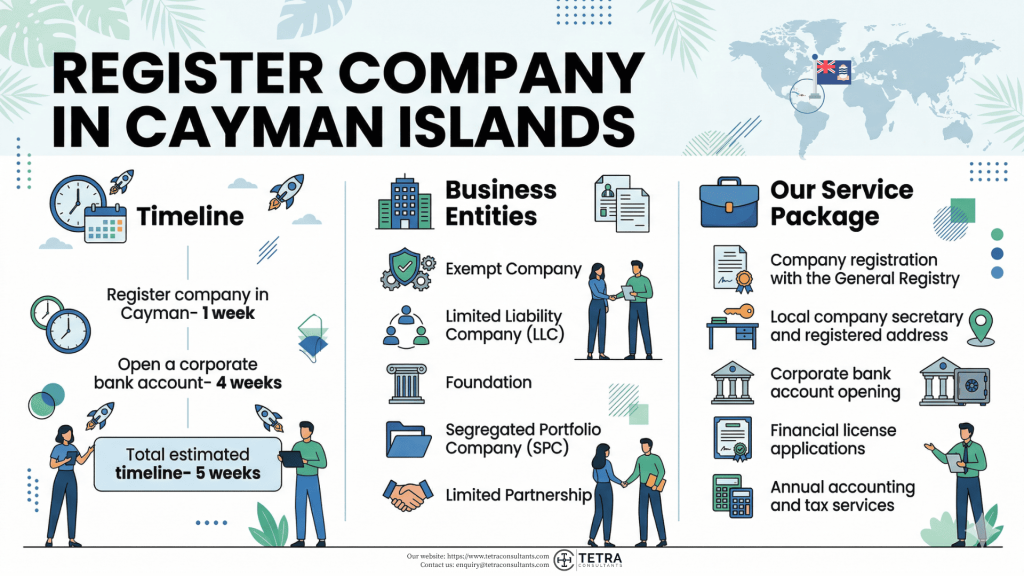
- The timeline to register a company in Cayman Islands is:
- Register company in Cayman- 1 week
- Open a corporate bank account- 4 weeks
- Total estimated timeline- 5 weeks
Cost to register company in Cayman Islands in 2026
- Typical company registration fees for a Cayman Islands Exempt Company range from US$1,300 to US$3,000 depending on the exact services required.
- For a standard Exempt Company with authorized share capital up to US$42,000, the government registration fees around US$853.66.
- For a standard Exempt Company with authorized share capital between US$42,001 to US$820,000, the government registration fee will increase to around US$1,219.51.
- Once contacted, Tetra Consultants will send over a detailed proposal with exact breakdown of the fees for company incorporation, registered agent, registered address, annual renewal, corporate bank account opening and other corporate service provider services.
- At Tetra Consultants, we follow a transparent fee policy, where all costs (including government fees, professional service charges, and any third-party expenses are clearly outlined in the engagement letter prior to commencement. This is to ensure that there are no hidden charges and complete cost visibility for our clients.
Key Legal Framework governing company registration in Cayman Islands (2026)
- Before proceeding with company incorporation, it is important to familiarize yourself with the legal and regulatory framework governing businesses in the Cayman Islands. As a business owner, you should ensure that your company complies with the applicable legislation, particularly as the jurisdiction continues to align with international transparency and compliance standards.
- Some of the key laws that may affect your company structure, operations, and ongoing compliance obligations include:
- Companies Act (2021 Revision) ; If you are planning to incorporate a company in the Cayman Islands, this will be one of the primary legislations governing your business. The Act regulates company formation, administration, corporate governance, and dissolution procedures within the jurisdiction.
- Local Companies Control Law (LCCL): If your business intends to conduct operations locally within the Cayman Islands, you should review the requirements under this law, as it regulates foreign ownership and local business activities.
- International Tax Co-operation (Economic Substance) Act (2018): Depending on the nature of your business activities, you may be required to comply with economic substance requirements. This legislation applies to entities carrying out certain “Relevant Activities” and establishes specific reporting and operational obligations.
- Securities Investment Business Act (SIBA): If you intend to engage in securities investment activities or provide related financial services, your business may fall within the scope of this legislation and could be subject to additional licensing and regulatory requirements.
New economic substance requirements and their impact on companies in Cayman Islands in 2026
- If you are planning to register a company in the Cayman Islands, it is important to understand the Economic Substance requirements introduced under the International Tax Co-operation (Economic Substance) Law 2018. This legislation was developed in line with the OECD’s Forum on Harmful Tax Practices and requires certain entities to demonstrate adequate economic substance within the jurisdiction.
- Under this framework, entities classified as “Relevant Entities” that carry out “Relevant Activities” may be required to satisfy specific economic substance obligations.
- Relevant activities consist of banking, insurance, fund management, financing and leasing, headquarters, shipping, intellectual property, distribution and service centres, and holding company activities.
- If your company engages in any of these activities, you should determine whether it falls within the scope of the Economic Substance regime. The requirements commonly apply to locally incorporated entities, including companies, limited liability companies, limited liability partnerships, and registered foreign companies conducting relevant business activities.
- To comply with the Economic Substance requirements, your entity may be required to:
- Conduct Core Income Generating Activities (CIGAs) within the Cayman Islands.
- Ensure that the business is directed and managed from within the jurisdiction.
- Maintain an adequate physical presence, sufficient operating expenditure, and appropriately qualified personnel in the Cayman Islands.
- In addition to meeting operational requirements, you should also be aware of the annual compliance obligations associated with the regime.
- In terms of compliance filings, your companies are required to submit:
- Economic Substance Notification (ES Notification)– It is filed annually via the General Registry
- Economic Substance Return (ES Return)– A detailed report submitted to the Department for International Tax Co-operation (DITC)
- The Tax Information Authority (TIA) oversees enforcement and may impose penalties or strike off non-compliant entities.
Beneficial Ownership Transparency in Cayman Islands (2024–2026 Update)
- If you are planning to establish or operate a company in the Cayman Islands, it is important to understand the implications of the Beneficial Ownership Transparency Act, 2023. The introduction of this legislation represents a significant development in the Cayman Islands’ regulatory framework, enhancing corporate transparency while continuing to balance privacy and data protection considerations.
- Under this framework, Cayman Islands entities are required to maintain accurate and up-to-date beneficial ownership registers. Although beneficial ownership information was historically subject to a high degree of confidentiality, the jurisdiction is gradually moving towards a more regulated access regime that aligns with evolving international transparency standards.
- To remain compliant with the Act, your company should ensure:
- Identification and verification of all beneficial owners.
- Timely updates whenever ownership information changes.
- Compliance with reporting and disclosure obligations to the relevant competent authorities.
- Failure to meet these requirements may result in penalties, regulatory scrutiny, or other enforcement actions. As part of your ongoing compliance responsibilities, it is important to maintain accurate ownership records and ensure that your corporate structure remains aligned with the Cayman Islands’ beneficial ownership and transparency requirements.
Specialized entity structures in Cayman Islands in 2026
- In addition to traditional company structures, the Cayman Islands offers several advanced entity types that may be suitable if you are pursuing specific investment, asset protection, wealth management, or international expansion objectives.
Segregated Portfolio Company (SPC)
- If your business operates multiple investment strategies, funds, or business divisions, you may consider establishing a Segregated Portfolio Company (SPC). This structure allows assets and liabilities to be separated into distinct portfolios, with each portfolio operating independently. As a result, you can reduce exposure to cross-liability risks between different investment portfolios or business activities.
Foundation Company
- If your objectives involve wealth preservation, succession planning, philanthropy, or innovative digital asset projects, a Foundation Company may be a suitable structure. Widely used for wealth structuring and charitable purposes, Foundation Companies combine certain characteristics of trusts and corporations while offering flexibility, governance control, and asset protection. In recent years, they have also become increasingly popular for Web3 projects, decentralized autonomous organizations (DAOs), and digital asset ventures.
Ready-Made (Shelf) Companies
- If you require a faster market entry or prefer a company with an existing incorporation date, you may consider acquiring a Ready-Made (Shelf) Company. These entities are pre-registered and have not conducted any business operations, allowing you to obtain an already incorporated company without going through the standard registration timeline.
- Before selecting any of these structures, you should carefully assess your business objectives, ownership requirements, regulatory obligations, and long-term expansion plans to determine which entity type best aligns with your intended use and operational strategy.
Looking to register company in Cayman Islands in 2026?
- Tetra Consultants works as your advisor and trusted partner in your business expansion and Cayman Islands company incorporation. With our own team of lawyers, incorporation specialists, compliance team, and accountants, we tell our clients what they need to know, instead of what they want to hear. Most importantly, we are known for being a one-stop solution for our valued clients.
- Contact us to know more about how to register company in Cayman Islands. Our dedicated and experienced team will revert within the next 24 hours and answer all your queries.
FAQ

Author
Sharma Prabakaran
Sharma Prabakaran is the Head of International Business Advisory at Tetra Consultants. With over 15 years of professional experience, he specialises in international business setup, accounting and tax advisory, and cross-industry SME engagements. His expertise encompasses end-to-end project management, ranging from company incorporation and corporate bank account establishment to ongoing annual accounting and tax compliance.