


Company Registration
2 Weeks
Local Director?
No
Bank Account Opening
4 Weeks
Travel Required?
No
Lithuania cryptocurrency license in 2026
- At Tetra Consultants, our team of lawyers, licensing specialists, compliance professionals, and accountants will assist you in seamlessly obtaining a Lithuania Cryptocurrency License in 2026. We provide end-to-end support including Lithuanian company incorporation, preparation and submission of the CASP license application under the EU’s Markets in Crypto-Assets Regulation (MiCAR), regulatory compliance advisory, and post-licensing operational support, ensuring your business meets all requirements set by the Financial Crime Investigation Service (FNTT).
- Under the MiCAR regulatory framework, crypto businesses that are operating in Lithuania should adhere to new licensing, governance and operational requirements to get authorization as a Crypto-Asset Service Provider (CASP). The framework harmonizes crypto regulation across the European Union and will become fully enforceable by 1 January 2026.
- With the assistance of our team at Tetra Consultants now you can easily get a Lithuania cryptocurrency license in 2026, our team ensures that the license application adhere to EU MiCAR framework, ensuring that there are no delays.
Lithuania cryptocurrency license overview MiCA framework (2026)
- Lithuania is among the best jurisdictions for crypto businesses with a fast, cost-effective, and transparent legal framework that is compliant with the European Union’s MiCA legislation. To apply for crypto license in Lithuania, a minimum share capital of €125,000 and a local AML officer/MLRO are required. This license also allows for crypto-to-fiat exchange, custodial wallet services, ICOs, and staking activities.
- Licensed businesses enjoy a tax-friendly regime with 15% corporate tax, no VAT on crypto exchanges, access to the European market and non-residents can be accepted as directors. The FNTT (Financial Crime Investigation Service of Lithuania) oversees compliance to AML/CTF regulations and issues licenses.
| Aspect | Details |
| Jurisdiction | Lithuania – EU member with MiCA-compliant CASP framework |
| Minimum Share Capital | €125,000 (can be deposited in cash or crypto; appraised value accepted) |
| Local Requirement | Appointment of a local AML officer/MLRO |
| Permitted Activities | Crypto-to-fiat exchange, custodial wallet services, ICOs, staking |
| Corporate Tax | 15% |
| VAT | No VAT on crypto exchanges |
| Directors | Non-residents can act as directors |
| Regulator | Financial Crime Investigation Service (FNTT) |
| AML/CTF Compliance | Strict oversight by FNTT |
| Timeline | 10-11 weeks (company registration and bank account in 6 weeks, and 4-5 weeks for Lithuanian cryptocurrency license) |
MiCA transition timeline and 2026 deadline
- The European Union’s markets in Crypto-Assets Regulation (MiCAR) introduces a unified regulatory framework for crypto businesses across all the EU member states. The existing crypto businesses must transition to the CASP licensing framework before 1 January 2026.
- The timeline milestones include:
- 2024- Initial implementation of MiCAR provisions across EU jurisdictions
- 2025- Transition period for existing Virtual Asset Service Providers (VASPs)
- 1 January 2026- Mandatory compliance deadlines for all CASPs operating in the EU
What are the regulatory requirements for obtaining a Lithuania cryptocurrency license in 2026?
- Entities applying for a Lithuania cryptocurrency license (CASP authorization under MiCAR) must comply with the following key requirements:
- Minimum share capital- Maintain a registered share capital of at least €125,000, as introduced under the 2022 amendment to the Law on the Prevention of Money Laundering and Terrorist Financing (Law No. VIII-275, Amendment XIV-1374).
- Local AML Officer / MLRO- Appoint a qualified AML Officer or Money Laundering Reporting Officer (MLRO) who is a permanent tax resident of Lithuania.
- Substantial local operations- The company must conduct genuine business activities in Lithuania and cannot operate solely for foreign markets without meaningful local presence.
- Shareholder requirement- The company must have at least one shareholder, who can be an individual or a legal entity, with no nationality restrictions.
- Director requirement- The company must appoint at least one director (the shareholder can also act as the director), with no residency or citizenship restrictions.
- CASPs may also be required to conduct a technical ICT audit of their blockchain infrastructure in order to ensure operational resilience, cybersecurity, and data integrity in compliance with DORA regulations.
What are the types of Lithuania cryptocurrency licenses in 2026?
In Lithuania it is possible to obtain two types of licenses for working with virtual currency:
Cryptocurrency exchange license
- A cryptocurrency exchange license authorizes a company (or business unit) to exchange cryptocurrency for fiat and crypto‑to‑crypto, for a commission.
- This is an official license that covers the services of exchanging real money for cryptographic currency and vice versa, as well as crypto for crypto. In addition, this license in Lithuania is issued for the activities of a cryptocurrency exchange.
Cryptocurrency wallet and custodian services license
- This is a license required for those who provide cryptocurrency storage wallets to have. The cryptocurrency wallet service provider creates encrypted keys for customers who can use the service to store, exchange and transfer virtual money.
- A company can hold either license or both the cryptocurrency exchange and wallet licenses. Whichever license you are interested in, Tetra Consultants’ team of experienced professionals will help and guide you in applying for any of the aforementioned Lithuania cryptocurrency licenses: cryptocurrency exchange license and/or cryptocurrency wallet and custodian services license.
CASP license classification under MiCAR
- Crypto licenses under the MiCAR framework are generally categorized into three operational classes:
- Class 1- Order execution and crypto brokerage services
- Class 2- Custody and wallet services for client assets
- Class 3- Crypto trading platforms and exchange operations
- The required compliance standards increase depending on the complexity and risk of services offered.
- The application for a cryptocurrency license is considered by the Bank of Lithuania, regulated by the Financial Crimes Investigation Service (FNTT), and issued by the Business Register. FNTT is an independent structural unit of the Lithuanian Police and Border Police Department.
- Crypto companies operating in Lithuania must also register beneficial ownership and shareholder information with the JADIS (Register of Legal Entities Participants Information System) and the JANGIS (Beneficial Owner Information System). These registries improve transparency and help regulators monitor corporate ownership structures.
- The Financial Crimes Investigation Service’s (FNTT) objective is to preserve the public financial system by investigating criminal activities and other breaches of the law.
Which law governs the licensing of cryptocurrency businesses in Lithuania in 2026?
- A Lithuanian company may apply for a license for cryptographic activities under the Order on instructions to deposit for virtual currency money monitors and operators for virtual currency exchanges for the prevention of money laundering and/or financing. The purpose of the Law is to prevent the use of Lithuania’s financial system and economic space for money laundering and terrorist financing by increasing the reliability and transparency of the business environment.
- This law regulates the principles of assessment, management, and hedging of risks related to money laundering and the financing of terrorism, supervision of responsible persons, obligations arising from the collection and publication of data of beneficial owners, obligations related to the collection and publication of data on the holders of payment accounts, liability of the persons liable in case of violation of the requirements arising from the legislation.
Who Should Apply for a Lithuania cryptocurrency license in 2026?
- Entrepreneurs and startups that wish to formally register their activities as a cryptocurrency exchange or wallet service in the EU.
- Companies that want to provide Lithuanian financial services license such as crypto-to-fiat exchange, crypto-to-crypto, custodial wallet services, ICOs and staking activities.
- Companies that can satisfy the post-MiCAR minimum registered share capital requirement of €125,000.
- Businesses that are prepared to implement strong AML/KYC/CTF processes including appointing a local AML officer who is a resident taxpayer in Lithuania.
- Companies which can set up the necessary local activity in Lithuania, without requiring local office or local director.
- International corporations interested in accessing the European Economic Area (EEA) and benefits of the European Union’s MiCAR.
- Businesses that are prepared to keep positive reputations with shareholders, beneficial owners, and executives without criminal records.
- Businesses willing to comply with mandatory reports to the Financial Crime Investigation Service (FNTT), including transaction value reports and suspicious activity reports.
- Companies that do not want an undue financial audit but are open to periodic regulatory audit assessments.
Token classification under the Lithuanian law in 2026
- Crypto assets in Lithuania may be categorized on the basis of the Lithuanian Civil Code (Articles 1.101–1.108) and MiCAR provisions.
- The major classifications include:
- Asset-referenced tokens (ART)- Tokens that reference various assets like the commodities, fiat currencies, and cryptocurrencies.
- E-money tokens (EMT)- Tokens that maintain a stable value by referencing a single fiat currency.
- Utility tokens– These tokens offer access to a service or product within a blockchain ecosystem. The proper classification of a token determines the applicable regulatory obligations under the MiCAR.
What are the benefits of obtaining a Lithuania cryptocurrency license in 2026?
Our team has summarized the benefits of setting up a cryptocurrency business in Lithuania as and getting the respective licenses:
- Costs are lower than in other major European countries.
- The licensing process is faster and can take only a few weeks.
- There is an opportunity to register a Lithuanian company remotely.
- The country has a wide range of tax incentives and low corporation tax rates.
- Minimum procedural requirements and bureaucratic burden of the process.
- Getting a license from Lithuania does not have to be complicated or time-consuming Tetra Consultants can get it completed remotely from anywhere globally.
- Only requires one member of staff to act as the director. It is not mandatory for a company’s director to have Lithuanian citizenship.
- A company’s KYC/AML officers do not need to go through any type of interview with Lithuanian authorities to get assessed if their qualification/experience is suitable for the respective company. It is a company’s CEO who shall seek that KYC/AML officers and other employees hold sufficient experience.
What are the activities allowed under a Lithuania cryptocurrency license in 2026?
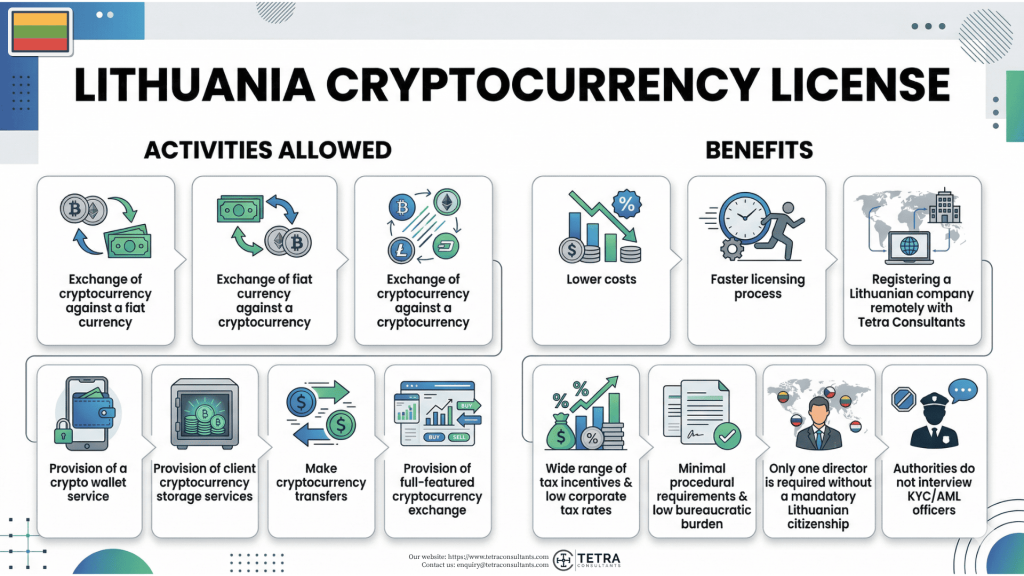
Obtaining any type of Lithuania cryptocurrency license enables an applicant to provide the following type of services:
- Exchange of cryptocurrency against a fiat currency
- Exchange of fiat currency against a cryptocurrency
- Exchange of cryptocurrency against a cryptocurrency
- Provision of a crypto wallet service
- Provision of client cryptocurrency storage services
- Make cryptocurrency transfers
- Provision of full-featured cryptocurrency exchange
Eligibility Criteria for a Lithuania cryptocurrency license in 2026
- Register a legal entity in Lithuania in the form of a limited liability company.
- Have at least one shareholder and one director (can be the same person).
- Maintain a minimum registered share capital of €125,000 (or between €50,000 to €150,000 post-MiCA, depending on the business model and risk profile).
- Appoint an exclusive AML Officer who is a permanent tax resident of Lithuania.
- Ensure all board members, shareholders, and beneficial owners have a clean criminal record and impeccable business reputation.
- Prepare and implement AML, KYC, and CFT policies and procedures.
- Provide a physical or virtual office in Lithuania.
- Submit a detailed business plan including operational, risk management, and financial projections.
- Comply with reporting obligations to the Financial Crime Investigation Service (FNTT).
- No mandatory financial audit but subject to periodic regulatory assessments.
Digital operational resilience act (DORA) compliance
- Crypto-Asset Service Providers that are operating within the European Union must comply with the Digital Operational Resilience Act (DORA), which establishes cybersecurity and operational resilience standards for financial institutions.
- Key requirements include:
- ICT risk management framework
- Incident reporting procedures
- Operational resilience testing
- Cybersecurity audits of Distributed Ledger Technology (DLT) infrastructure
- DORA compliance ensures that CASPs are maintaining strong security and operational continuity within the EU financial system.
What is the procedure to obtain a Lithuania cryptocurrency license in 2026?
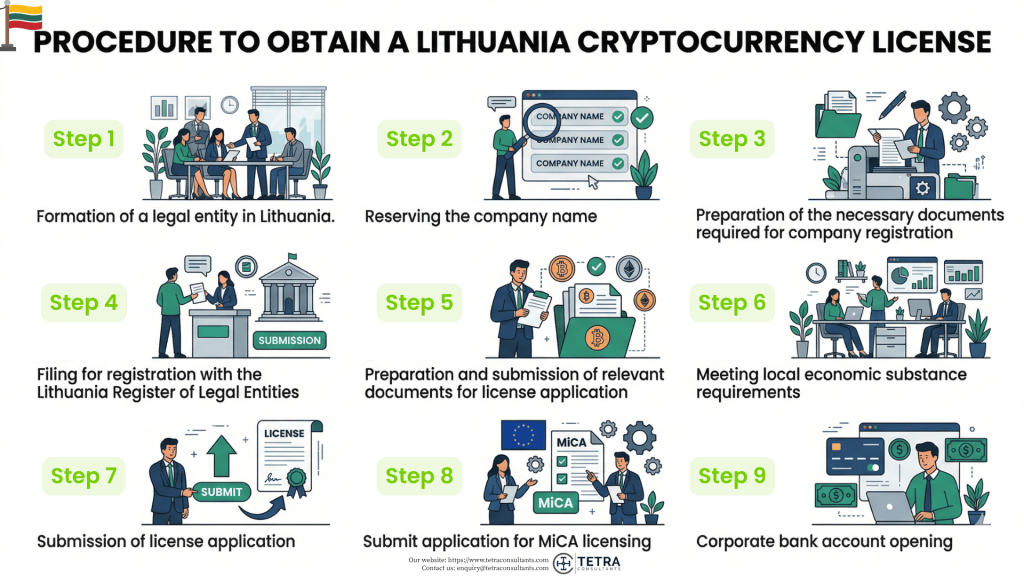
Step 1: Formation of a legal entity in Lithuania
- To start with the procedure, a Lithuanian legal entity must be established, typically in the form of a private Limited Liability Company (UAB).
- Our lawyers and licensing specialists will first assess your business objectives and recommend the most suitable corporate structure. Our team will also conduct internal due diligence and prepare the required documentation upon receiving the KYC documents of directors and shareholders.
Step 2: Reserving the company name
- Once the structure is confirmed, our team of lawyers and licensing specialists will reserve your preferred company name with the Lithuania Register of Legal Entities through the required application.
- The approved company name can generally be reserved for up to six months.
Step 3: Preparation of the necessary documents required for company registration
- Tetra Consultants’ lawyers and licensing specialists will prepare the required incorporation documents, including:
- Articles of Association
- Company constitution
- Business plan
- Director and shareholder details
- Our team will also arrange document translation, notarization, and registered office setup in Lithuania where required.
Step 4: Filing for registration with the Lithuania Register of Legal Entities
- Once the documents are finalized, our legal team and licensing specialists will submit the incorporation application to the Lithuania Register of Legal Entities for approval.
- After successful registration, the Certificate of Incorporation and corporate documents will be issued and delivered to the client.
Step 5: Preparation and submission of relevant documents for license application
- After company incorporation, our team of lawyers and licensing specialists will prepare the cryptocurrency license (CASP) application.
- Clients will be required to provide:
- Passports and proof of address of directors and shareholders
- CVs of key personnel
- Criminal record certificates
- Corporate documents of the company
- Our team will also prepare the AML/CFT policies, internal compliance procedures, and risk management framework required by the regulator.
Step 6: Meeting local economic substance requirements
- To meet regulatory requirements, the company must appoint a local AML Officer / MLRO.
- Tetra Consultants will assist with recruitment and onboarding of qualified local compliance personnel where required.
- In addition, Tetra Consultants will ensure that employment structures and operational arrangements comply with local regulatory and reporting requirements.
Step 7: Submission of license application
- Once all documents are prepared, our lawyers and licensing specialists will submit the cryptocurrency license application to the regulator (FNTT).
- If required, our team will prepare you for regulatory interviews and respond to additional queries from the authority during the review process.
Step 8: Submit application for MiCA licensing
- Following the national licensing process, our team will assist with submitting the Crypto-Asset Service Provider (CASP) authorization under the EU Markets in Crypto-Assets Regulation (MiCAR).
Step 9: Corporate bank account opening
- To finalize the licensing process, the company must open a corporate bank account or EMI account in Lithuania to deposit the required share capital.
- Tetra Consultants will assist with corporate bank account opening with reputable financial institutions and ensure the €125,000 capital requirement is properly deposited to support the license approval.
Comparison of Lithuania cryptocurrency license with Other Jurisdictions
Minimum share capital:
- With a minimum share capital of €125,000, Lithuania has a similar minimum share capital to Estonia (approximately €125,000), a higher minimum share capital than Poland (~€50,000), and has a minimum share capital similar to the Czech Republic (€150,000).
Regulatory landscape:
- Lithuania has already aligned with the EU’s MiCA regulation ahead of time and is offering a transparent, crypto-friendly environment, whereas, Poland and the Czech Republic have adapted or are adapting to MiCA with less regulatory maturity.
AML compliance:
- Lithuania has very strict AML requirements, such as the requirement for a resident AML officer, which go beyond the less explicit requirements in Poland, and are more strict than possible regulations in both Estonia and the Czech Republic.
Taxation:
- Lithuania also has a very attractive corporate tax of 15%, lower than the 20% flat rate from Estonia, and similar to Poland with 19%, and there is no VAT for crypto transactions.
Scope of services:
- Lithuania has a wide scope of crypto activities, including staking and ICOs, generally similar to Estonia and Czech Republic, while Poland may present restrictions on types of certain services.
Banking access and management:
- Lithuania has more straightforward access to European EMIs and also allows foreign non-resident directors, which could be more flexible than Poland and some other territories that require local directors or more comprehensive banking relations.
Market access and reputation:
- Lithuania has full EU and EEA passporting, able to be accessed under MiCA, and offers the same features as Estonia and the Czech Republic, but a simpler and more credible regulatory environment (easier than Poland).
What is the tax implication of starting a cryptocurrency business and obtaining a Lithuania cryptocurrency license in 2026?
The taxation of cryptocurrency companies in Lithuania is similar to that of ordinary companies registered in Lithuania. Some key points to note are:
- As with ordinary UABs in Lithuania, a cryptocurrency company must pay a corporate tax rate of 15% on profits. A “micro company” with under 10 employees with a gross annual income of €300,000 is taxed at a reduced corporate tax rate of between 0% and 5%.
- Cryptocurrency exchange services are not liable for VAT; however, services that are provided and accounts that are paid in cryptocurrencies are subject to normal VAT.
How much time does it take to obtain a Lithuania cryptocurrency license in 2026?
- The standard time taken by Tetra Consultants to register a company in Lithuania and open a corporate account is typically around 6 weeks. While the approval of the application for a Lithuania cryptocurrency license by the Lithuanian Financial Authority takes approximately 4 to 5 weeks (depending on the sufficiency of the application and ancillary documents provided). However, the MiCA application could take up to 1 year to get reviewed, based on the speed of the regulators.
- Prior to the start of the engagement, Tetra Consultants will send you a project plan with the timelines stipulated for company registration, preparation of documents as well as license application. This is to ensure that all parties are clear on the upcoming project.
Our services
- Tetra Consultants works as your advisor and trusted partner in your business expansion and cryptocurrency license application. With our own team of lawyers, licensing specialists, compliance team, and accountants, we tell our clients what they need to know, instead of what they want to hear. Most importantly, we are known for being a one-stop solution for our valued clients.
- Contact us to find out more about how to get a Lithuania cryptocurrency license. Our team of experts will revert within the next 24 hours.
FAQs

Author
Sharma Prabakaran
Sharma Prabakaran is the Head of International Business Advisory at Tetra Consultants. With over 15 years of professional experience, he specialises in international business setup, accounting and tax advisory, and cross-industry SME engagements. His expertise encompasses end-to-end project management, ranging from company incorporation and corporate bank account establishment to ongoing annual accounting and tax compliance.