


Company Registration
1 Week
Local Director?
Yes
Bank Account Opening
4 Weeks
Travel Required?
No
New Zealand FMA license
- The FMA License will allow your financial services firm to officially enter and operate within a highly respected financial hub. Receiving a NZ FMA License means you are now regulated by the Financial Markets Authority, which requires your company to comply with a number of requirements related to how you conduct business, provide information to customers, and manage risk, in addition to providing investors with confidence to invest in a business operating within a stable market environment.
- Since its formation in 2011, the FMA has granted approximately 1,500 licenses, with the latest reported compliance rates of over 95% at the time of an audit in 2025. This demonstrates the strength of the regulatory framework in New Zealand to reduce instances of financial crime. Recent statistics show a 20% increase in the approvals of FMA Licenses to fintech and/or investment business in the previous year, and this indicates a growing interest worldwide for this type of service.
- To embark on this journey, businesses often choose to register company in New Zealand, and take advantage of New Zealand’s business-friendly environment, you will likely be interested in incorporating FMA regulated company New Zealand to access its tax treaties.
- At Tetra Consultants, using our extensive experience, we will assist you throughout the FMA licensing process by simplifying the process so you can establish your business for long-term success in the growing financial services industry within New Zealand.
Benefits of the New Zealand FMA license
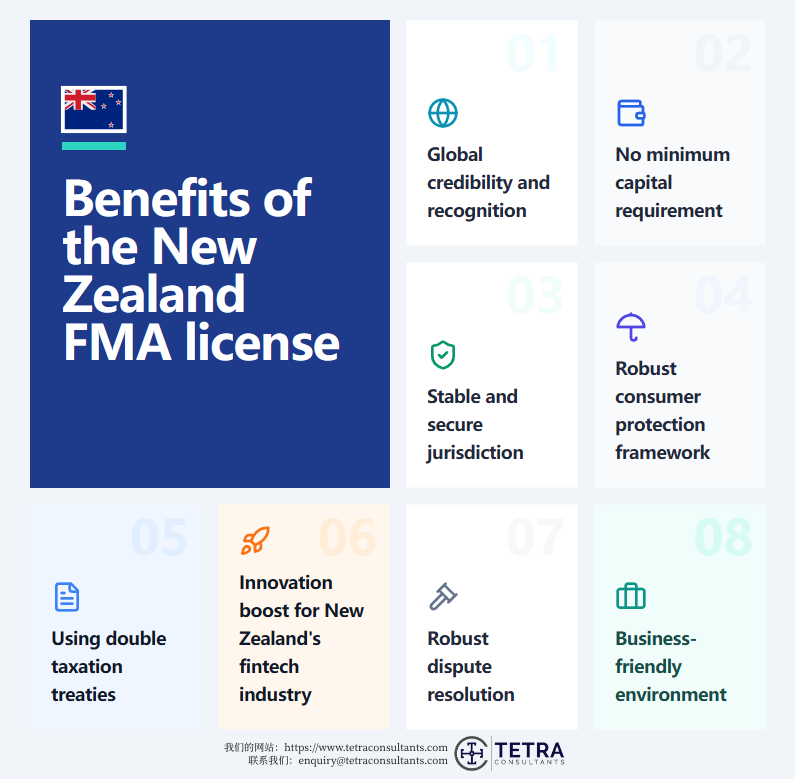
Global credibility and recognition
- Licensing by New Zealand’s Financial Markets Authority (FMA) establishes a high level of compliance with regulations, enabling international clients and partners to have confidence in New Zealand business as well as their operating environment. In addition, New Zealand has been identified as a leading ‘onshore’ jurisdiction, thereby avoiding the stigma of being on a blacklist and potential tax problems resulting from OECD regulatory expectations. As a result, business operating within a New Zealand FMA License are well-positioned to take advantage of market access and investor confidence while placing themselves as competitive players within the global finance community.
No minimum capital requirement
- While there is no fixed statutory minimum capital requirement, the FMA expects licensed entities to maintain adequate financial resources that are proportionate to the nature, scale, and complexity of their activities. This approach provides flexibility for start-ups and small to medium-sized enterprises, while ensuring financial resilience and responsible risk management. Businesses are able to allocate capital efficiently to support growth and operations, rather than meeting rigid capital thresholds, while still adhering to the FMA’s expectations on sound financial management, conduct, and disclosure standards.
Stable and secure jurisdiction
- Through the Westminster system, New Zealand has ensured political stability, while New Zealand’s geography provides security against the unstable nature of the world market today. New Zealand has a highly developed and advanced infrastructure, and banking and professional services within New Zealand offer ongoing operational stability for companies operating under an FMA license. Additionally, New Zealanders benefit from efficient air travel and high-speed digital connections, making it easier to conduct international business.
Robust consumer protection framework
- New Zealand’s FMA supervises the conduct of licensed financial services providers and ensures that consumers have access to fair conduct provisions, as well as anti-money laundering (AML) & counter-financing of terrorism (CFT) programs, and transparent disclosures. By enforcing these consumer protection measures under the Financial Markets Conduct Act, the FMA reduces the risk of any wrongdoing and builds loyalty with clients through required adherence to fair dealing. The recent audits of licensees have demonstrated high levels of compliance achieved.
Using double taxation treaties
- The Double Taxation Treaty (DTT) Network is one of New Zealand’s greatest international assets. New Zealand has signed DTTs with over 40 countries, which allow businesses that hold a license in New Zealand to reduce the amount of withholding tax that they have to pay on earnings (dividends, interest & royalties) that arise from doing business overseas. Businesses will be able to maximize their profits and minimize the tax implications associated with their international operations.
Innovation boost for New Zealand’s fintech industry
- The Financial Markets Authority (FMA) promotes innovation and growth within the Fintech sector. The FMA’s regulatory framework incorporates regulatory sandboxes and innovation hubs, which allow businesses to experiment with new financial products under supervision. This allows these businesses to enter the market more quickly and develop groundbreaking solutions for their customers, such as digital currencies (cryptocurrencies), making them trailblazers in technology-based finance.
Robust dispute resolution
- The independence of New Zealand’s judiciary and the existence of specialized Financial Dispute Resolution services mean that businesses have reliable options when resolving disputes. NZ FMA licensed entities benefit from being able to resolve disputes through an efficient and fair process of arbitration and mediation, which reduces the risk associated with litigation. The willingness of FMA license New Zealand businesses to use such mechanisms will provide greater assurance to stakeholders and the business community in New Zealand and contribute to sustainable business relationships.
Business-friendly environment
- The ease of obtaining a license to conduct business as a Fintech entity in New Zealand contributes to growth within the Fintech and investment industries. DTTs facilitate cross-border operations and reduce withholding taxes when New Zealand businesses operate overseas. Consequently, businesses can register as FMA regulated company New Zealand, take advantage of the benefits of operating from a business-friendly jurisdiction, and benefit from the progressive nature of New Zealand’s economy and regulatory framework.
Types of the New Zealand FMA license
The Financial Markets Authority (FMA), a governmental authority in New Zealand that oversees all financial markets, has established 9 categories of licenses available under the Financial Markets Conduct Act 2013. The licenses are as follows:
- Manager of a registered scheme: Responsible for managing the investments and administration of pooled funds from investors.
- Discretionary Investment Management Services (DIMS) provider: Responsible for making investment decisions on behalf of clients in their portfolios.
- Derivatives issuer: Responsible for providing and issuing derivatives to retail clients.
- Provider of regulated financial advice (financial adviser license): Responsible for providing advice about financial products, based on full Financial Advice Provider (FAP) licenses in one of three classes (1, 2, or 3), based on scale.
- Platform providers: Responsible for providing an investment platform for retail access.
- Broker/Dealer: Responsible for executing trades in financial products.
- Crowdfunding service providers: Responsible for facilitating crowdfunding and peer-to-peer lending (equity or debt) offers.
- Peer-to-peer lending service providers: Responsible for matching borrowers with lenders online.
- Administrators of financial (index) benchmarks: Responsible for overseeing indices that are used in financial products.
Timeline for the New Zealand FMA license
- On average, obtaining an FMA market services license in New Zealand requires on average 3-5 months from submission of your completed application, assuming that a pre-planned structure is followed. Tetra Consultants provides assistance to clients at every stage to ensure completeness, accuracy, and alignment with FMA expectations.
- The first step is registering on the Financial Service Providers Register (FSPR) and then completing the FMA’s comprehensive review under the Financial Markets Conduct Act of 2013. This review assesses governance and operational structures, compliance and risk management practices, fair conduct programs, as well as the fitness and propriety status of directors and shareholders. It is possible that the FMA may provide questions for follow-up during its review.
- Using early regulatory mapping as well as a well-structured process for documentation, followed by frequent communications with the FMA throughout the licensing process, Tetra Consultants has been able to reduce processing time and increase the likelihood that the application meets the shorter processing timelines of 3-5 months.
Regulatory authority of the New Zealand FMA license
- The Financial Markets Authority (FMA) is the primary regulator of FMA license New Zealand issuance and supervision in New Zealand and is governed by the Financial Markets Conduct Act 2013 (FMC Act), Financial Service Providers (Registration and Dispute Resolution) Act 2008, and the Anti-Money Laundering and Countering Financing of Terrorism Act 2009. The Financial Markets Authority was established as a separate Crown entity in 2011.
- The Financial Markets Authority is responsible for licensing providers of financial advice, market services (i.e., derivatives issuers and crowdfunding services), and promoting compliance through supervision, audits, and investigations as well as penalties to protect investors and foster transparency in the financial market.
- The Reserve Bank of New Zealand is the other primary regulator of the banking sector, while the Financial Markets Authority is a co-regulator of the banking and financial services sectors, arising from their respective regulatory Authorities and the shared area of regulation. Additionally, the Companies Office is responsible for the registration of New Zealand companies, which is an important part of the licensing process.
Who need to apply for the New Zealand FMA license
- In New Zealand, the Financial Markets Authority (FMA) requires that any person or business who is currently or intends to provide a regulated financial service or activity obtain a license from the FMA to ensure compliance with New Zealand law. The following is a list of services and activities for which an FMA license is required:
- To act as manager of a registered managed investment scheme
- To act as an independent trustee of a restricted scheme
- To offer Discretionary Investment Management Services (DIMS)
- To issue derivatives to investors
- To provide certain intermediary services, such as crowdfunding and peer-to-peer lending platforms
- To provide financial advice services as a license Financial Advice Provider (FAP)
- To operate a financial product market
- To act as supervisor for offers made in accordance with the Financial Markets Conduct Act
- To act as administrator for a financial benchmark
- If your business provides any services or products within these categories, it is essential that you are licensed to do so by the FMA prior to making them available to clients in New Zealand.
Steps for obtaining the New Zealand FMA license
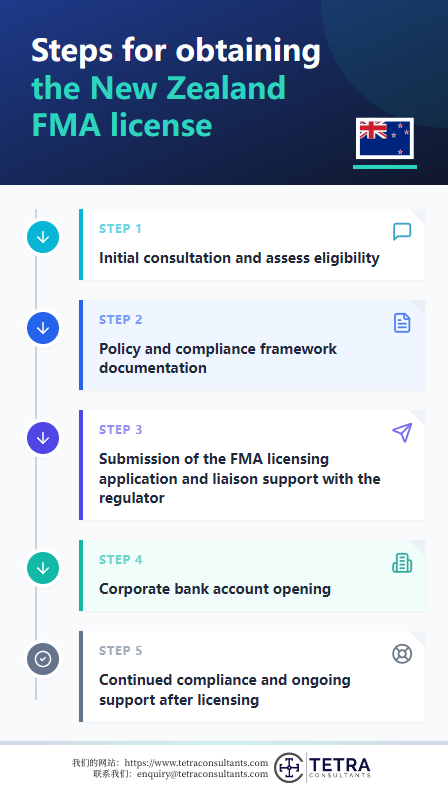
- In order for clients to apply for a license from the Financial Markets Authority license NZ, clients must first either have been registered or currently be in the process of being registered with the Financial Service Provider Registration at the Financial Service Provider Register (FSPR), where registration on the FSPR is a required condition for obtaining an FMA license confirming that the organization is authorized to operate and provide financial services within New Zealand.
Step 1: Initial consultation and assess eligibility
- We will conduct a comprehensive initial consultation to assess your business model against the requirements of the Financial Markets Conduct Act and the licensing obligations imposed by the Financial Markets Authority (FMA). Our team will determine the most appropriate FMA licensing category for your activities, evaluate your readiness for registration on the Financial Service Providers Register (FSPR), and identify any regulatory or structural gaps. Based on this assessment, we will prepare a clear eligibility and readiness report outlining key compliance risks and a step-by-step roadmap to support a successful FMA license application.
Step 2: Policy and compliance framework documentation
- Further, all necessary regulatory documents to be prepared for submission (including but not limited to business plan, risk management programme, AML/CFT programme, compliance manual, and financial forecasts and client disclosures) with regard to FMA expectations, in order to assure operational readiness and establish a smooth and successful process of assessing for a license to operate successfully.
Step 3: Submission of the FMA licensing application and liaison support with the regulator
- We have a complete process for filing a licensing application via the FMA Portal, along with payment of fee(s) and documentation for submission to the regulator. Our role as your regulatory liaison includes answering any questions from the FMA and responding to any requests for clarification from them. We will also proactively reach out to the regulator and work collaboratively with them to resolve any issues and expedite the approval of your license.
Step 4: Corporate bank account opening
- Once your license has been approved, we can help you with a corporate bank account opening with a well-known bank in New Zealand. This includes helping you to complete all documentation required by both KYC (Know Your Client) and due diligence that will be required by your license approval. We will also ensure that the banking format used corresponds with the activities permitted under your license and any future prudential or operational requirements imposed by the FMA.
Step 5: Continued compliance and ongoing support after licensing
- Ongoing compliance monitoring, internal reviews, and the preparation of any required annual reports to the FMA will be provided by us following the completion of your licensing process. As rules change or become clarified over time, we will notify you of how any changes may affect your business and assist you with finding additional resources or information that will help to keep you in compliance with the terms and conditions of your license.
Requirements for the New Zealand FMA License
- Before applying for a license from the Financial Markets Authority (FMA), an individual or company must be either registered, or in the process of registering, as a Financial Service Provider (FSP) on the Financial Service Providers Register (FSPR).
- When assessing an FMA license application, the regulator evaluates whether the applicant has appropriate governance arrangements, risk management and compliance systems, fair conduct frameworks, and operational capability proportionate to the financial services being provided. The FMA also conducts fit and proper assessments on directors and senior management, focusing on competence, integrity, financial soundness, and regulatory history.
- Depending on the license type, controlling shareholders may also be subject to fit and proper requirements, and prior approval may be required for material changes in ownership. Applicants must establish and maintain an Anti-Money Laundering and Countering Financing of Terrorism (AML/CFT) programme where applicable, in accordance with the AML/CFT Act 2009.
- Following licensing, entities must continue to meet ongoing obligations, including maintaining fair treatment of clients, notifying the FMA of material changes to the business, and ensuring key personnel remain fit and proper.
Cost for obtaining the New Zealand FMA license
- The cost for a New Zealand Financial Markets Authority (FMA) license varies based on the type and complexity of the financial services sought. Important elements influencing this include the type of license desired, whether cross-border services will be offered, and whether or not the business will have to comply with the Anti-Money Laundering and Countering Financing of Terrorism Act 2009 and FMA guidance.
- Most costs incurred in obtaining an FMA license will relate to gathering documents to submit with your license application and preparing your regulatory documentation such as governance arrangements, business plan, risk management framework, an AML/CFT risk assessment, a program to comply with AML/CFT, your financial projections and client disclosure material. How much needs to be created and the breadth and depth of tailoring will influence the costs to obtain a license.
- Other costs may include the application and processing fees payable to the FMA, registration fees due to the Financial Service Providers Register (FSPR), external reviews as necessary, and additional work to respond to follow-up questions or information requests received from the FMA during its assessment of your application.
Why choose us?
- We at Tetra consultants can provide full assistance to all businesses wishing to gain approval from New Zealand’s Financial Markets Authority (FMA). At each point during the licensing process, we offer thorough support to ensure that you are compliant with applicable laws.
- We evaluate all FMA requirements, including initial eligibility assessment, Financial Service Provider Registration (FSPR), creation of required governance, Anti-Money Laundering & Counter-Terrorism Financing (AML/CFT), and disclosure documentation to apply for the Financial Markets Authority Licensing applications via the FMA Portal, and regulatory compliance consulting, and assistance with corporate bank account opening and coordinating ongoing compliance activities with New Zealand regulatory authorities.
- By using our integrated service platform, clients experience a single point of contact, reduced regulatory risks, improved governance standards, and a streamlined way to obtain and maintain an FMA license.
Looking to obtain the New Zealand FMA license
- Tetra Consultants unrivalled capability in comprehending New Zealand Financial Services Regulation. Anti-Money Laundering (AML) and Countering the Financing of Terrorism (CFT) obligations, as well as how the Financial Markets Authority (FMA) expects you to conduct yourself, to provide a structured and reliable route for obtaining and keeping an FMA License. We work toward making it easy to obtain a license while ensuring total compliance with all legislation and regulations relating to obtaining an FMA license.
- Tetra Consultants provides ongoing assistance from pre-licensing regulatory assessments and application preparation, through ongoing regulatory coordination and support, and post-licensing support for the complete life of your FMA-licensed business. The scope of our support includes bespoke solutions based on both the FMA guidance and international best practices, allowing you to trade in confidence in a heavily regulated financial services market.
- By partnering with Tetra Consultants, you can successfully navigate complex regulations, enhance your corporate governance structure, and ensure the long-term viability of your licensed business in New Zealand.
- Contact us to know more about New Zealand FMA Services, and we will revert within 24 hours.
FAQ
What does an FMA license mean in New Zealand?
What requirements are necessary for an FMA registration?
Who needs to hold an FMA license?
What are the key eligibility criteria?
What makes directors fit and proper?
Is shareholder approval required?
What is FMA AML/CFT compliance?
What ongoing license conditions apply?