


Company Registration
3 Weeks
Local Director?
Yes
Bank Account Opening
4 Weeks
Travel Required?
No
`
Table Of Contents
Switzerland Crypto License in 2026
- At Tetra Consultants, our team of lawyers, licensing specialists, compliance professionals, and accountants will assist you in seamlessly obtaining a Switzerland Crypto License in 2026. We provide end-to-end support including Swiss company incorporation, preparation and submission of the license application to the Swiss Financial Market Supervisory Authority (FINMA).
- We also help with regulatory compliance advisory in line with Swiss AML regulations, and post-licensing operational support, ensuring your business meets all requirements set by FINMA and operates in full compliance within Switzerland’s evolving crypto regulatory framework.
- From initial consultation to final approval, Tetra Consultants streamlines procedures, empowering clients to establish a compliant presence in Switzerland’s thriving crypto market with confidence. Our expertise services include:
- Register company in Switzerland
- Company secretary and registered office address services
- Nominee director and shareholder services
- Cryptocurrency license application
- Obtaining business licenses and trade permits
- Accounting and tax obligations
Regulatory overview of Switzerland Crypto License in 2026
- Switzerland provides a well-defined legal framework for crypto businesses, that combines traditional financial regulations, with blockchain-specific laws. A main provision is Article 973d of the Swiss Code of Obligations (Art. 973d CO), which recognizes ledger-based securities, allowing the legal tokenization of assets.
- The DLT Act further improves this framework by integrating blockchain into the existing financial regulations, while FinMIA (Financial Market Infrastructure Act) especially Chapter 4a, which governs DLT trading facilities, enabling regulated platforms for tokenized securities.
- Lastly, at the international level, the EU’s Markets in Crypto-Assets Regulation (MiCA) is now fully in force as of 2026. Swiss companies that are serving EU clients should evaluate MiCA applicability or depend on Reverse Solicitation (Art. 61 MiCA) where services are offered only upon client’s request without active EU marketing.
Types of Switzerland Crypto Licenses in 2026
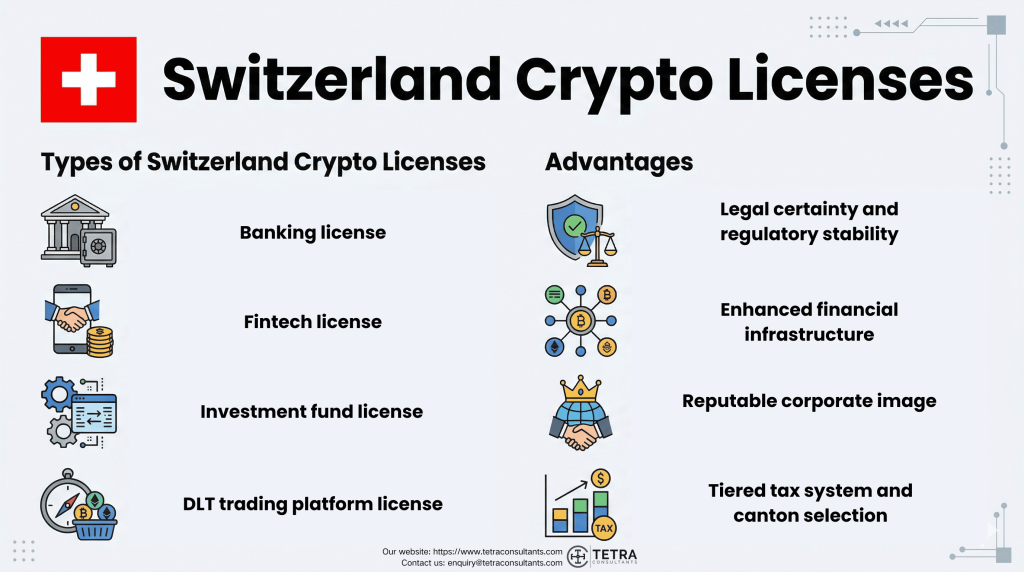
- In Switzerland, there are different types of crypto licenses available for conducting legitimate cryptocurrency operations. By engaging with Tetra Consultants, you can obtain the Switzerland crypto license type and even offshore financial licenses for your business.
Crypto exchange license:
- Obtaining a crypto exchange license in Switzerland is a rigorous yet rewarding process overseen by FINMA, the Swiss Financial Market Supervisory Authority.
- Applicants must register a firm within Switzerland, demonstrate the ability to adhere to comprehensive KYC/AML policies, and ensure that company officials maintain impeccable reputations.
- Once licensed, crypto exchanges benefit from a favorable corporate tax rate of 12-18% and the assurance of operating within a stable regulatory environment for at least the next five years.
- In addition to licensing by the Swiss Financial Market Supervisory Authority (FINMA), crypto businesses in Switzerland are subject to strict anti-money laundering (AML) supervision and reporting obligations.
- Licensed entities must comply with transaction monitoring and reporting requirements to the Money Laundering Reporting Office Switzerland, which is responsible for receiving and analyzing suspicious activity reports.
- Furthermore, Switzerland’s crypto regulatory landscape is shaped by policy guidance from the State Secretariat for International Finance, which plays a key role in developing financial market strategies and international regulatory alignment.
- Depending on the business model, companies may also be required to join a recognized Self-Regulatory Organization (SRO) such as VQF, ARIF, or PolyReg to ensure compliance with AML obligations under Swiss law.
Financial Market Supervisory Authority (FINMA) identifies the main types of business licenses:
Banking license:
- This license empowers financial institutions to function as banks, offering conventional banking services alongside cryptocurrency-related solutions. Swiss banks embracing crypto friendliness extend services like cryptocurrency storage and trading in addition to traditional financial products.
FinTech license:
- Widely sought-after, the fintech license permits financial transactions and intermediation, enabling crypto entities to accept public deposits of up to 100 million Swiss francs without interest investment obligations.
Investment fund license:
- With an investment fund license, fund managers are authorized to manage collective fund assets on behalf of clients, ensuring compliance with regulatory standards.
DLT trading platform license:
- Introduced under the DLT Act in 2021, this license enables crypto firms to operate multilateral trading platforms for DLT securities and other assets, aligning with regulatory frameworks for secure trading environments.
Emerging licensing categories in 2026
- Switzerland continues to evolve its regulatory framework in order to accommodate innovation in the digital finance. One of the main developments expected in 2026 is the introduction of Payment Instrument Institutions, which is a proposed licensing category by Swiss Financial Market Supervisory Authority.
- This category is created to regulate businesses that are facilitating digital payment instruments and crypto-based payment solutions, offering greater regulatory clarity for fintech and crypto payment service providers.
- As regulatory expectations continue to expand, businesses that enter the Swiss crypto markets should stay aligned with changing licensing categories and compliance requirements.
- The Swiss Financial Market Supervisory Authority (FINMA) is tasked with overseeing the integrity of cryptocurrency operations, including the issuance of crypto licenses and the enforcement of anti-money laundering (AML) measures. Progressive cantons within the country are actively working to attract and catalyze the growth of crypto companies by fostering collaborative ecosystems.
Which legal framework is overseeing the Switzerland Crypto License in 2026?
- The Swiss Federal Act on the Adaptation of Federal Law to Developments in Distributed Ledger Technology (DLT Act) serves as a primary legal framework governing cryptocurrency operation in Switzerland. It establishes regulations concerning crypto licensing, trading, anti-money laundering (AML), financial market infrastructure for cryptocurrency trading, and bankruptcy procedures.
- Here are some legal frameworks that governs Switzerland crypto license in 2026:
- SR 955.0 (Swiss Anti-Money Laundering Act – AMLA)- This act establishes strict obligations for customer due diligence, transaction monitoring, and reporting of suspicious activities.
- Financial market infrastructure (FinMIA), Chapter 4a- This law governs DLT trading facilities, enabling regulated platforms to trade tokenized securities under the supervisory oversight.
- Article 973d of the Swiss Code of Obligations (Art. 973d CO)- This law offers the legal basis for ledger-based securities, allowing tokenized assets to be legally recognized and transferred through blockchain.
- Banking Act (BankA) and Collective Investment Schemes Act (CISA)– This law applies to crypto businesses engaging in deposit-taking, asset management, or fund-related activities.
Regulatory requirements of Switzerland Crypto Licenses in 2026
- Establish a company in Switzerland, such as a joint stock company, limited liability company, or corporation with an unlimited number of partners. Appoint at least one manager who is a Swiss resident. An Anti-Money Laundering (AML) officer who is also a Swiss resident.
- Prepare a comprehensive business plan outlining the purpose, objectives, target market, products, services, risk management policies, governance, and compliance measures.
- Maintain sufficient capital, with a minimum requirement of CHF20,000, to cover operational and financial risks.
- Establish a registered office within Switzerland for the cryptocurrency business.
- Crypto companies operating in Switzerland are mandated to hold a banking account, with a minimum authorized capital of CHF100,000 required for establishment. This capital must be deposited in a block account held by a Swiss-based bank.
Procedure to obtain Switzerland Crypto License in 2026
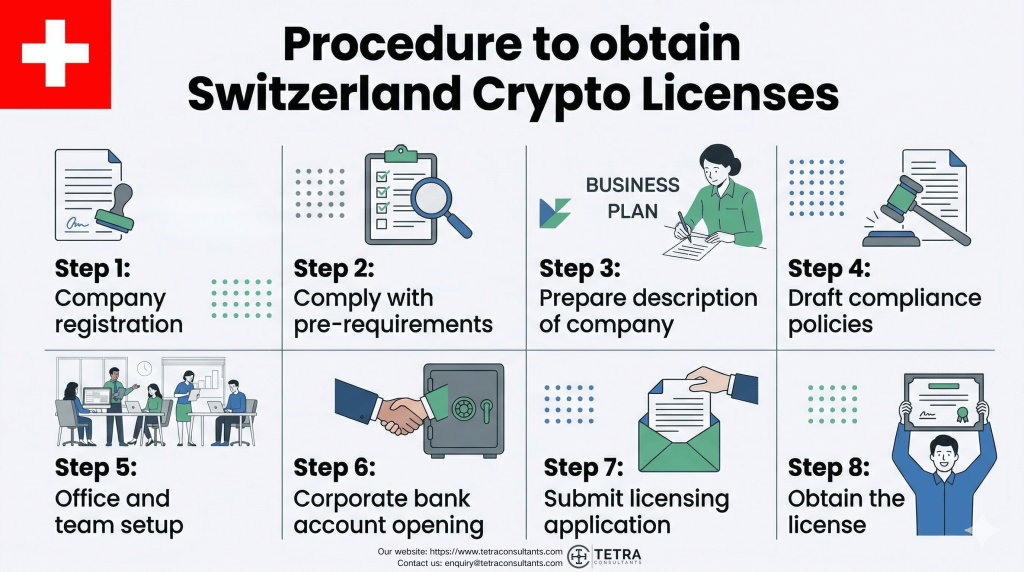
Step 1: Switzerland company registration
- Embarking on the journey to secure a Switzerland Crypto License begins with company registration, ideally opting for an AG or GmbH structure. Choose between a Limited Liability Company (GmbH) or a Corporation (AG) as the entity type. Ensure the name is distinctive and concludes with AG or GmbH for legal validity. Tetra Consultants streamline this process and offer name reservation services, ensuring a seamless start to your Switzerland Crypto License. Our legal team and licensing specialists will handle the company incorporation process, including name reservation and regulatory filings.
Step 2: Preparing for license application
- In order to acquire Switzerland Crypto License, it is required for the company to comply with the following pre-requirements for company incorporation. Our experts will provide you with various services such as nominee director and shareholder services, regulatory compliance consulting services and many more. Tetra Consultants team of lawyers and licensing specialists will ensure all pre-requirements are met in line with Swiss regulatory expectations.
- Tetra Consultants’ lawyers and incorporation specialists will then proceed to craft a comprehensive overview of the company’s business model and create a graphic representation illustrating the organizational structure. Once the company description is crafted, our team of lawyers and licensing specialists will move forward to develop and prepare Anti-Money Laundering/Know Your Customer (AML/KYC) policies along with a business plan.
- Further, Tetra Consultants facilitate the process of securing a Switzerland Crypto License by assisting in renting office space and hiring local employees. We meticulously prepare corporate documents, establish suitable organizational structures, and develop internal regulations fully compliant with Swiss AMLA regulations. With our expertise, we ensure seamless navigation through these crucial steps, enabling clients to establish a solid foundation for their crypto ventures in Switzerland
Step 3: Submit licensing application
- Tetra Consultants streamlines the process by assisting in preparing and compiling the application package with all necessary documentation for submission to FINMA. We ensure compliance by promptly providing any additional documents requested by the Regulator. Tetra Consultants arranges and facilitates personal meetings to present the business case effectively. For clients with legal entities among shareholders or management, we handle the submission of corporate documents in apostilled form. Additionally, Tetra Consultants offers expert guidance in ensuring that documents requiring execution in specific languages meet regulatory requirements.
Step 4: Obtain the license
- Switzerland Crypto License is granted upon the successful completion of preceding stages. The licensed company must commence its operations within six months of obtaining the license to avoid revocation. Following licensing, any alterations in the licensee’s structure and activities, including key documents, top management, and technical setup, must be promptly reported to FINMA.
Step 5: Corporate bank account opening
- Our lawyers and licensing specialists conducts a comprehensive analysis to identify the most suitable banks or Electronic Money Institutions (EMIs), comparing their risk appetites with the client’s based on pre-established Anti-Money Laundering (AML) policies. We collect essential documents from the client, including flow of funds, source of wealth, and purpose of account opening.
- To obtain a Switzerland Crypto License, a business bank account is imperative. Tetra Consultants facilitate the process, ensuring a seamless experience. Within 4 weeks of company incorporation, clients receive their business bank account, thanks to our efficient corporate bank account services.
Step 6: Accounting and tax obligations
- After getting the Switzerland Crypto License, the company should adhere with ongoing accounting and tax requirements regulated by the Swiss Federal Tax Administration as well as cantonal and municipal tax authorities.
- Crypto businesses in Switzerland are usually taxed on the basis of their activities, with cryptocurrencies typically treated as assets rather than fiat currency. Companies that are tax residents in Switzerland are taxed on worldwide income, while non-residents are taxed only on Swiss-sourced income. Most of the crypto license holders are needed to adhere with the following taxes at the federal, cantonal, or even municipal level:
- Corporate Income Tax (CIT) is approximately 12%–21% depending on the canton
- Capital Gains Tax (CGT) is approximately 0.001%–0.5% depending on applicable activities
- Value Added Tax (VAT) is 7.7%
- Withholding Tax (WHT) is 35%
- Social Security Contributions (SSC) is 0.5%–5.3%
- Issuance Stamp Duty (ISD) is 1%
- Swiss taxation operates on a three-tier system (federal, cantonal, and municipal). The federal corporate tax rate is 8.5% on profits after deductions, while cantonal and municipal tax rates vary depending on the company’s registered canton.
- Tetra Consultants will assist clients in identifying the most tax-efficient canton for establishing their crypto business and ensure timely compliance with all accounting and tax filing requirements.
- Lastly, our accounting and tax team will prepare all audited financial statements in accordance with Swiss regulatory requirements.
OECD CARF (2026) Tax Transparency Compliance
- In the present scenario, Switzerland is aligning with the OECD’s Crypto-Asset Reporting Framework (CARF), effective from 2026, requiring crypto businesses to collect, verify, and report customer transaction data to ensure global tax transparency and cross-border information exchange.
How long does it take to obtain Switzerland Crypto Licenses in 2026
- Register company in Switzerland: 3 weeks
- Obtaining crypto license: 3 to 5 months
- Opening corporate bank account-: 1 month
- Overall estimated timeline- 5 to 7 months
Looking to obtain Switzerland Crypto License
- Tetra Consultants works as your advisor and trusted partner in your business expansion and cryptocurrency license application. With our own team of lawyers, licensing specialists, compliance team, and accountants, we tell our clients what they need to know, instead of what they want to hear. Most importantly, we are known for being a one-stop solution for our valued clients.
- Contact us to know more about Switzerland Crypto License and our experts will revert within the next 24 hours.
FAQs
Who regulates crypto activities in Switzerland?
What are the prerequisites for obtaining a crypto license in Switzerland?
What are the types of crypto licenses available in Switzerland?
Are there residency requirements for managers of crypto companies in Switzerland?
Are there restrictions on the residency or nationality of shareholders in Swiss crypto companies?
Can shareholders participate in the annual general meeting remotely?
What are the documents required for Switzerland Crypto License?
What are the advantages of Switzerland Crypto License in 2026?

Author
Sharma Prabakaran
Sharma Prabakaran is the Head of International Business Advisory at Tetra Consultants. With over 15 years of professional experience, he specialises in international business setup, accounting and tax advisory, and cross-industry SME engagements. His expertise encompasses end-to-end project management, ranging from company incorporation and corporate bank account establishment to ongoing annual accounting and tax compliance.