


Company Registration
2 Weeks
Local Director?
No
Bank Account Opening
4 Weeks
Travel Required?
No
`
Table Of Contents
Cayman Islands crypto license in 2026
- A Cayman Islands crypto license establishes a framework that supports numerous activities and provides a high level of legal certainty, including tax incentives and international credibility to businesses involved in virtual asset activity. At Tetra Consultants, our team of lawyers and licensing specialists, compliance team, and accountants can help to seamlessly obtain a crypto license in the Cayman Islands in 2026.
- The new addition to the Virtual Asset (Service Providers) (Amendment) Regulations that came into effect on April 1, 2025, requires that all crypto custody or retail establishments also comply with AML and global standards of cybersecurity, and therefore must be licensed.
- If you register company in Cayman Islands benefit from the benefits of a stable financial environment with flexible ownership structures and no corporate tax. These features create a desirable jurisdiction for growth and expansion for companies operating within the crypto and fintech spaces worldwide. Our understanding simplifies the process, ranging from document preparation to regulatory compliance.
- The Cayman Islands Monetary Authority (CIMA) is responsible for licensing cryptocurrency businesses, overseeing Virtual Asset Service Providers (VASPs) such as exchanges, brokers, and custodians. As of April 1, 2025, under the Virtual Asset Service Providers Amendment Regulations 2025, VASPs are required to secure CIMA licenses through the REEFS system.
- This follows the 2020 Virtual Asset Service Provider Act (VASP Act), where anti-money laundering (AML) and counter-terrorism financing (CTF) standards are a focus through the Proceeds of Crime Act (POCA). Schedule 1 of SIBA regulates “securities” through SIBA Schedule 1, while Virtual Service Tokens, also known as non-transferable utility tokens, are exempt under Section 3(2). Note that we are also provide Deputy Money Laundering Reporting Officer (DMLRO).
Regulatory requirements for obtaining Cayman Islands crypto license in 2026
- A local AML officer.
- A local CIMA-approved director is required if VASP activity includes custodians. As of 2026, at least 3 directors total (1 independent) are required. These requirements can be complied with the help of our nominee director and shareholder services.
- The company must have at least one shareholder, who can be an individual or a corporate entity without residency requirements.
- The minimum paid-up share capital required for obtaining a crypto license is US$100,000. This capital must be deposited and maintained to demonstrate financial stability and support operational activities.
- A dedicated compliance officer must be appointed to oversee adherence to all relevant regulations, including AML and CFT (counter-terrorism financing) measures.
- The company must have a registered office located in the Cayman Islands. This physical presence is essential for compliance with local regulations and ensures that the company can be reached by regulatory authorities.
- A detailed business plan outlining the company’s operational strategy, risk management framework, and financial projections is required as part of the application process.
- Companies must develop and implement comprehensive AML/KYC (Know Your Customer) policies that comply with local regulations. This includes monitoring transactions and reporting suspicious activities.
Key Cayman VASP compliance rules in 2026
CIMA maintains stringent rules and regulations for VASPs operating in the Cayman Islands:
- Travel rule: It strictly enforces compliance in the transfer of virtual assets.
- 72-Hour reporting rule: It demands timely notification to CIMA within 72 hours in case of a cyber-attack.
- Quarterly regulatory return: It now demands quarterly returns instead of annual returns.
- Asset segregation rules: It strictly demands segregation of client assets from operational assets.
- IFRS and reporting annex: It demands IFRS-compliant financial statements in line with the Virtual Asset Reporting Annex.
Activities allowed under Cayman Islands crypto license
- The Cayman Islands crypto license enables companies to undertake a number of activities within the cryptocurrency space. Below are the most significant activities supported by this licensing arrangement:
Exchange services:
- Companies may facilitate the exchanges between virtual assets and fiat money, or exchanges among various convertible virtual assets.
Brokerage services:
- Authorized bodies may operate as brokers, arranging transactions involving virtual currencies for customers.
Trading activities:
- Businesses may operate to buy and sell digital assets on their own, taking an active role in the market.
Custody services:
- The license enables businesses to provide virtual asset custody services for safekeeping and management of assets on behalf of customers.
Virtual asset issuance:
- Companies can conduct or provide financial services pertaining to the issue and sale of virtual assets, for example, arranging Initial Coin Offerings (ICOs).
Innovative financial technology (FinTech):
- The license tends to prefer FinTech business providing innovative services regarding virtual assets.
Sandbox licensing:
- Businesses with new models can test services under regulatory supervision, aligned with financial licensing, VASP/VATP Authorizations, AML/CFT compliance, and institutional banking.
Types of Cayman Islands crypto license
Crypto exchange license:
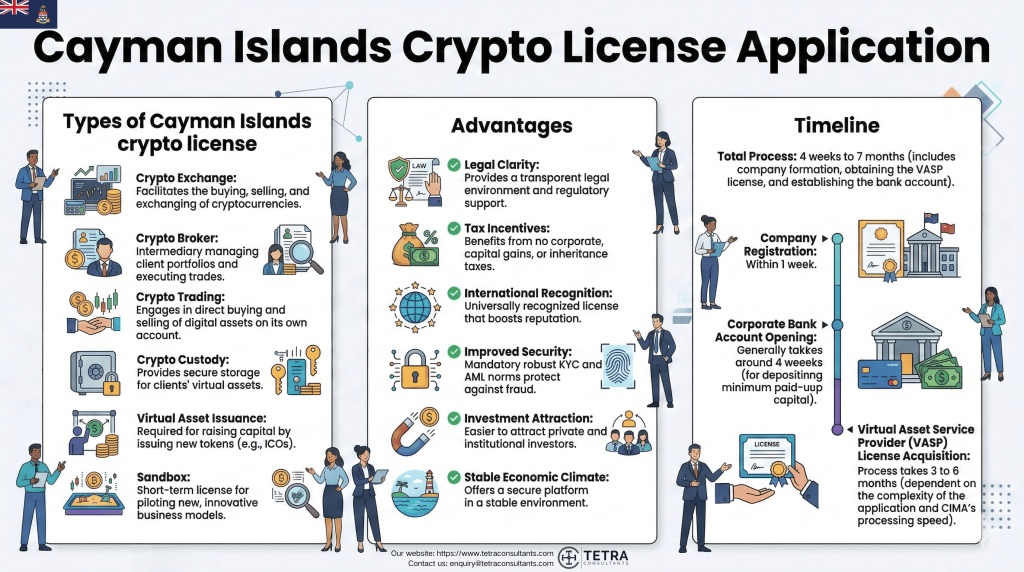
- This license enables businesses to operate cryptocurrency exchanges that enable the exchange of virtual currencies for fiat currencies or other cryptocurrencies. It is ideal for platforms where users can buy, sell, and exchange digital currencies.
- These businesses are required to comply with anti-money laundering (AML) and counter-terrorism financing (CTF) guidelines, have strict security in place to protect user funds and data, and practice fair trading to ensure market integrity.
Crypto broker license:
- The Crypto Broker License is for companies that are intermediaries in cryptocurrency transactions. The brokers make transactions on the accounts of their customers, manage portfolios, and provide advisory information. The licensed brokers must adhere to very strict regulatory demands, perform due diligence appropriately on customers, and be clear in their actions and operations in serving the best interests of their clients.
Crypto trading license:
- This license is designed for businesses that directly engage in the selling and buying of digital assets. It applies to proprietary trading firms or market makers actively engaging in the cryptocurrency market. Licensees can trade on their own account, offer liquidity exchanges, and must deploy effective risk management to avoid losses from price volatility.
Crypto custody license:
- Companies can offer virtual asset storage services on behalf of clients. This can be specially noted for institutional investors or those that want to secure their digital assets. Custodians are required to apply stronger security measures like cold storage and multi-signature wallets, comply with the regulatory guidelines for managing assets, and may insure in case of potential breach or failure.
Virtual asset issuance license:
- This license enables businesses to issue virtual assets, such as performing Initial Coin Offerings (ICOs). It is necessary for businesses that want to raise capital through token sales. Issuers are required to adhere to Cayman Islands Monetary Authority (CIMA) regulations regarding disclosures and investor protections, categorize their tokens as utility or security tokens, and be transparent by giving thorough documentation regarding the risks involved in the investment.
Sandbox license
- The Sandbox License is provided for new business models that do not fit within the existing licensing categories. The license enables companies to pilot test new products or services in a controlled environment with CIMA’s oversight for up to 12 months. This short-term license offers regulatory latitude for experimentation with the opportunity for businesses to shape their offerings in response to regulators’ feedback before seeking a full license.
Steps for obtaining Cayman Islands crypto license
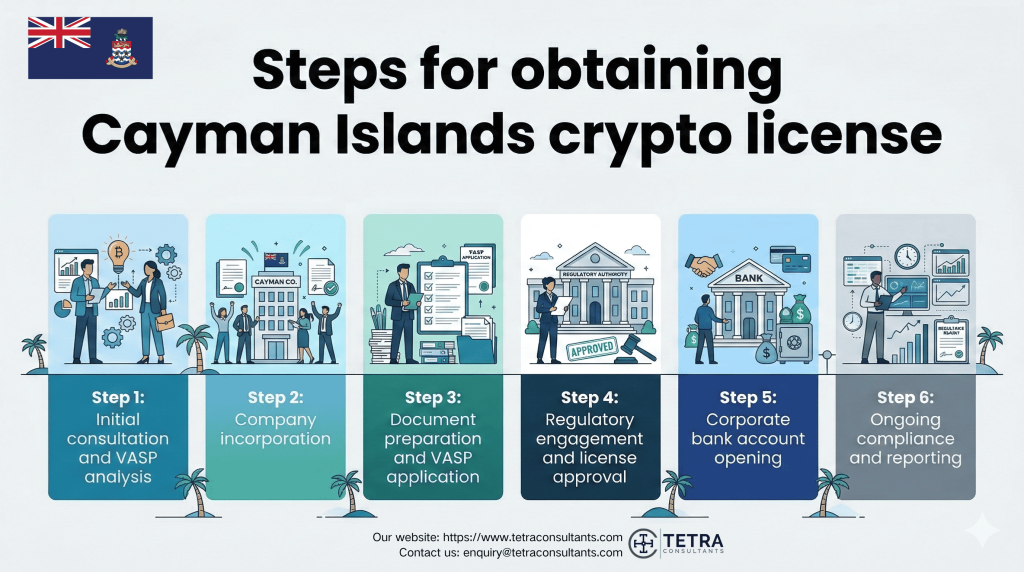
Step 1: Initial consultation and VASP analysis
- Tetra Consultants’ experts will begin the process with a consultation to understand your business model, market scope, and business operation. Our legal team and licensing specialists conduct a VASP analysis to identify the most appropriate license category under the CIMA license. At this point, we will ensure regulated entity structuring & FATF regulatory Integration to align your crypto business model with international regulations.
Step 2: Company incorporation
- Our experts will assess the need to acquire a license as a VASP and proceed to incorporate a Cayman Islands exempted company. We will conduct KYC/AML checks on directors, shareholders, and UBOs. We will draw up the constitutional documents such as the Memorandum and Articles of Association. We will also facilitate independent fiduciary and governance appointments (if required).
Step 3: Document preparation and VASP application
- Once the incorporation process is complete, Tetra Consultants assist with the preparation of the required documents for the VASP license application. This includes the development of the AML/CFT policies and procedures, cybersecurity measures, a comprehensive business plan, and information on the organizational structure. Additionally, we develop the Institutional Asset Safeguarding & Liaison frameworks to ensure the safekeeping of client assets prior to the submission of the VASP application through the CIMA portal, REEFS.
Step 4: Regulatory engagement and license approval
- Once the application has been submitted, Tetra Consultants engage with the CIMA during the review process to provide the additional information and clarification required to complete the application process. Our team provides regulatory filing and CIMA engagement support to complete the application process successfully. At this stage, the applicant must prove to have the financial stability and liquidity to operate the VASPs and to have sound risk management systems.
Step 5: Corporate bank account opening
- After approval of the VASP License, our legal team will assist in corporate bank account opening with reputable financial institutions in the Cayman Islands or abroad.
Step 6: Ongoing compliance and reporting
- Once the above processes are completed, we will provide ongoing compliance services to ensure compliance with CIMA regulations. This includes monitoring Anti Money Laundering/KYC Compliance and maintenance of records. Also, our accounting and tax team will prepare annual financial statements and provide assistance with renewal of licenses.
- In addition to this, we also provide guidance on regulatory updates to ensure long-term operational compliance.
Timeline to obtain Cayman Islands crypto license
- With Tetra Consultants, one can obtain a Cayman Islands crypto license on a scheduled timeline. Company registration will be done within 1 week, having your business duly registered and in line with local legislation. Then, the acquisition of the Virtual Asset Service Provider (VASP) license will be a process that will take 3 to 6 months, depending on how complicated application is and how fast the Cayman Islands Monetary Authority (CIMA) is.
- Throughout this time, the Tetra Consultants’ legal team and licensing specialists will help prepare and file all the required documents, such as AML/CFT policies and business plans. Also, a corporate bank account opening with a well-established financial institution generally takes around 4 weeks to allow minimum paid-up capital to be deposited for the purpose of licensing.
- In total, Tetra Consultants rationalize each part of this procedure to make sure that it remains efficient and regulatory compliant. It will take from 4 to 7 months for the complete process, which includes company formation, obtaining the VASP license, and establishing the bank account. We would like to help your business achieve this with no hassle.
Advantages of obtaining Cayman Islands crypto license
Legal clarity and regulatory support
- A crypto license gives firms a transparent legal environment and regulatory support, encouraging user and investor confidence. This transparency is necessary for long-term viability in the fast-changing world of cryptocurrencies.
Tax incentives
- The Cayman Islands is highly reputable for its favorable taxation regime, i.e., no corporate taxation on income, no capital gain taxation, or tax on inheritance. This can encourage businesses to make more profit and invest more easily.
International recognition
- A Cayman Islands crypto license is universally recognized, boosting a firm’s reputation and appeal to foreign traders and investors. This helps to contribute to higher liquidity and trading volumes.
Improved security measures
- The process of licensing involves robust KYC (Know Your Customer) and AML (Anti-Money Laundering) norms, which enhance the security of operations and safeguard against fraud, thereby raising customer confidence.
Investment attraction
- Regulated entities can attract private and institutional investment with greater ease since compliance with regulatory requirements gives confidence to investors about the safety of their investments.
Stable economic climate
- The Cayman Islands has a stable political and economic environment, offering a secure platform for crypto activities. This stability boosts investor confidence and facilitates business expansion.
Cost of obtaining Cayman Islands crypto license
- At Tetra Consultants, we adopt a well-defined methodology for obtaining a crypto license in the Cayman Islands, ensuring that clients are aware of the complete process. Our consultants offer clients a detailed breakdown of the costs involved, such as government costs, costs for incorporation, compliance costs, and bank account opening costs.
- Apart from this, we offer additional services such as appointing an AML officer, ensuring complete compliance, and other value-added services. Our expertise enables us to offer financial licensing, VASP/VATP Authorizations, AML/CFT Compliance, and institutional banking, ensuring that the business is fully compliant with all the regulations.
- Furthermore, we offer additional services such as post-licensing, where we provide assistance for audits, reporting, license renewals, etc.
How can Tetra Consultants help in obtaining Cayman Islands crypto license?
- Tetra Consultants works as your advisor and trusted partner in your business expansion, offshore financial licenses, and cryptocurrency license. With our own team of lawyers, licensing specialists, compliance team, and accountants, we tell our clients what they need to know, instead of what they want to hear. Most importantly, we are known for being a one-stop solution for our valued clients.
- Tetra Consultants provides businesses with end-to-end solutions to obtain a cryptocurrency license in the Cayman Islands in 2026. This ensures that the process is smooth and hassle-free for the business. The consultancy provides expert regulatory advice to businesses, along with business structuring advice that is specific to their needs. In addition to that, Tetra Consultants ensure that all the necessary documentation is prepared with utmost accuracy and provides transparent pricing to businesses.
Looking to obtain Cayman Islands crypto license
- Contact us to know more about Cayman Islands crypto license and our team will revert back in 24 hours.
FAQs
What is a cryptocurrency license in the Cayman Islands?
Who oversees cryptocurrency operations in the Cayman Islands?
What are the types of licenses for cryptocurrency enterprises?
What are the minimum requirements for a crypto license?
Is it necessary to have a physical office in the Cayman Islands?
How can Tetra Consultants help acquire a crypto license?
What are the benefits Tetra Consultants providing for crypto licensing?
Do I require legal counsel to make a crypto license application?
What are the costs of acquiring a crypto license?
Is ongoing reporting required after obtaining a crypto license?
Is the declaration of the intended business activities required?
Are cybersecurity and operational structure details required during the application?
What types of activities are excluded from the crypto license regime in the Cayman Islands?

Author
Sharma Prabakaran
Sharma Prabakaran is the Head of International Business Advisory at Tetra Consultants. With over 15 years of professional experience, he specialises in international business setup, accounting and tax advisory, and cross-industry SME engagements. His expertise encompasses end-to-end project management, ranging from company incorporation and corporate bank account establishment to ongoing annual accounting and tax compliance.