


Company Registration
2 Weeks
Local Director?
No
Bank Account Opening
4 Weeks
Travel Required?
No
Cyprus Cryptocurrency License in 2026
- We assist international companies in obtaining a cryptocurrency license (CASP) issued by the Cyprus Securities and Exchange Commission (CySEC) under the 2026 MiCAR regulations. At Tetra Consultants, our team of lawyers, licensing specialists, compliance team, and accountants ensures that entrepreneurs receive end-to-end support in obtaining a cryptocurrency license in Cyprus, including company incorporation in Cyprus, opening corporate bank accounts in Cyprus, appointing company secretaries, opening offices in Cyprus, and submitting the application to the CySEC. We ensure compliance with the local residency requirements for directors and AML/CFT regulations for smooth cryptocurrency business operations.
What are the laws governing a Cyprus Cryptocurrency License in 2026?
Markets in Crypto-Assets Regulation (MiCAR):
- This Markets in Crypto Assets Regulation (MiCAR) is applicable to all European Union jurisdictions. It was implemented in June 2024, with full application by December 2024.
- All member states of the European Union should start enforcing these regulations on crypto-licensed businesses operating within Europe from this implementation date. Then, the full extent of MiCAR will become fully effective over the course of the next 18 months, targeting December 2025, at which point EU countries will harden their demands and set requirements.
- The EU’s comprehensive crypto-assets regulation, fully operational since 2026, requires CASPs dealing in exchange services, custodianship, wallets, and trading platforms to be authorized by CySEC.
- MiCAR provides a unified licensing framework for all member states, covers consumer protection, stablecoins, and prevents market abuse by replacing fragmented national VASP registrations with a unified passporting regime for all EU member states.
Prevention and Suppression of Money Laundering Law (AML/CFT):
- Cyprus’s national AML/CFT legislation for crypto businesses, in compliance with the EU’s 5th/6th AML Directive package, requires robust KYC/AML measures from crypto businesses. Licensees must appoint a resident MLRO, monitor transactions, report suspicious transactions to FIU, and maintain a 5-year audit trail, with CySEC imposing fines up to €350,000 on violators.
CySEC Circulars (e.g., C417):
- CySEC prudential directives establish capital requirements (min €125,000 – €150,000), risk management practices, cybersecurity measures, and fitness checks for directors/shareholders. CySEC authorizes crypto services through investment firm models, including reporting obligations, stress testing, and client asset segregation.
Investment Services and Activities Law:
- The legislation transposes MiFID II for crypto services, including local substance requirements, corporate governance arrangements, IT systems, and compliance infrastructure. CySEC carries out pre-authorization inspections and annual audits for operational integrity and investor protection.
Tax Implications of Cyprus Cryptocurrency License (CASP) in 2026
Corporate Income Tax:
- A standard rate of 15% on worldwide profits, compared to 12.5% previously, with an 80% exemption under the IP Box regime, equalling a reduced rate of 2.5%. In addition, a new regime eliminates dividend tax for 17 years.
Crypto Disposal Tax:
- A flat rate of 8% under Article 20E of the Income Tax Law on crypto sales, swaps, spending, and donations, applicable to both companies and individuals, effective from 1st January 2026, with no loss offsetting against other forms of income.
VAT:
- A standard rate of 19% applies, with a possible 9% reduced rate applicable to financial advice under the MiCAR regime, applicable to crypto exchanges and custody services, which are exempt as financial services.
Payroll and Social Insurance:
- A progressive income tax of 13-35% applies to local staff, while employer contributions of 8.8% social insurance and 4% redundancy fund are applicable to required directors and employees of companies.
60-day tax rule:
- Cyprus provides a flexible 60-day tax residency rule, enbaling indiviuals including company directors to qualify as residences if they spend at least 60 days in Cyprus within a calendar year, provided they do not reside in any country for more than 183 days and maintain economic ties like directorship in Cyprus company. This rule is particularly advantageous for CASP holders, as it enables foreign directors to establish tax residency efficiently while benefiting from Cyprus’ favourable personal and dividend tax framework.
Notional Interest Deduction (NID)
- Cyprus offers a Notional Interest Deduction (NID) regime, allowing companies to claim a tax-deductible “interest” expense on new equity that is injected into the business. This effectively reduces taxable profits and can significantly lower the overall corporate tax burden. For crypto companies and CASPs, NID is particularly beneficial when funding operations through equity rather than debt, enabling efficient capital structuring while remaining compliant with substance requirements.
Our tax experts are adept at optimizing IP Box structuring as well as crypto tax compliance filings under the new 2026 regime.
Who is a crypto-asset service provider?
- Under MiCAR, a CASP engages in crypto-fiat exchange, crypto-crypto exchange, custody or safekeeping, wallet services, or ICO distribution. CASPs that operate in or from Cyprus must register with CySEC. EEA CASPs must notify CySEC with proof of home‑state AML/CFT registration; non‑EEA CASPs apply directly. Post-July 2026, MiCAR grandfathering will no longer require all crypto services to be authorized by CySEC for Cyprus residents.
Reverse Solicitation Under MiCAR 2026
- In the latest MiCAR system fully in force in 2026, reverse solicitation with EU clients directly engaging non-EU CASPs without prior marketing efforts is heavily curtailed under the latest CySEC rules for MiCAR.
- The exemption now requires exclusive client-driven services with zero provider targeting, solicitation, or geo-unblocking (even VPNs violate). CySEC monitors through IP records, payment records, and complaints, with fines of €700K+ for non-compliance.
- It finally closes the VASP loophole for legacy services, with only true reverse solicitation of EU clients qualifying and requiring full licensing for active marketing efforts.
What services can be offered with the Cyprus Cryptocurrency License?
According to the regulator, financial services regarding the distribution, offer, and/or sale of crypto assets are:
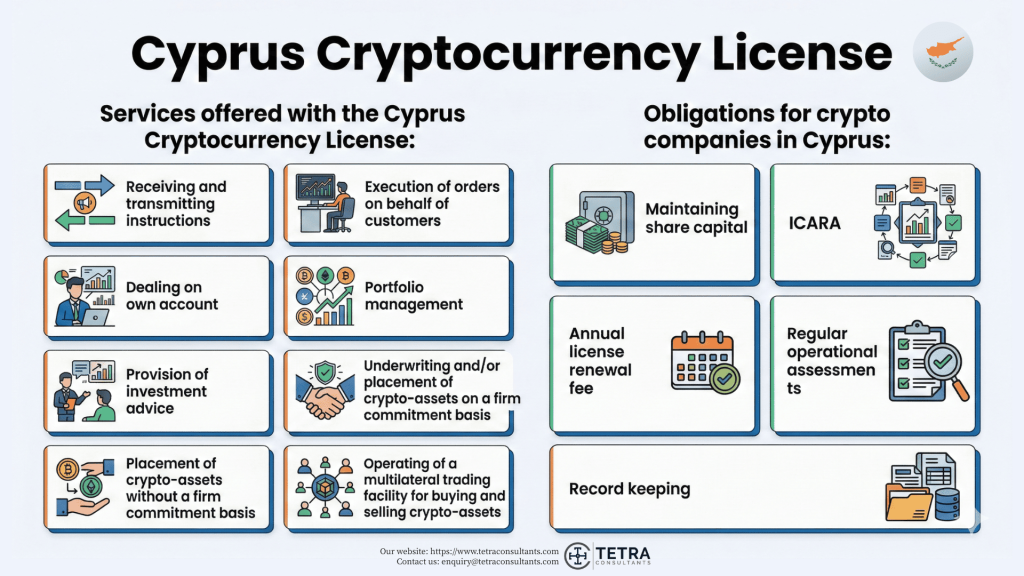
- Receiving and transmitting instructions,
- Execution of orders on behalf of customers,
- Dealing on own account,
- Portfolio management,
- Provision of investment advice,
- Underwriting and/or placement of crypto-assets on a firm commitment basis,
- Placement of crypto-assets without a firm commitment basis,
- Operating of a multilateral trading facility for buying and selling crypto-assets.
What are the categories of Cyprus Cryptocurrency License?
- When it comes to the authorization process, there are 3 different levels of authorization. The basis for their definition is the scope of crypto asset services provided by the company. Accordingly, all three levels of authorization are subject to varying capital requirements.
Class 1 license
- This category includes CASP, which provides investment advice.
- Capital requirement: €50,000
Class 2 license
- The CASP, which falls into this category, is authorized to provide services included in a class 1 license, plus the following range of cryptographic asset services:
- Exchange between cryptographic assets and/or exchange between cryptographic and fiat currencies
- Placing cryptographic assets without a fixed liability
- Receiving and executing customer orders (including performing on behalf of clients)
Crypto portfolio management - Participation or provision of financial services related to the distribution, supply, and/or sale of cryptographic assets (including the original offer)
- Capital requirement: €125,000.
Class 3 license
- The CASP, which falls into this category, is authorized to provide services included in Class 1 and Class 2 licenses, plus the following range of cryptographic asset services:
- Underwriting and/or placing crypto assets with a firm commitment
- Administration, transfer of ownership, transfer of title, storage, and/or storage (including storage) of operations related to cryptographic assets, cryptographic keys or cryptographic asset controls
- Functioning of a multilateral system that brings together multiple third parties to buy and sell interests in crypto assets in a way that leads to a transaction.
- Capital requirement: €150,000.
Cyprus cryptocurrency license requirements in 2026
- Incorporate a Cyprus entity with a Board of Directors with at least 4 directors, of which 2 are Executive Directors.
- Directors must be approved by CySEC and meet the fit and proper criteria based on their knowledge and experience.
- Establish a fully functional office in Cyprus with staff employed on a full-time basis to perform key company functions.
- Provide a detailed organizational chart as part of the requirements for MiCAR regulatory compliance.
- Establish a Head of Operations (HoO) role for day-to-day trading, settlement, and IT functions with at least 3 years of experience in the crypto space and pre-approval by CySEC.
- Establish a Risk Manager role for managing liquidity, market, and cyber risks, as well as for developing the ICARA process and quarterly reporting to the board.
- To maintain an internal audit function for annual independent compliance audits and provide MiCA Pillar III disclosures and report to the board or audit committee.
- To implement policies for AML and CFT in accordance with the Law and Directive for the Prevention and Suppression of Money Laundering and Terrorist Financing.
- To establish proper internal control mechanisms for the smooth running of the company’s business.
- To maintain proper governance with transparent reporting lines.
What is the procedure for obtaining a cryptocurrency license?
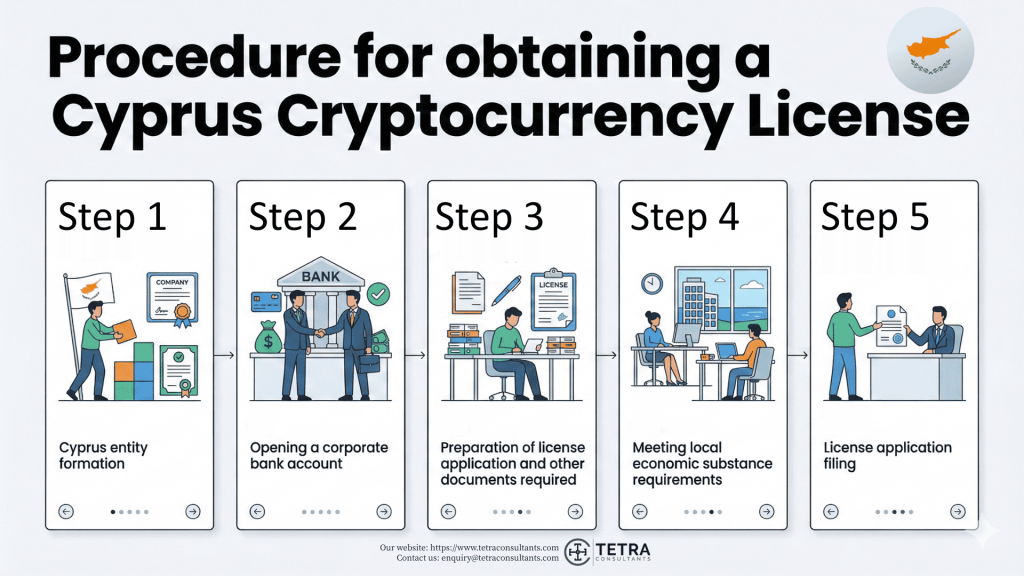
- In order to set up and operate a cryptocurrency venture in Cyprus, you need to be duly registered as a financial service provider in the nation. The requirements and procedures to be undergone heavily rely on the business needs and goals of your company. Tetra Consultants has summarised the most prevalent steps followed when attaining a Cyprus Cryptocurrency License.
Step 1: Cyprus entity formation
- For businesses planning to establish themselves as Crypto Asset Service Providers in Cyprus, it is essential to first register the company and seek approval from the Cyprus Securities and Exchange Commission (CySEC) before starting business operations in the country.
- The company registration in Cyprus services provided by our lawyers and licensing specialists will help in registering the company in Cyprus and preparing the necessary documentation with the Companies Registry.
Step 2: Opening a corporate bank account
- Tetra Consultants will open a corporate bank account with a reputable financial institution. The minimum paid-up capital required to secure the license will be deposited into this bank account.
Step 3: Preparation of license application and other documents required
- Our lawyers and licensing specialists will begin preparing the required documents for the cryptocurrency licensing application. These documents will include the business plan, financial statements, AML/CFT policy, and insurance policy, as required by local regulations.
- After the documents have been created for review, Tetra Consultants will supply you with prototypes. We will then email them to you for e-signature before moving forward with your license application.
Step 4: Meeting local economic substance requirements
- To fulfill the requirements set by the Cyprus Securities and Exchange Commission, the applicant should be able to show the economic substance by providing a registered address and qualified employees locally in Cyprus.
- Tetra Consultants’ team of legal and licensing experts will help the applicant in setting up the local presence. Our HR team will help the applicant in shortlisting the candidates and conducting the initial interviews for key positions like the MLRO (Money Laundering Reporting Officer) role.
- Additionally, our team will be able to provide the applicant with a list of potential office spaces with the relevant information, such as monthly rent, floor area (sqm), and lease terms.
Step 5: License application filing
- Once the above is completed, our team of our lawyers and licensing specialists will submit the application to the local regulator. Depending on the requirements of regulatory authorities, you may be required to attend an interview with the regulator prior to license approval. In this case, Tetra Consultants will prepare you for the interview and assist with the follow-up actions required by regulatory authorities.
- If all goes well, your firm will receive the Cyprus Cryptocurrency License and will be required to start business operations within the stipulated time frame to maintain the license.
Obligations for crypto companies in Cyprus
Maintaining share capital
- A Cyprus cryptocurrency license-holding company should have deposited share capital. It should be equal to the initial share capital declared when applying or at least 25% of the company’s fixed costs in the previous year of operation, effective from the second year.
ICARA (Internal Capital and Risk Assessment Process)
- CASPs are expected to have an Internal Capital and Risk Assessment Process (ICARA) in place to ensure ongoing compliance with CySEC requirements under MiCAR 2026. This includes regular stress testing, capital assessment for ranges of €50K to €150K per class, liquidity risk management, and recovery plans to ensure overall financial stability and investor protection.
Annual license renewal fee
- As part of the Cyprus cryptocurrency licensing requirements, the company must pay an annual renewal fee of €5,000 to keep its license active and in good standing.
Regular operational assessments
- Under the crypto regulation in Cyprus, the company is required to review its operations and activities from time to time. Reviews are crucial and include the following areas for compliance:
- Employee incentives: The good incentive of employee motivation would be to ensure the incentives given do not give rise to any kind of conflict of interest with the needs and interests of clients.
- Annual risk assessments: To critically evaluate the company’s potential risks it may face, the company must conduct yearly risk assessments and develop risk matrices.
- AML-CFT compliance: Ongoing monitoring and reviewing the adequacy and effectiveness of the Anti-Money Laundering and Counter-Terrorism Financing policies and procedures to ensure there are no lacunae in the applicable law.
Record keeping
- Further, the company must maintain clear and readable records of operations and business relations with ease of access. This would ensure that the information needed is forthwith retrieved for assessment, following the regulations of the license of cryptocurrency in Cyprus.
- Pillar III Disclosures also require annual publications by authorized persons regarding capital adequacy, risk exposure, and liquidity ratios, thereby promoting transparency and discipline in the market for better investor protection. Additionally, our tax and accounting team can also assist in structuring your business to ensure smooth business operations.
Comparing Cyprus to other EU countries
| Feature | Cyprus | Malta | Estonia | Lithuania |
| Primary Regulator | CySEC | MFSA | FI | Bank of Lithuania |
| License Type | CASP (MiCAR Class 1-3) | VFA / MiCAR CASP | MiCAR CASP | MiCAR CASP |
| Local Director Req. | 2 resident executives | 1 resident director | Local AML officer | Resident compliance officer |
| Substance Rules | Office + local staff | Physical office | Local management | Local office/staff |
| Capital Tiers | €50K-€150K (class-based) | €50K-€150K MiCA | €50K minimum | €50K-€125K MiCA |
| Tax Rate | 15% CIT + 8% crypto gains | 35% (5% effective) | 22% income tax | 15% CIT |
| EU Passporting | Full MiCA passport | Full MiCA passport | Full MiCA passport | Full MiCAR passport |
What are the benefits of obtaining a Cyprus Cryptocurrency License?
There are multiple reasons why Cyprus is so popular amongst financial service providers.
- Firstly, in terms of legislation and regulation, it has a clear and proven network, allowing service providers to choose from hundreds of licenses for various financial services.
- In further distinction, many popular licenses are split into different levels, allowing for case-sensitive application requirements and higher application success rates. Cyprus also recognizes and supports a wide range of financial instruments – including crypto derivatives. This further contributes to a very diverse business environment on the island.
- Finally, the taxation scheme in Cyprus bears lower tax rates than most countries in continental Europe, allowing better conditions for sustainable corporate growth and development. Regulatory bodies also work to offer good conditions to foreign investors, who have extensive rights when opening companies here.
- And as a final significant advantage, compared to other international jurisdictions, Cyprus poses no restrictions on cryptocurrency mining activities.
How long does it take to obtain a cryptocurrency license?
- Prior to the start of the engagement, our legal and licensing experts will send you a project plan with the timelines stipulated for company registration, preparation of documents as well as license application. This is to ensure that all parties are clear on the upcoming project.
Our services
- Tetra Consultants works as your advisor and trusted partner in your business expansion and cryptocurrency license. With our own team of lawyers, licensing specialists, compliance team, and accountants, we tell our clients what they need to know, instead of what they want to hear. Most importantly, we are known for being a one-stop solution for our valued clients.
- Tetra Consultants can help you obtain cryptocurrency licenses in prominent jurisdictions such as Cyprus. The licensing experts at Tetra Consultants can assist financial service organizations in acquiring the correct offshore financial licenses that match the firm’s long-term operational and licensing objectives. Additionally, our accounting and tax team will manage all tax and accounting matters of the company, ensuring smooth and compliant operations.
Find out more!
- Contact us to find out more about how to get a Cyprus Cryptocurrency License. Our team of experts will revert within the next 24 hours.
FAQs

Author
Sharma Prabakaran
Sharma Prabakaran is the Head of International Business Advisory at Tetra Consultants. With over 15 years of professional experience, he specialises in international business setup, accounting and tax advisory, and cross-industry SME engagements. His expertise encompasses end-to-end project management, ranging from company incorporation and corporate bank account establishment to ongoing annual accounting and tax compliance.