


Company Registration
3 Weeks
Local Director?
No
Bank Account Opening
4 Weeks
Travel Required?
No
Malta gaming license in 2026
- At Tetra Consultants, our team of lawyers, licensing specialists, compliance professionals, and accountants will assist you in seamlessly obtaining a Malta Gaming License in 2026. We provide end-to-end support including Malta company incorporation, preparation and submission of the Gaming Service (B2C) or Critical Gaming Supply (B2B) license application, regulatory compliance advisory, and post-licensing operational support, ensuring your business meets all requirements set by the Malta Gaming Authority (MGA).
- Malta’s gaming industry is controlled under the Gaming Act (Cap.583) and the Gaming Authorisations Regulations (S.L. 583.05), which has established a robust EU-regulated framework for both Gaming Service (B2C) and Critical Gaming Supply (B2B) operators.
- Under the Gaming Authorisations Regulations, it is stated that “no persons shall provide or carry out a gaming service or provide a critical gaming supply from Malta or to any person in Malta, or through a Maltese legal entity, except when in possession of a valid license, or when such person is exempt from the requirement of a license under the Act or any other regulatory instrument”.
- The Malta Gaming Authority has adopted a single licensing framework that is categorized into:
- Gaming Service (B2C)
- Critical Gaming Supply (B2B)
Gaming Service license (B2C)
A business to consumer license to offer or operate a gaming service
Critical Gaming Supply license (B2B)
A business to business license to provide or carry out a critical gaming supply. Generally, the gaming types should be any one or more of the following:
Type 1
- Games of chance played against the house. Generally, casino type games such as roulette, blackjack, baccarat and Esports are classified under Type 1.
Type 2
- Games of chance played against the house with outcome determined by an event or competition separate from a game of chance. Games such as fixed odds betting and pool betting are classified under Type 2.
Type 3
- Games of chance not played against the house, with the operator not assuming gaming risk. Instead of profiting from the game, the operator generates revenue by taking a commission or charging based on the stakes or the prize pool. Games such as poker, bingo are classified under Type 3.
Type 4
- Controlled skill games such as fantasy sports are classified under Type 4.
Licensing scope and exemptions (MGA framework)
- Under the Gaming Act (Cap. 583) and the Gaming Authorisations Regulations (S.L. 583.03), any entity offering a gaming service from or within Malta or through a Maltese registered company, should get a valid authorization from the Malta Gaming Authority (MGA), unless explicitly exempted.
Scope of licensing
- A Malta Gaming License is needed for:
- Operators providing Gaming Service (B2C) activities to players
- Businesses that targets Malta-based players or operating through a Maltese legal entity
- Entities offering Critical Gaming Supply (B2B) services, this includes software, platforms, and operational support
Regulatory classification
- Where a gaming activity falls within multiple categories, the MGA will classify the activity based on its dominant operational and risk characteristics, ensuring it aligns with the appropriate license type.
Regulatory exemptions
- The MGA may exempt certain activities that fall outside the regulatory scope, including:
- Games that do not involve monetary stakes or prizes
- Pure skill-based games that are not classified as controlled skill games (Type 4)
- Limited or low-risk gaming activities assessed under MGA guidelines
Mandatory requirements for Malta gaming license in 2026
- To be awarded a Malta Gaming License, you will have to possess the following qualities:
- Ready to conduct a gaming business;
- Correctly prepared from a business strategy perspective;
- Has the operational and statutory requirements to meet the obligations prescribed by law and policy; and
- Has correctly implemented and reviewed, in a virtual environment, before its official opening
- When an applicant is examined, specifically incorporation documents, games, business processes, rules, terms, conditions, policies, procedures and technical documentation of the gaming system is evaluated. Licensees are also subjected to a minimum issued and paid-up share capital as per their license type.
- Applicants looking to apply for a Type 1 or Type 2 license must have minimally €100,000. On the other hand, applicants looking to acquire a Type 3 or Type 4 license must possess minimally €40,000.
Mandatory key functions:
- Money Laundering Reporting Officer (MLRO)
- Key Compliance officer
- Key Technical officer
Operational readiness requirements:
- Fully developed gaming system
- Documented AML/CFT policies
- Internal control procedures
- Business continuity planning
Recognition notice for EU/EEA licensed operators
- For those operators who are already licensed in another EU/EEA jurisdiction they can apply for a Recognition Notice from the Malta Gaming Authority (MGA). This enables the provision of gaming services in or from Malta without getting a full Malta Gaming License, subject to regulatory approval and compliance checks.
- A Recognition Notice is typically suitable for operators seeking faster market entry while maintaining compliance with the Gaming Act (Cap. 583) framework.
Timeline of Malta gaming license application in 2026
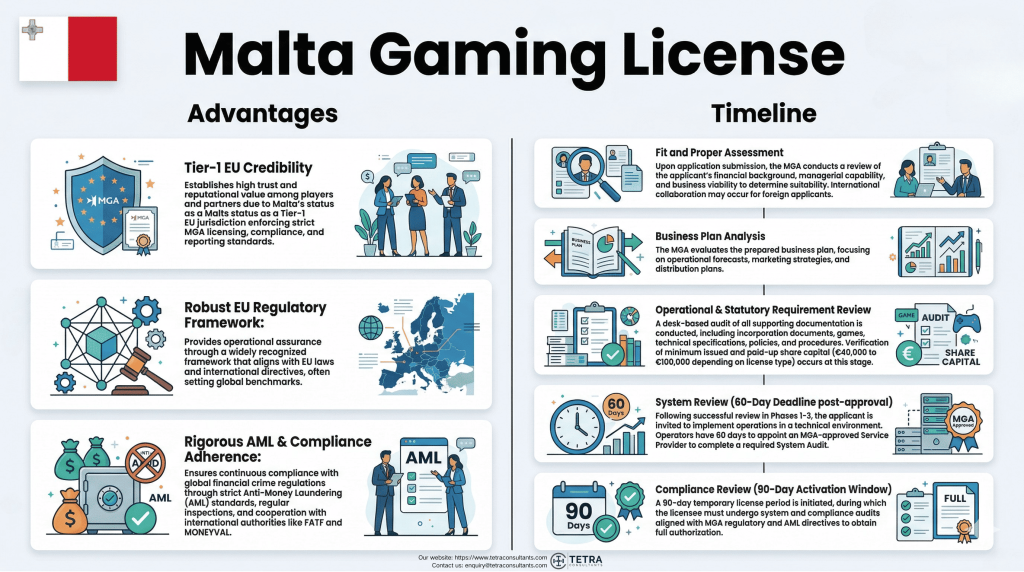
- The process of applying for a Malta Gaming License can be split into 5 phases. The Malta Gaming License process includes a 90-day temporary license period, during which operators must complete system and compliance audits before full authorization is provided.
Phase 1: Review of Applicant
- Once an application has been submitted to the MGA, a fit and proper assessment will be conducted. The assessment includes a review of all information related to the applicant. Information regarding financing, managing and business viability will be taken into consideration when assessing the candidate’s suitability. For foreign businesses, MGA will further collaborate with other national and international regulatory bodies and law enforcement agencies to gauge the capability and legitimacy of the applicant.
Phase 2: Analysis of Business Plan
- In the following step, the MGA will review and analyse the business plan prepared and submitted by the applicant. Typically, the outline of your plan should include an elaborate forecast of the operation. Accounts of marketing and distribution strategies should be attached to the business plan.
Phase 3: Review of Applicant’s Ability to Meet Operational and Statutory Requirements
- At this stage, the Authority will review all supporting documents submitted by the applicant. This will include analyzing incorporation documents, games, business processes, rules, terms, conditions, policies, procedures as well as all other technical documentation related to the gaming and control system. It will also be reviewed as to whether the license is meeting the minimum issued and paid-up share capital requirements. The requirements are as follow:
| Type of Gaming Service | Issued and Paid-up Share Capital |
| Type 1 | Minimum €100,000 |
| Type 2 | Minimum €100,000 |
| Type 3 | Minimum €40,000 |
| Type 4 | Minimum €40,000 |
- In essence, this stage will be seemingly alike to a desk-based audit of the application requirements.
Phase 4: System Review
- Following the above 3 phases, you should receive your application outcome. If successful, you will be invited to implement the operation into a technical environment. A 60-day deadline will be imposed where you may appoint a Service Provider approved by the MGA to carry out a system audit. This stage includes a System Audit conducted by an MGA-approved third-party auditor. After the deadline has passed, the application will be considered cancelled, and you will have to reapply for the license.
Phase 5: Compliance Review
- The licensee will have to undergo a series of compliance audits within 90 days from the notice issued by the MGA. This includes a Compliance Audit aligned with MGA regulatory and AML directives. Typically, the compliance audit would come after the first year of operation or is otherwise reliant on the compliance plan. Adhering to a compliance audit is important or you could face a suspension or termination of your license.
Fees
- License holders are required to pay a fixed annual license fee and compliance contribution to the Authority. There are 2 types of licenses in Malta, the Gaming Service License/Business-to-Consumer (B2C) License, and the Gaming Supply License/Business-to-Business (B2B) License.
Gaming service license/business-to-consumer (B2C) license
- This is a license for an online gambling operator who wishes to provide online gambling services such as poker, roulettes, slots, and lotteries to consumers. The gambling platform provided must have a B2B license.
Fees for gaming service license (B2C License)
| Non-refundable Fixed Annual License Fee | |
| Type 1, Type 2, Type 3 Holders | €25,000 |
| Type 4 Holders | €10,000 |
| Type 1 Gaming Services | |
| Compliance Contribution for the Financial Year | Rate |
| For every euro of the first €3,000,000 | 1.25% |
| For every euro of the first €4,500,000 | 1.00% |
| For every euro of the first €5,000,000 | 0.85% |
| For every euro of the first €7,500,000 | 0.70% |
| For every euro of the first €10,000,000 | 0.55% |
| For every euro of the remainder | 0.40% |
| Type 2 Gaming Services | Rate |
| Compliance Contribution for the Financial Year | 4.00% |
| For every euro of the first €3,000,000 | 3.00% |
| For every euro of the first €4,500,000 | 2.00% |
| For every euro of the first €5,000,000 | 1.00% |
| For every euro of the first €7,500,000 | 0.80% |
| For every euro of the first €10,000,000 | 0.60% |
| For every euro of the remainder | 0.40% |
| Type 3 Gaming Services | |
| Compliance Contribution for the Financial Year | Rate |
| For every euro of the first €2,000,000 | 4.00% |
| For every euro of the first €3,000,000 | 3.00% |
| For every euro of the first €5,000,000 | 2.00% |
| For every euro of the first €5,000,000 | 1.00% |
| For every euro of the first €5,000,000 | 0.80% |
| For every euro of the first €10,000,000 | 0.60% |
| For every euro of the remainder | 0.40% |
| Type 4 Gaming Services | |
| Compliance Contribution for the Financial Year | Rate |
| For every euro of the first €2,000,000 | 0.50% |
| For every euro of the first €3,000,000 | 0.75% |
| For every euro of the first €5,000,000 | 1.00% |
| For every euro of the first €5,000,000 | 1.25% |
| For every euro of the first €5,000,000 | 1.50% |
| For every euro of the first €10,000,000 | 1.75% |
| For every euro of the remainder | 2.00% |
Gaming supply license/business-to-business (B2B) License
- This is a license for a game developer or software provider for online gambling. They supply the gaming platform that is to be used by the operator to provide the gambling service to consumers.
Fees for critical gaming supply license (B2B license)
| Non-refundable Fixed Annual License Fee | |
| Type 4 Holders | €10,000 |
| Supply and Manage Material Elements of the Game | |
| License Fees on Annual Revenue | Fee |
| Where annual revenue does not exceed €5,000,000 | €25,000 |
| Where annual revenue exceeds €5,000,000 but does not exceed €10,000,000 | €30,000 |
| Where annual revenue exceeds €10,000,000 | €35,000 |
| Supply and Management of Software | |
| License Fees on Annual Revenue | Fee |
| Annual revenue does not exceed €1,000,000 | €3,000 |
| Annual revenue in excess of €1,000,000 | €5,000 |
Additionally, for low-risk games, you can expect to make payment for a one-time non-refundable fee of €25. Generally, this would apply to non-profit, commercial communication and limited commercial communication games. Instead of a fixed gaming tax, Malta operates on a Compliance Contribution model, calculated based on Gross Gaming Revenue (GGR), typically ranging from 0.40% to 5% depending on license type and revenue tiers. Malta also offers a 6/7ths corporate tax refund mechanism, significantly reducing the effective corporate tax rate for gaming operators.
How to apply for Malta gaming license in 2026?
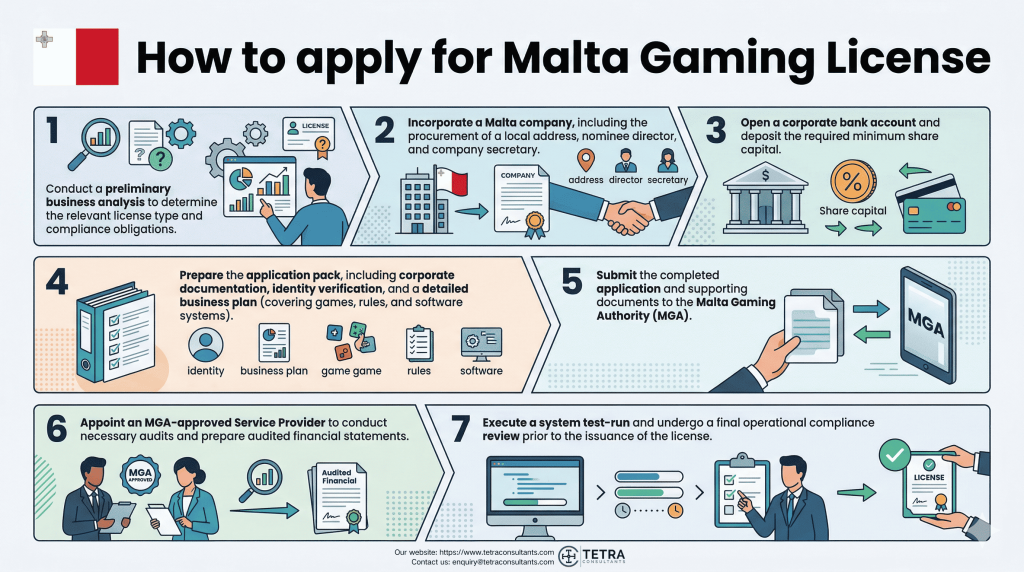
- Prior to commencing the engagement, our consultants will seek to understand your gaming business before advising you on the relevant license and compliance obligations to keep your business running.
- Tetra Consultants will then assist you in registering a Malta company by providing a local company address, local nominee director and local company secretary. Typically, this process should take approximately 2 weeks.
- Upon registering the company, we will proceed to open a corporate bank account with either a reputable local bank or an international bank. The bank account will primarily be utilized to deposit the minimum pay up capital required. You can expect your corporate bank account to be ready in 4 weeks.
- Concurrently, our team of lawyers and licensing specialists will assist you in preparing the necessary documents for submission to the MGA. Typically, these documents will include your Certificate of Incorporation, identity documents, bank references and more.
- A detailed business plan with details of the games, rules, terms, conditions as well as software systems is required to be submitted to the MGA. As such, Tetra Consultants will draft a copy for your perusal to ensure that you meet the necessary requirements and gain approval for your application.
- To meet your compliance requirements, you will be required to undergo a series of audits imposed as a requirement by the MGA. Prior to the audit, our accounting and tax team will assist in preparing audited financial statements and ensuring compliance with IFRS and MGA reporting obligations. Following, a Service Provider approved by the MGA has to be appointed to assist in conducting the audits. Our team of consultants will also assist in the appointment.
- As you will require to conduct a test-run, our lawyers and licensing specialists will advise and review your business operations to ensure that you meet all compliance requirements during the test-run.
Financial and operational activity
- Once your license has been approved, you will be granted a ten-year license. If you wish to make any changes to the details and rules of the game that has not already been stated in the original license application, you will have to seek approval from the Malta Gaming Authority. All licensees must comply with ongoing MGA reporting obligations, including financial disclosures, player fund segregation, and AML compliance reporting.
- In addition, you will face a compliance audit after the first year of operation. Tetra Consultants will continue to remind you about your compliance obligations and assist you in meeting these requirements. Key reports that you will need to submit include:
Yearly audited accounts
- Your company will be required to submit a set of financial statements that is prepared and audited according to the International Financial Reporting Standards (IFRS). The financial report must include a Directors’ Report and the report should be submitted within 180 days after company’s financial year has ended.
Tax considerations of Malta gaming license in 2026
- There is more to love about Malta. With extensive taxation benefits, Malta is viewed as an ideal jurisdiction among many foreign investors looking to expand their gaming business. Besides exemption benefits from the Value-Added Tax Act, gaming businesses set up in Malta can also leverage on over 70 double taxation treaties. For highly qualified persons, you can expect to be taxed a flat rate of only 15% on your personal income. Should your Maltese company also hold minimally 10% of equity, capital gains and dividend income received from subsidiaries of your company will also be exempted from any tax payments.
- Malta offers a competitive tax regime supported by a full imputation system, where shareholders may benefit from a 6/7ths tax refund, reducing the effective corporate tax rate significantly.
Benefits of a Malta gaming license in 2026
High credibility
- Malta is considered to be a Tier-1-EU regulated jurisdiction, with the Malta Gaming Authority (MGA) enforcing strict licensing, compliance, and reporting standards. Licensed operators will have to maintain transparency, and comply with regulatory obligations, which improves their credibility and trust among players and partners.
EU regulatory framework
- Malta is a member of European Union, and operates under the EU laws and directives. The regulatory framework of MGA is widely recognized and has often set benchmarks for other jurisdictions, offering assurance of compliance with international standards.
Strong AML and compliance standards
- Malta follows strict anti-money laundering (AML) regulations, and works closely with authorities like the Financial Intelligence Analysis Unit (FIAU), MONEYVAL, and FATF. Regular inspections ensure that the operators stay compliant, with global financial crime regulations.
Conclusion
- Tetra Consultants works as your advisor and trusted partner in your business expansion and offshore gaming license application. With our own team of lawyers, licensing specialists, compliance team, and accountants, we tell our clients what they need to know, instead of what they want to hear. Most importantly, we are known for being a one-stop solution for our valued clients.
- Contact us now for a free consultation. Our team of experts will revert within the next 24 hours.
FAQ

Author
Sharma Prabakaran
Sharma Prabakaran is the Head of International Business Advisory at Tetra Consultants. With over 15 years of professional experience, he specialises in international business setup, accounting and tax advisory, and cross-industry SME engagements. His expertise encompasses end-to-end project management, ranging from company incorporation and corporate bank account establishment to ongoing annual accounting and tax compliance.