


Cryptocurrency license in 2026
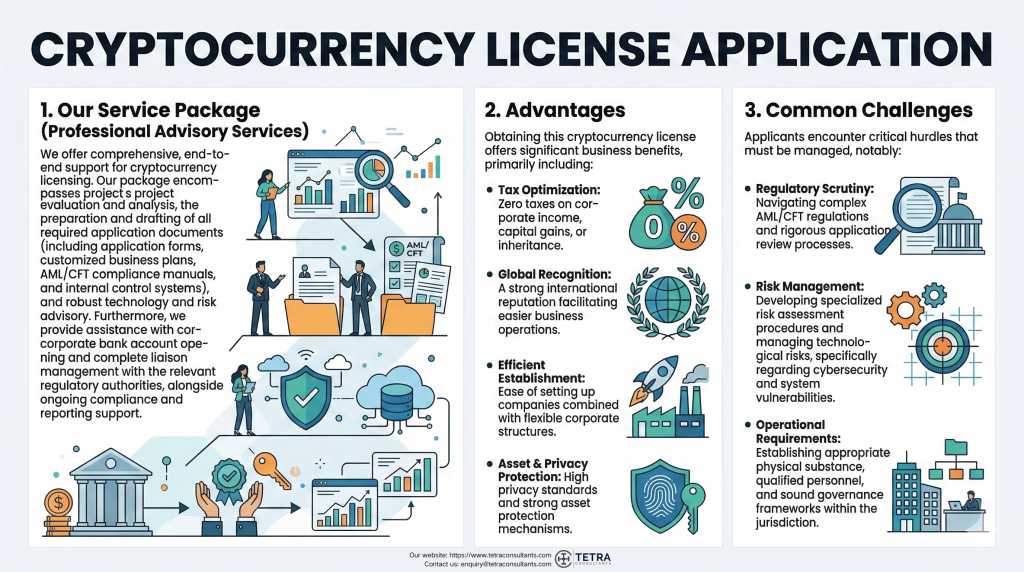
- Businesses that carry out cryptocurrency related activities will be required to apply for a cryptocurrency license in 2026. At Tetra Consultants, we provide entrepreneurs with the necessary guidance in setting up a cryptocurrency business through our team of lawyers, licensing specialists, and accountants.
- Through our team of lawyers and licensing specialists, Tetra Consultants will assist the entrepreneur from the initial consultation to the entire business structuring process to the preparation of the necessary regulatory documents to facilitate the process for the entrepreneur to apply for a cryptocurrency license.
Key U.S. cryptocurrency compliance requirements in 2026
- In order for businesses engaged in any cryptocurrency-related activity within the United States to be compliant with applicable laws and regulations, they must meet many regulatory and reporting requirements aimed at increasing financial transparency and preventing illegal financial activity. Compliance with the above-listed requirements also provides for the appropriate level of monitoring, reporting and governance of those organizations that provide cryptocurrency platforms or services that process transactions involving cryptocurrency.
U.S.- Specific Compliance:
- Organizations providing cryptocurrency services must comply with various federal regulatory requirements requiring organizations to perform monitoring, reporting, and transparency of operation.
Bank Secrecy Act (BSA):
- This is the primary statute governing the activities of Money Services Businesses (MSB) and requires an MSB to have adequate recordkeeping and anti-money laundering program requirements in place.
SAR (Suspicious Activity Report):
- Entities must file a SAR report when suspicious or unlawful financial activity is detected in their business.
CTR (Currency Transaction Report):
- Mandatory reporting for large transactions in cash or cryptocurrency, when these transactions exceed a certain threshold.
FinCEN MSB Registration (Financial Crimes Enforcement Network):
- Cryptocurrency businesses acting as MSBs must register with FinCEN and adhere to their reporting regulations.
ATS (Alternative Trading System):
- Platforms that allow trading in tokenized securities must register as an ATS.
OFAC Compliance (Office of Foreign Assets Control):
- Businesses must ensure transactions do not involve sanctioned parties or jurisdictions (OFAC compliance).
Key International & EU Cryptocurrency regulatory standards in 2026
- Cryptocurrency businesses that are international or operate within the European Union must adhere to various evolving cryptocurrency regulations that are geared towards ensuring that there are transparency, security, and financial integrity within the digital asset ecosystem.
MiCA (Markets in Crypto-Assets):
- The most prominent cryptocurrency regulation within the EU that provides a framework for crypto-asset service providers and digital asset businesses.
DORA (Digital Operational Resilience Act):
- An EU framework that provides regulations for cybersecurity, resilience, and risk management within financial and digital asset institutions.
VASP vs. CASP:
- The regulation distinguishes between the Virtual Asset Service Provider (VASP), which is the standard terminology for cryptocurrency businesses globally, and the Crypto Asset Service Provider (CASP), which is the terminology for cryptocurrency businesses within the MiCA regulations.
Travel Rule Compliance:
- A standard regulation for cryptocurrency businesses globally that requires the sharing of information during digital asset transactions.
What are the types of cryptocurrency licenses?
Core service licenses
Exchange/trading license
- This license covers the operation of spot exchanges, crypto-fiat exchanges, crypto-crypto exchanges, as well as order book exchanges.
Custody/wallet service license
- This license covers the safekeeping of clients’ crypto-assets. This license might include staking services in addition to wallet services, provided that the service provider has control over the keys.
Payment/processing license
- This license covers the operation of crypto as a means of payment, crypto payment processing services, as well as crypto-fiat acquiring services.
Issuance and Investment Licenses
Token Issuance/Offering License
- This includes the issuing and offering of tokens, which may be utility, asset-referenced, security, or e-money type. This includes the issuing and offering of utility, asset-referenced, security, or e-money type tokens, including the operation of Initial Coin Offerings (ICOs), Initial Exchange Offerings (IEOs), and Initial Decentralized Offerings (IDOs).
Investment Management/Fund License
- This includes the management of portfolios or funds investing in virtual assets, discretionary management of portfolios or funds of virtual assets, and advice in relation to crypto investment products.
Market structure and advanced trading licenses
Multilateral Trading Facility/ATS License
- This includes the operation of a multilateral facility for the trading of tokenized securities or certain classes of crypto-assets where the facility matches the buying and selling interests of third parties.
Derivatives / leveraged trading license
- Covers futures, options, perpetual swaps, margin/leveraged trading, and other derivative contracts referencing crypto-assets.
Money and value transfer-oriented
Money transmission/remittance license
- Involves money transfer services for others, including crypto, on- and off-ramping of fiat, as well as international money transfers, usually referred to as money services business licenses.
Stablecoin/e-money type issuer license
- Involves the issuance of stablecoins/e-money type tokens, including asset-backed tokens, that serve as alternatives to traditional e-money.
Other niche licenses
Mining/Validator/Infrastructure license
- In some jurisdictions, it includes mining activities.
Kiosk/ATM Operator license
- Involves the operation of crypto ATMs/kiosks that enable the buying/selling of crypto in exchange for cash.
Decentralized autonomous organizations (DAOs): Regulatory treatment in 2026
- Decentralized Autonomous Organizations (DAOs) refers to a blockchain-based governance structures that operate through smart contracts, enabling token holders to participate in decision-making without any centralized management. In 2026, regulators are increasingly focusing on DAOs because of their growing role in decentralized finance (DeFi), investment pooling, and protocol governance.
Legal classification of DAOs
- DAOs are not uniformly recognized as legal entities across jurisdictions. However, several countries have begun introducing frameworks to regulate them:
- Some jurisdictions such as Wyoming, Marshall Islands recognize DAOs as legal entities (DAO LLCs)
- Others treat DAOs as unincorporated associations, that exposes members to potential liability
- In strict jurisdictions, DAOs usually fall under securities or investment fund regulations on the basis of activities.
When does a DAO require a cryptocurrency license?
- A DAO may require licensing if it engages in regulated activities such as:
- Operating a decentralized exchange (DEX)
- Managing pooled investment funds (DeFi protocols)
- Issuing governance or utility tokens with financial characteristics
- Providing lending, staking, or yield-generating services
- In these cases, regulators may classify the DAO as a Virtual Asset Service Provider (VASP) or equivalent and requires licensing and compliance.
Compliance considerations for DAOs
- Despite decentralizations, regulatoions increasingly expects DAOs to incorporate:
- AML/KYC procedures for front-end interfaces or onboarding layers
- Governance transparency, including voting mechanisms and treasury management
- Smart contract audits to ensure security and operational integrity
- Legal wrappers (e.g., foundation or LLC structures) to interact with regulators and financial institutions
- At Tetra Consultants our team helps clients in structuring DAOs by using compliant legal wrappers while also preserving decentralization benefits.
Real- world asset (RWA) tokenization: Structures and licensing implications
- RWA tokenization refers to the procedure of converting ownership rights in physical or traditional financial assets into digital tokens on a blockchain. In 2026, RWA tokenization is one of the fastest-growing segments in the crypto industry, that covers assets such as real estate, bonds, commodities, and private equity.
Common RWA tokenization structures
- Depending on the jurisdiction and asset type, RWA tokenization can be structured in several ways:
Special purpose vehicle (SPV) structure
- A legal entity (SPV) holds the underlying asset
- Tokens represent shares or economic rights in the SPV
- Common for real estate and private equity tokenization
Trust or custodial structure
- A licensed custodian or trustee holds the asset
- Tokens represent beneficial ownership
- Often used for commodities (e.g., gold-backed tokens)
Direct on-chain issuance
- Tokens are issued directly by the asset originator
- Suitable for digital-native or hybrid assets
- Requires strong legal and compliance frameworks
Licensing requirements for RWA tokenization
- RWA tokenization usually falls under the multiple regulatory regimes based on the structure:
- Securities licenses, if tokens showcase shares, bonds, or investment contracts
- Broker-dealer or ATS licenses for secondary trading platforms
- Asset management licenses for pooled investments or funds
- custody licenses for safekeeping of tokenized assets
- Under frameworks like MiCA and similar global regulations, many RWA projects are classified as asset-referenced tokens (ARTs) or security tokens, requiring full regulatory approval.
Who issues a cryptocurrency license?
- A cryptocurrency license is issued by the regulatory authority regulating the cryptocurrency business or digital assets in the country.
- For example in Singapore, cryptocurrency companies are regulated by the Monetary Authority of Singapore under Singapore’s Payment Services Act, 2020. Hence cryptocurrency businesses must obtain a license from the regulatory authority to operate a cryptocurrency exchange or wallet.
Top jurisdictions for obtaining a cryptocurrency license in 2026
Singapore
- Singapore is one of the world’s leading financial centers with a stable economy and a business-friendly environment. The country’s infrastructure and high internet penetration rates make it almost ideal for crypto businesses. Singapore’s progressive stance on cryptocurrencies is evident from the number of investments in blockchain projects. Personal and corporate cryptocurrency holdings benefit from tax exemptions, although profits from active trading are taxed at a rate of 17%. Registering a company in Singapore provides a supportive regulatory framework conducive to innovative blockchain activity.
Dubai
- Regulators/zones such as VARA, DMCC, DIFC, and ADGM provide leading frameworks and are the best places for cryptocurrency licenses in 2026 because they do not impose any personal taxes, corporate taxes are minimal, and there is 100% foreign ownership. Moreover, the regulations are robust and innovative in ensuring AML compliance. If you register company in Dubai allows your business to operate within a progressive and innovation-driven environment.
Switzerland
- Switzerland is renowned for being crypto-friendly, with many blockchain projects establishing their headquarters there. Its regulatory framework supports decentralization, innovation, and inclusivity. The country imposes no income or capital gains tax on crypto ventures, providing a tax-efficient environment for investors. Registering a company in Switzerland can position your business in a progressive, innovation-driven environment.
Mauritius
- Mauritius is an excellent jurisdiction to apply for a cryptocurrency license in 2026, given its regulated Virtual Asset regime under the FSC, which provides tax benefits such as a 3% effective corporate tax rate, as well as no capital gains tax, while also providing FATF AML/KYC compliant requirements, fast licensing, and access to African/Indian Ocean markets for VASPs/exchanges. If you register company in Mauritius it will positions your business within a forward-thinking and innovation-focused commercial landscape.
What are the regulatory requirements for a cryptocurrency license in 2026?
- For a typical cryptocurrency license, a regulator would want you to consider the following factors before proceeding with the application.
Incorporation and structure
- Entities must be locally incorporated as a legal entity (e.g., LLC, equivalent) with evidence of physical presence in the jurisdiction and resident directors/key personnel. Background checks, including fingerprints, as well as financial disclosure of owners/principals, must be conducted to verify fitness and propriety.
Capital and financial proof
- Minimum capital requirements vary, typically in the range of €50,000 to €150,000 for exchanges/custody (Class 1-3 under frameworks like the EU’s MiCAR regime), including surety bonds and audited financial statements. The business plans of applicants must include multi-year plans, including revenue, risks, and liquidity.
AML/KYC and risk controls
- Entities must implement comprehensive anti-money laundering/combating financing of terrorism (AML/CTF) measures, including customer due diligence, transaction monitoring, suspicious activity reporting, as well as compliance with the Travel Rule (no threshold in certain instances). Cybersecurity measures, as well as data privacy compliance (e.g., GDPR equivalent), as well as client fund segregation/insurance, must be implemented.
Documentation and ongoing obligations
- Regulatory applications require detailed documentation, including business model description, governance policies, IT/system audits, and third-party due diligence. For ongoing obligations, annual renewals require updating proofs, audits, fees, as well as supervisory reporting, including metrics like volume.
Costs associated with cryptocurrency licensing
- The cost of obtaining a cryptocurrency license depends on the jurisdiction and the type of license. Additionally, businesses will incur costs such as AML and KYC compliance, regulatory audits, capital reserve costs, and license renewal fees. Tetra Consultants provides cost transparency and assists businesses in the initial setup and long-term compliance of the cryptocurrency license.
What is the procedure for obtaining a cryptocurrency license?
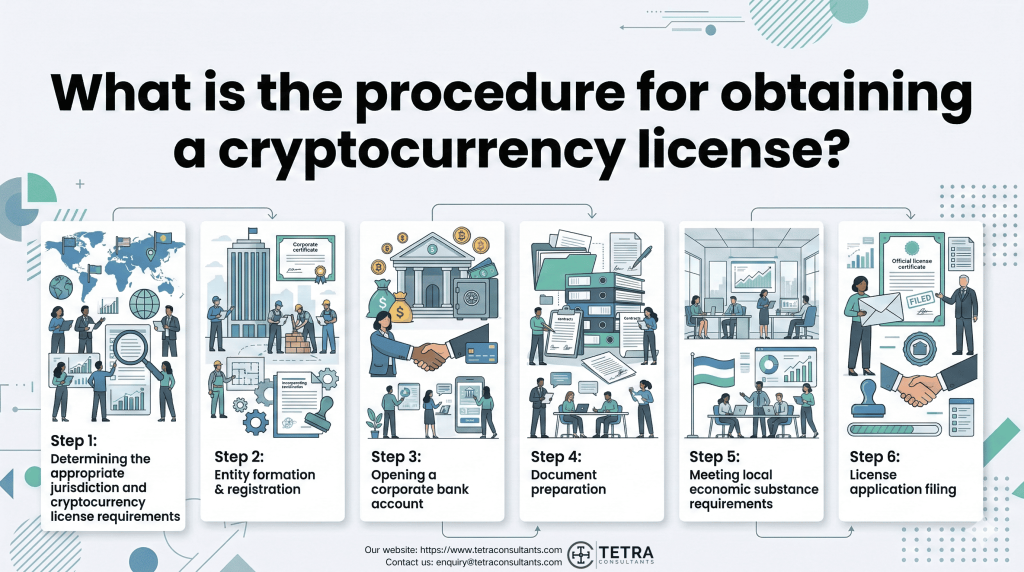
- Operating a cryptocurrency exchange requires a license. The procedure varies depending on the jurisdiction. Tetra Consultants summarizes the common steps involved in obtaining a cryptocurrency license:
Step 1: Determining the appropriate jurisdiction and cryptocurrency license requirements
- Based on your company’s planned activities and customer base, our team of lawyers and licensing specialists will advise you on the most suitable jurisdiction and type of cryptocurrency license for your business model.
- We familiarize you with requirements such as paid-up capital, local economic substance criteria, timeframes, and regulations before engagement begins.
Step 2: Entity formation & registration
- Tetra Consultants conducts due diligence on the management and shareholders of the firm. Once we receive all KYC documents, incorporation documents, and power of attorney, we begin registering the company with the local Companies Registry.
- After successful registration, we provide corporate documents, such as the Certificate of Incorporation and Memorandum and Articles of Association.
Step 3: Opening a corporate bank account
- Our lawyers and licensing specialists will open a corporate bank account with a reputable financial institution. The minimum paid-up capital required for licensing will be deposited into this account.
Step 4: Document preparation
- Our team of lawyers and licensing specialists will prepare the necessary documents for the cryptocurrency license application. These include the business plan, financial statements, AML/CFT policy, and insurance policy as per local regulations.
- Once documents are ready, Tetra Consultants will provide prototypes for review and send them for e-signatures before proceeding with the license application.
Step 5: Meeting local economic substance requirements
- If the local regulator requires economic substance (e.g., a local registered address and approved personnel), Tetra Consultants’ lawyers and licensing specialists will assist in meeting these criteria, including recruiting local employees.
- Our HR team will shortlist candidates and conduct preliminary interviews for key roles, including compliance officers. You can then finalize the selection, and we will help prepare employment contracts.
- We will compile a list of potential office spaces, considering factors like location and cost, to help you choose the best option. Tetra Consultants will also handle lease agreements once a space is selected.
Step 6: License application filing
- After completing the above steps, Tetra Consultants will submit the license application to the local regulator. Depending on the jurisdiction, you may need to attend an interview before approval. We will prepare you for the interview and assist with follow-up actions.
- Once approved, your firm will receive the cryptocurrency license and must start operations within the stipulated timeframe to maintain the license.
- Additionally, after filling, our accounting and tax team will manage all tax and accounting-related matters of the company, ensuring smooth and compliant operations without burdening the client.
Maintaining a cryptocurrency license: post-license requirements
- After obtaining a cryptocurrency license, it is essential to comply with ongoing regulatory requirements to ensure the license remains valid. These requirements vary by jurisdiction but commonly include:
Compliance with AML and KYC Regulations
- Ongoing compliance with Anti-Money Laundering (AML) and Know Your Customer (KYC) regulations involves:
- Conducting regular audits of customer transactions to detect suspicious activities.
- Maintaining updated KYC records for all clients.
- Training staff on compliance protocols and regulatory changes.
Financial reporting and audits
- Many regulatory bodies require licensed cryptocurrency businesses to submit financial reports and undergo periodic audits. Our accounting and tax team will manage all tax and accounting-related matters of the company, ensuring smooth and compliant operations.
Operational compliance
- Adhering to operational standards set by regulators involves:
- Ensuring cybersecurity measures are in place to protect client data.
- Maintaining a physical presence in the licensing jurisdiction.
- Updating business practices in line with evolving regulations.
Communication with regulatory authorities
- Maintaining open communication with regulatory authorities includes:
- Promptly reporting changes in business structure or ownership.
- Notifying regulators of significant incidents or breaches that may impact compliance.
Legal implications of operating without a cryptocurrency license
- Operating a cryptocurrency business without the required licenses can result in severe legal consequences. Regulations vary by jurisdiction, but common implications include:
Criminal sanctions
- Running a cryptocurrency business without the proper license is often criminalized. For instance, under 18 U.S.C. § 1960 in the U.S., operating an unlicensed money transmitting business can lead to up to five years in prison.
Financial sanctions and penalties
- Unlicensed operations can incur heavy fines. For example, Binance faced a $2.25 million fine in India for non-compliance, and similar companies in the U.S. paid over $4 billion in fines for license and AML violations.
Civil liabilities
- Unlicensed operators may face lawsuits from customers or investors for losses due to lack of oversight, leading to substantial financial liabilities and reputational damage.
Operational restrictions and shutdowns
- Regulatory authorities may shut down unlicensed businesses. For instance, offshore crypto exchanges banned in India faced severe operational risks and long-term brand damage.
Increased scrutiny and regulatory action
- Operating without a license can attract heightened scrutiny, leading to more thorough investigations and legal challenges that disrupt operations.
Loss of business opportunities
- Without proper licensing, businesses may struggle to partner with banks, payment processors, or financial institutions, limiting growth and market expansion.
How long does it take to obtain a cryptocurrency license?
- Before starting an engagement, Tetra Consultants provides a project plan outlining timelines for company registration, document preparation, and license application, ensuring clarity for all parties.
Our services
- Tetra Consultants works as your advisor and trusted partner in your business expansion and cryptocurrency license. With our own team of lawyers, licensing specialists, compliance team, and accountants, we tell our clients what they need to know, instead of what they want to hear. Most importantly, we are known for being a one-stop solution for our valued clients.
- Tetra Consultants specializes in obtaining cryptocurrency licenses, helping you operate legally in your chosen jurisdiction with expert guidance.
- We also assist in obtaining other offshore financial licenses aligned with your business goals.
Find out more!
Contact us to learn more about obtaining a cryptocurrency license. Our team will respond within 24 hours.
FAQs

Author
Sharma Prabakaran
Sharma Prabakaran is the Head of International Business Advisory at Tetra Consultants. With over 15 years of professional experience, he specialises in international business setup, accounting and tax advisory, and cross-industry SME engagements. His expertise encompasses end-to-end project management, ranging from company incorporation and corporate bank account establishment to ongoing annual accounting and tax compliance.